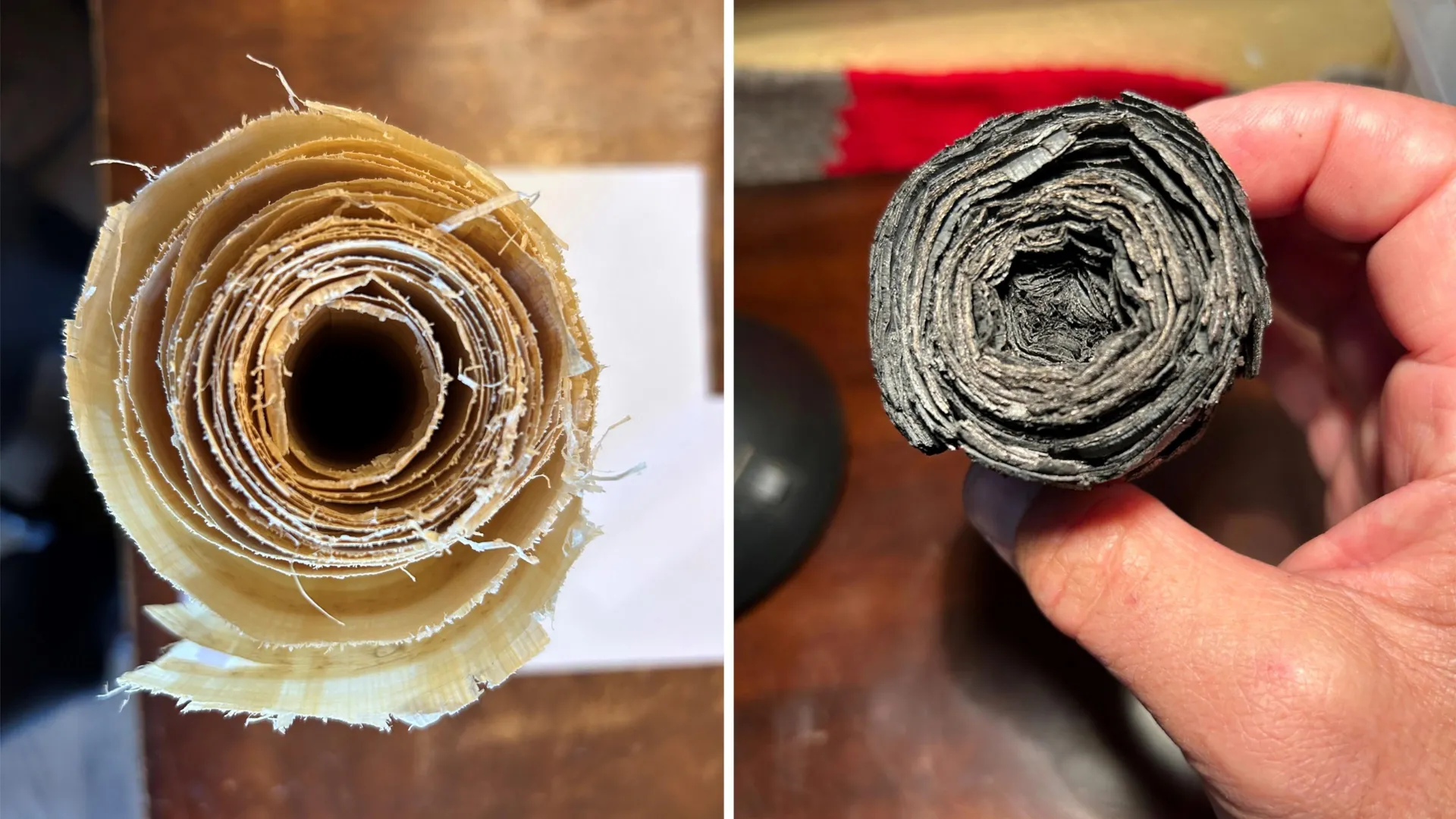
Douglas Seiler didn’t set out to destroy ancient texts. But in a lab at Berkeley SETI, he rolled up papyrus, sealed it in a container, and burned it until it was blackened carbon—just like the scrolls entombed by Mount Vesuvius in 79 C.E. His goal? To solve a 2,000-year-old mystery: how to read what’s inside without unrolling them.
The answer, as his team discovered, lay in a trace of lead. Ancient ink with even tiny amounts of lead becomes visible under X-ray scans when embedded in charred papyrus. That breakthrough, reported in ScienceDaily, could unlock lost works of Greek philosophy, Roman poetry, or early Christian writings—texts that have survived only because they were destroyed.
This is the paradox of discovery: sometimes you must burn to reveal, travel millions of years back to understand the present, or peer into alien oceans to see ourselves more clearly.
At Cornell University, researchers uncovered a gene called BC200—a human brain gene that also behaves like a 'jumping gene,' capable of moving within genomes. It’s the first known functional human gene that still jumps, a relic from transposons millions of years old. As Phys.org reports, this duality—essential for brain function yet mobile like a virus—rewrites our understanding of how evolution repurposes genetic chaos into order.
Meanwhile, scientists at the University of St Andrews pieced together another origin story: bats. By combining fossil records with genomic data from 103 species, an international team found that bats most likely originated in Europe 65 million years ago—not Asia or Africa, as once thought. Their study, published in Nature, reveals that both flight and echolocation evolved near the dawn of bat history, and opens new paths to studying their extraordinary longevity and disease resistance—traits that could one day help humans live healthier, longer lives.
In Texas, Dr. Terje Raudsepp and his team mapped the chromosomes of the elusive aardwolf—the least-studied hyena—and found something astonishing: despite 60 million years of separate evolution, its chromosomes are strikingly similar to those of domestic cats. The finding, published in the Journal of Heredity, underscores how deeply conserved some genetic blueprints are, even across wildly different species.
And beyond our galaxy, astronomers led by Julie Kiel Holm spotted the first stellar stream outside the Milky Way—a faint ribbon of stars trailing through an ultra-diffuse galaxy. Because these streams respond to gravity, they act as tracers of dark matter. As ScienceDaily notes, this discovery offers a new way to map the invisible scaffolding of the universe.
Closer to home, on Saturn’s moon Enceladus, hope for extraterrestrial life grows stronger. Professor Frank Postberg and his team found that the moon’s subsurface ocean ejects ice particles rich with organic compounds—making it easier than ever to analyze its chemistry without landing. Even more promising: certain Earth microorganisms could survive in those conditions, suggesting life might not only exist there, but thrive.
Back on Earth, researchers at Mount Sinai are decoding the human brain itself. The PsychAD Consortium, launched in 2019, has published nine landmark studies mapping Alzheimer’s, Parkinson’s, and schizophrenia at single-cell resolution. Their work, spread across Nature journals, represents one of the most comprehensive atlases of brain disease ever built—offering real hope for future treatments.
Science, at its best, is a mosaic of curiosity-driven acts: burning scrolls, tracing star streams, sequencing bat DNA, trusting personal experience over reputation (as Rissho University’s study showed we naturally do). Each piece, no matter how small, helps us see the bigger picture.
And the picture emerging isn’t one of randomness, but of deep connection—from our neurons to distant galaxies, from ancient ink to alien oceans. We’re learning not just how life works, but how resilient, adaptable, and interwoven it truly is.
Sign in to join the conversation.
Comments (0)
No comments yet. Be the first to share your thoughts.