Alan Ramirez stood on the sunbaked soil of Emma, North Carolina, where solar panels now rise like sentinels over a mobile home community that refused to vanish. 'With solar power,' he said, 'we are saving our resources, our people, our future.' Just weeks later, 2,500 miles west, the California Independent System Operator (CAISO) logged a quiet milestone: solar had generated more electricity than natural gas on 82% of days in the first five months of 2026 — a seismic shift from just two years ago when gas still dominated.
And then, in May, it happened nationally: for the first time ever, solar power produced more electricity than coal across the entire United States. According to data from Ember, solar delivered 12.8% of the nation’s electricity that month, edging out coal’s 12.2%. The symbolic passing was years in the making, but its arrival felt sudden — like a wave finally cresting after years of slow build.
This isn’t just about grids and gigawatts. In Spain, where fossil fuel prices spiked due to global tensions blocking oil shipments through the Strait of Hormuz, families saved €10 a month on their electricity bills — €197 million in total — because wind and solar now cover 37% more generation than in 2021. Gas, once the price-setter in 52% of hours, now influences just 9%.
Meanwhile, fears about solar consuming farmland are being put to rest. A new interactive map from the Solar Energy Industries Association (SEIA) reveals solar uses only 0.07% of U.S. prime farmland — less than golf courses or suburban sprawl. In fact, many solar farms now double as pollinator habitats or grazing land, proving that energy and agriculture can coexist.
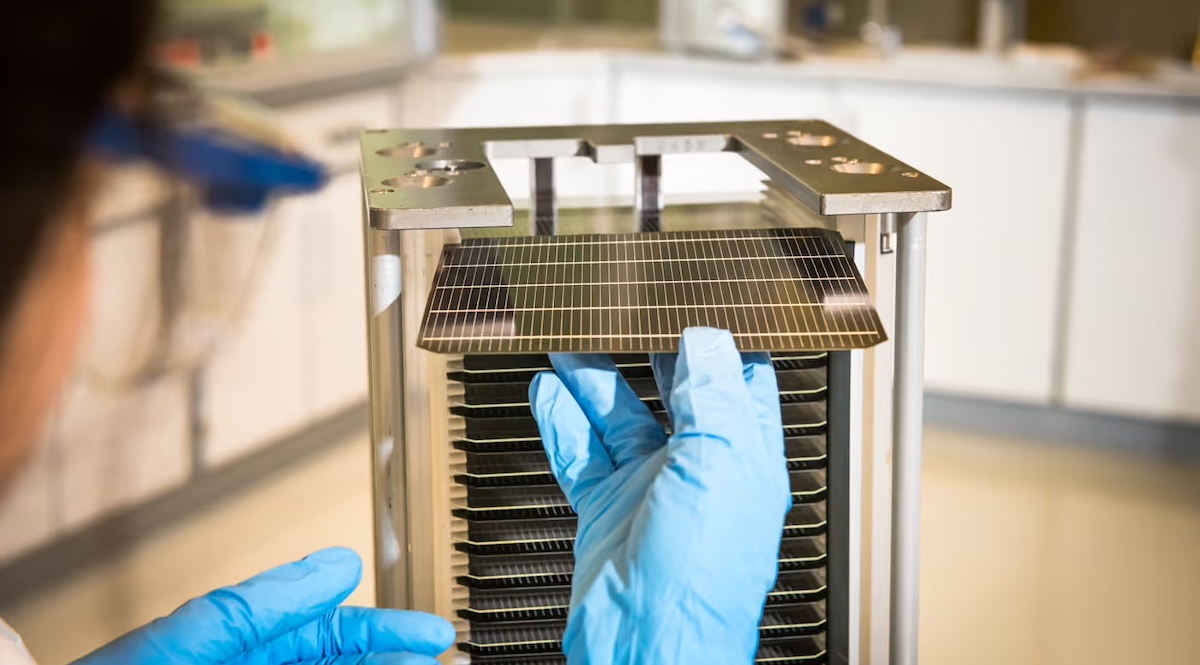
Innovation continues to accelerate. At a lab in Germany, researchers from Oxford PV and Fraunhofer ISE have combined perovskite-silicon tandem cells with matrix shingled interconnection to create rooftop modules that produce 491 watts — a leap toward ultra-efficient, mass-producible solar. In China, Jackery unveiled its Solar Roof tiles, each strong enough to support a grown adult, blending form, function, and resilience into a single tile.
Even the everyday experience of energy is changing. Wallbox launched its Pulsar Pro charger, integrating MID-certified metering directly into the device so EV drivers can be reimbursed fairly — a small but vital step as 80% of charging happens at home or work.
These threads — community resilience, technological leaps, economic savings, land stewardship — are not isolated. They are strands of a single transformation. Solar is no longer a promise. It is now a provider: of power, protection, and possibility.
And it’s just getting started.
Sign in to join the conversation.
Comments (0)
No comments yet. Be the first to share your thoughts.