Solar Power Is No Longer Just About Sunny Places
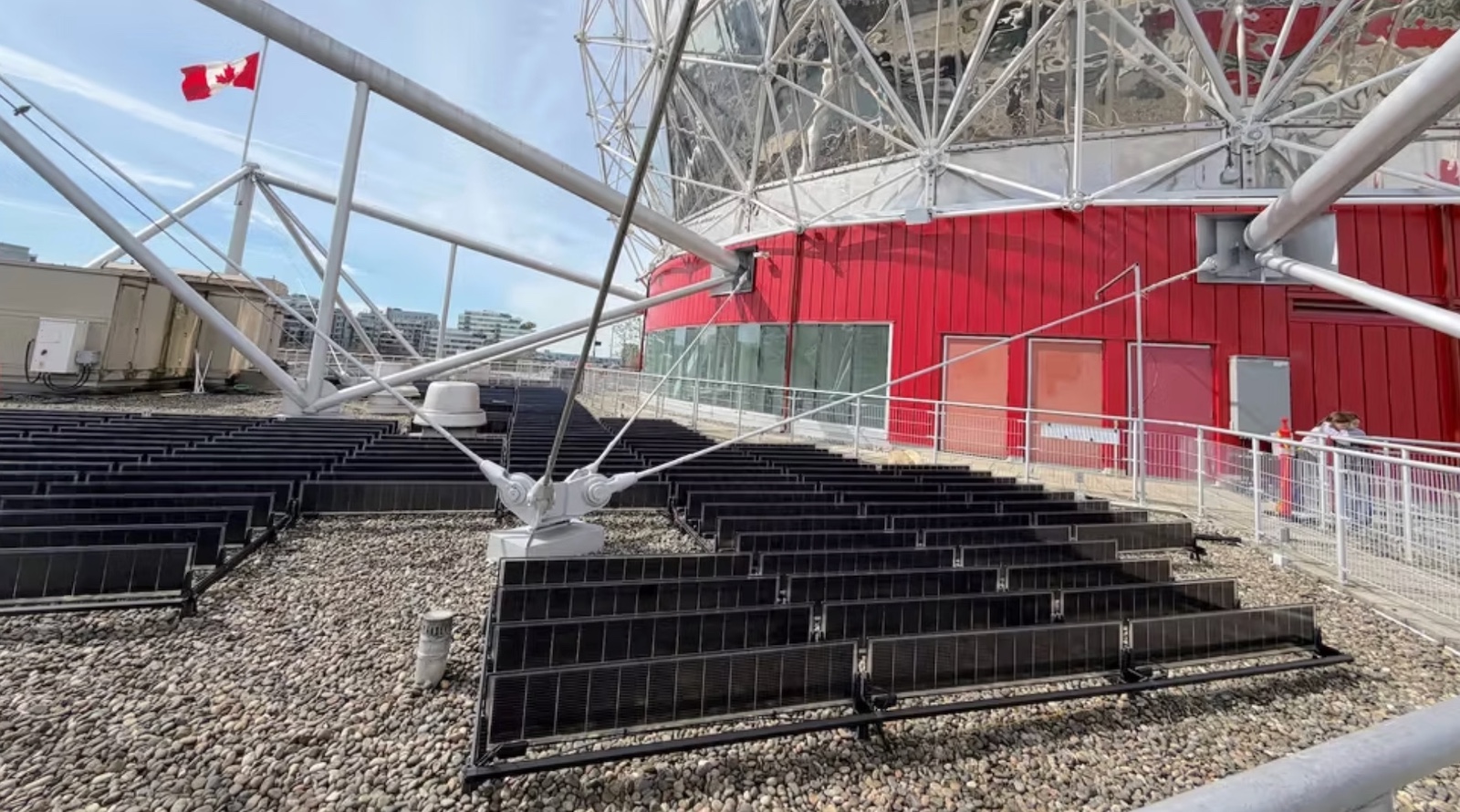
On a rain-soaked morning in Vancouver, snow from the previous week still clung to the rooftops. But at Science World—a geodesic dome on the city’s waterfront—something unexpected was happening: solar panels were generating electricity. Not the traditional tilted arrays you'd see in California or Spain, but upright panels designed to shed snow and capture light bouncing off the harbor.
The Norwegian company behind this, Over Easy Solar, has found its way to Canada with what it calls "vertical PV." The 19.5 kW installation is spread across three arrays on Science World's roof—part of a broader CAD 39 million retrofit that also includes heat pumps and better insulation. The goal: cut the museum's energy use by 42%.
It's a small number, but it represents something big: solar is no longer a technology for ideal conditions. It's becoming climate-agnostic.
The Numbers Behind the Movement
New York just hit 8 gigawatts of installed distributed solar capacity—rooftops and small-scale installations across the state. That puts it ahead of schedule toward its 10 GW by 2030 target. Three years ago, the state had 6 GW. In 2025 alone, it installed another 1.28 GW.
The economic ripple effects are significant: $12.2 billion in private investment, more than 16,000 jobs created, and 276,000 projects now providing electricity to over 1.3 million homes and businesses. During peak demand last summer, solar saved New York $90 million just by reducing strain on the grid. This June, solar provided 29% of the state's electricity demand during noon hours—a new record.
"We are seeing the benefits of New York's solar assets in real time," says Rory Christian, chair and CEO of the state's Public Service Commission. "Solar is reducing the strain on our electric grid, while providing significant reliability benefits."
Meanwhile, in Chile, Grenergy is auctioning off 1.5 TWh per year of solar and battery storage energy through its subsidiary GR Power. The auction includes 960 GWh of nighttime battery-stored energy and 540 GWh of solar generation. Companies can bid in 20 GWh contracting units with tenors ranging from 6 to 15 years.
This is the company's third reverse auction. The energy comes from plants across Chile's north and center, with supply scheduled between 2028 and 2029.
Solar For Those Who Need It Most
Back in North America, Massachusetts is channeling solar dollars toward communities that have historically been left out of the clean energy economy.
The state's Low-Income Services Solar Program just awarded $2.4 million in grants to 10 nonprofit organizations—the program's third round. The grants will fund 612.3 kW of rooftop solar capacity, helping these groups cut electricity bills by 70% to 100%.
Take Allston Brighton CDC in Boston, receiving $240,600 for a 70-kW system that will save $25,000 annually. The organization develops affordable housing and helps residents build economic stability. Or Catholic Charities Diocese of Fall River, getting $234,100 for a 62.4-kW installation.
"Together, these organizations will pay almost $275,000 less in electricity costs each year, providing more financial resources for their important missions," said Energy Resources Commissioner Elizabeth Mahony.
Growing Food and Power on the Same Land
One of solar's oldest land-use tensions is also finding new solutions. Critics have long argued that utility-scale solar competes with agriculture—converting farmland into power plants.
Agrivoltaics is changing that calculus. The Philippines, where arable land is both limited and economically vital, is emerging as a testing ground. Citicore Renewable Energy Corporation has built a nearly 200-megawatt facility in Batangas that combines utility-scale solar with crop production and battery storage—one of the first commercial agrivoltaics projects in Southeast Asia.
But here's the key insight from practitioners: agrivoltaics only works when the solar structure actually does farm work—providing shade, protecting crops, preserving water, or creating new revenue streams. When shade just exists because an electricity project needed a land-use story, it's costly theater.
The distinction matters. Sheep grazing under panels, semi-transparent structures above berries, vertical bifacial rows between crops, or steel canopy above broiler chickens—each solves a different problem. The common thread: the farm function must be explicit enough to survive comparison with simpler alternatives.
Beyond the Headlines
There's a communication problem hiding in plain sight. Despite growing urgency around climate impacts—insurance costs, billion-dollar weather disasters, heat records—media coverage of climate change has dropped 38% from its peak, and consumers report seeing less sustainability messaging from brands.
The movement has gone quiet precisely when the material impacts are hardest to ignore. A new report from the Potential Energy Coalition, grounded in data from over 83,000 survey respondents across six countries and more than 1,350 randomized controlled trials, suggests the problem isn't lack of public support—it's the wrong messages reaching the wrong audiences.
The challenge: making solar's story not just accurate, but compelling.
Across the world, the solar story is being rewritten. It's not just about desert installations anymore. It's about snow-shedding panels in Vancouver, 16,000 jobs in New York, nonprofits getting their power bills cut to zero in Massachusetts, and Filipino farmers growing crops beneath panels. The technology is spreading. The economics are working. The question now is whether we can tell the story as fast as it's happening.
Sign in to join the conversation.
Comments (0)
No comments yet. Be the first to share your thoughts.