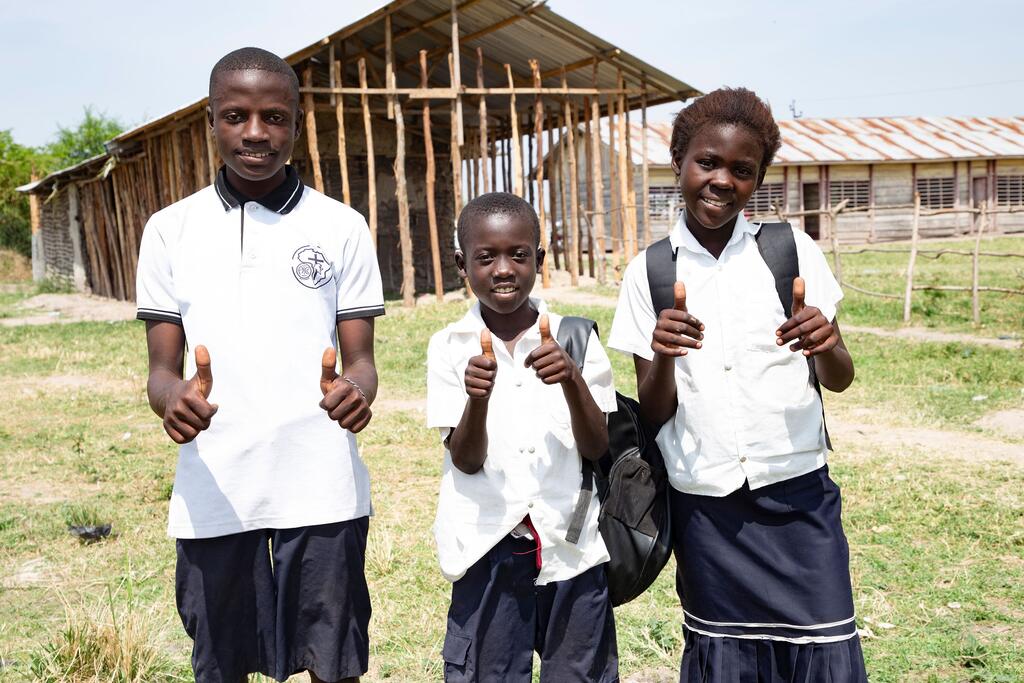
The Boy Who Wants to Be President
Ten-year-old Shadrac Anyazaka doesn't pause when asked about his future. "After finishing my studies, I would like to become President of the Republic one day," he tells visitors to his school in Ituri Province, eastern Democratic Republic of the Congo. His classmate Jérémie, who lost family members to the conflict that has displaced an estimated 5.3 million people inside the DRC, has a different dream: "I want to be a general so that I can advocate for peace in the country."
Both boys are alive. Both boys are in school. And that, right now, is extraordinary.
In a region where 6.4 million children remain out of school — where classrooms have been destroyed or occupied by armed groups — a new US$10 million programme funded by the UN's Education Cannot Wait initiative is working to reach more than 62,000 children with safe learning spaces. As the UN reports, girls and children with disabilities face the gravest risks. The programme is a bet, placed in the middle of a crisis, that dreams need room to grow.
That same bet is being placed, in very different ways, all over the world this spring.
From Vinnytsia to Cambridge
Four thousand miles away, in the classrooms of MIT's Department of Urban Studies and Planning, 13 graduate students are deep in a semester-long practicum called Innovating in Ukraine. Their client: the city of Vinnytsia, a city-region of 400,000 people located 280 kilometers from Kyiv, where two city representatives flew to Boston to work alongside students from MIT's School of Architecture and Planning, the Sloan School of Management, and Harvard's Kennedy School.
The course, taught by professor of the practice Elisabeth Reynolds, asks students to grapple with a brutal real-world constraint: how do you build an innovation ecosystem during a war? Ukraine has leaned hard into technology — its e-governance app Diia puts dozens of government services on a single cellphone screen, and a rapidly evolving drone industry has emerged from necessity. The final deliverable isn't a grade. It's a blueprint a real city might actually use.
That spirit of learning-as-action is rippling into K-12 classrooms too. At the University of Florida, professor Chris Thomas has replaced a standard essay assignment in his graduate-level school law course with something far more dynamic: a role-playing AI exchange called "PrincipalGPT," in which students interact with ChatGPT as a simulated school principal navigating legal dilemmas. According to Phys.org, the model is reshaping how legal literacy takes root — moving comprehension from the passive to the participatory.
The Doctor at 73
Then there is Dawn Zuidgeest-Craft, who carried a dream of medical school for the better part of five decades.
Life intervened — a divorce, a remarriage, four children across two families, a career as a nurse practitioner and pediatric educator. The dream faded. Then her husband Carl nearly died from a brain hemorrhage, and the two of them sat down with their bucket list. Carl wanted to travel. Dawn said she wanted to go to medical school. "He thought I was crazy," she told the Washington Post.
She wasn't crazy. She was determined. Digging into her retirement savings, Zuidgeest-Craft enrolled at St. James School of Medicine in Anguilla — an institution that waives the MCAT requirement — failed her first-year biochemistry exam, kept going, and graduated as the school's oldest-ever alumna at 72 years old. She received her doctorate this spring. She is, as of this writing, 73 years young and a practicing physician.
Her story sits alongside those of MIT master's student Sunshine Jiang and Rupert Li '24, both named 2026 Knight-Hennessy Scholars — one of the most competitive graduate fellowships in the world, offering up to three years of full support for study at Stanford. Jiang, from Hangzhou, China, graduated MIT with a double major in physics and electrical engineering. Two very different entry points to learning. One shared conviction: it's worth the effort.
A Record Crowd and a Mud-Covered Hero
Not all hope announces itself in lecture halls or policy reports. Sometimes it shows up at an Irish rugby stadium.
More than 30,000 tickets were sold for Ireland's women's final Six Nations match against Scotland at the Aviva Stadium in Dublin — a record for a women's rugby game in Ireland. Head coach Scott Bemand told the BBC: "The girls are desperate to get on the pitch and show people what they can do." That kind of hunger — to be seen, to compete, to prove — is its own form of world-building.
And then there is Maisy.
The 12-year-old Staffordshire bull terrier fell into a narrow crevice on the North Yorkshire moors and became trapped 21 feet underground. Her owner called emergency services. Eighteen members of the Scarborough and Ryedale Mountain Rescue Team spent six hours digging, chiseling, and wedging their bodies into the earth to reach her — no ropes, because ropes would have dislodged rocks. One rescuer climbed down with a hammer and chisel to widen the gap. They passed Maisy up hand by hand through a human chain. She emerged muddy, shaken, and alive.
Lead incident controller Tony Heap put it simply: "Everybody was focused on achieving the best outcome."
What All of This Adds Up To
A boy in a war zone imagining a peaceful DRC. A 73-year-old woman holding a medical degree she earned from her retirement savings. MIT students drafting economic blueprints for a besieged Ukrainian city. Eighteen volunteers spending their Saturday in a hole in the ground for a dog named Maisy.
None of these stories are perfect. War continues. Displacement continues. Dreams get deferred and sometimes extinguished. But this spring, in classrooms and stadiums and crevices and clinics around the world, an extraordinary number of people are refusing to wait for better conditions before doing something that matters. That refusal — stubborn, practical, sometimes muddy — is what hope actually looks like from the inside.
Sign in to join the conversation.
Comments (0)
No comments yet. Be the first to share your thoughts.