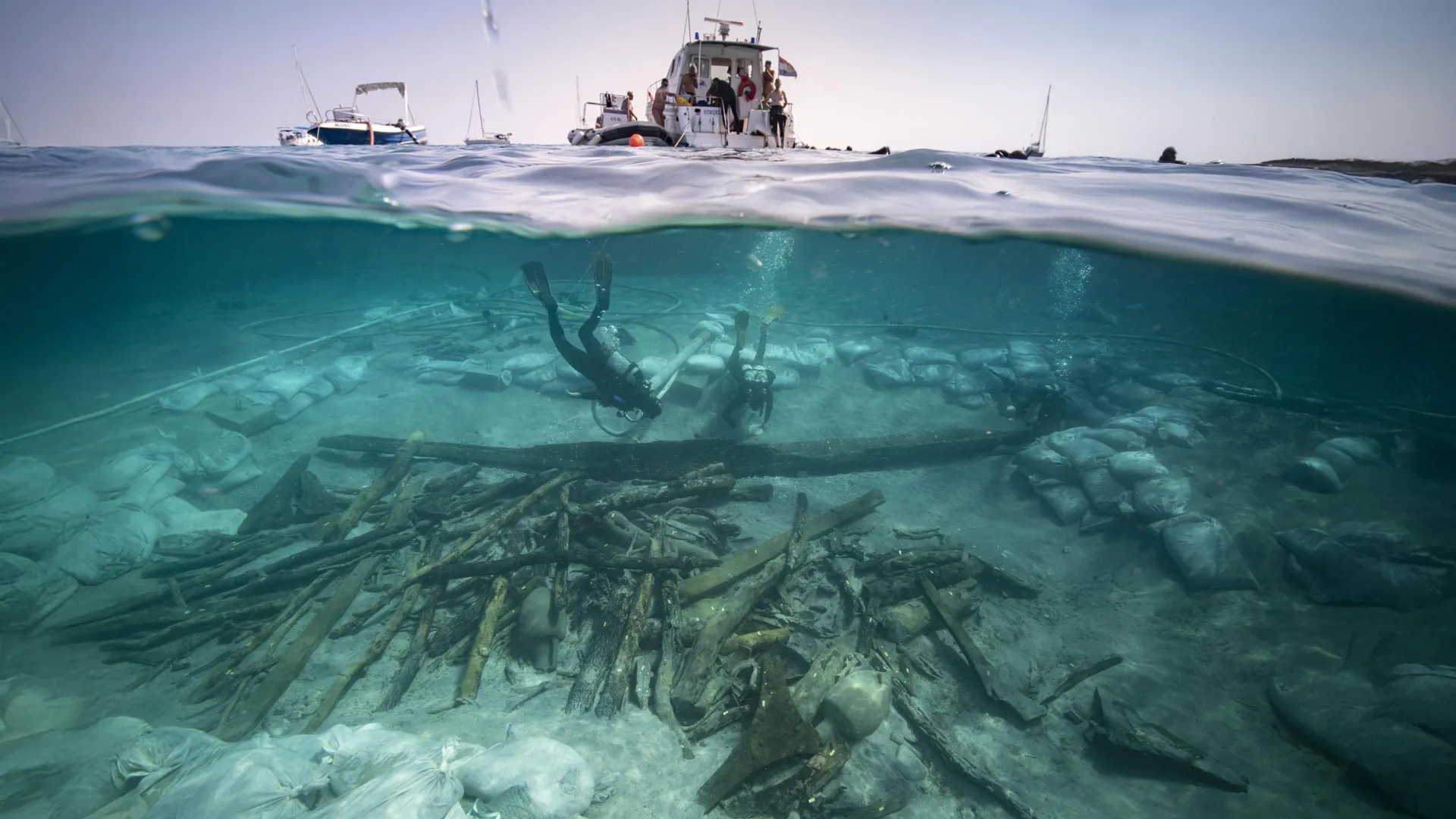
A smear of pine tar on a shipwreck off Croatia has held onto traces of the world around it for 2,200 years. In the sticky coating, researchers found two ancient waterproofing recipes—and pollen grains that may help tell where the ship was built or repaired.
The vessel, known as Ilovik-Paržine 1, sank during the Roman Republic era off the coast of modern Croatia. Its wreck was discovered in 2016, but its protective coatings had not received the same attention as its wooden parts. A new study in Frontiers in Materials brings together chemical analysis and pollen study to examine what made the ship seaworthy.
Researchers from the Croatian Conservation Institute’s Department for Underwater Archaeology and the ADRIBOATS program at Aix-Marseille University’s Centre Camille Jullian studied 10 coating samples. They found chemical traces of pine across the samples, showing that the main sealant was pitch: a thick material made from heated conifer resin or tar. Shipbuilders could warm the pitch so it spread over the wood and filled gaps between parts of the hull.
One sample revealed a second recipe: pine tar mixed with beeswax. Ancient Greek shipbuilders called this blend zopissa. Beeswax made the coating more flexible and easier to spread while hot. That flexibility mattered on a wooden vessel, where timbers could shift as the ship moved through waves and changing conditions.
The coatings also preserved pollen grains. Because different plants produce pollen with distinct shapes, scientists can identify plant types long after the plants are gone. The team used the kinds and relative amounts of pollen in the samples to narrow possible locations where the pitch was made or applied. The source material does not identify a final location, but the evidence offers a rare way to investigate the ship’s construction and repair history.
That matters because organic waterproofing materials have often been overlooked in archaeology, even though they were essential to travel by sea and river. Saltwater, tiny organisms and shipworms could all damage a vessel. Shipworms are not worms but marine mollusks that burrow into wood. A coating’s recipe could therefore reflect practical skill, as well as local shipbuilding traditions.
The researchers used several methods to study the coatings’ structure and ingredients, including mass spectrometry, which helps identify substances by measuring the masses of their molecules or atoms. First author Dr. Armelle Charrié, an archaeometrist at the Laboratory of Mass Spectrometry of Interactions and Systems in Strasbourg, said the materials are “true witnesses of past naval technologies.”
By reading both the recipe and the pollen trapped inside it, scientists can learn more than how ancient sailors kept water out. They can also begin to trace the places and traditions connected to a ship’s working life. Further study of coatings from other vessels may help reveal how varied those maritime skills were across the Adriatic.