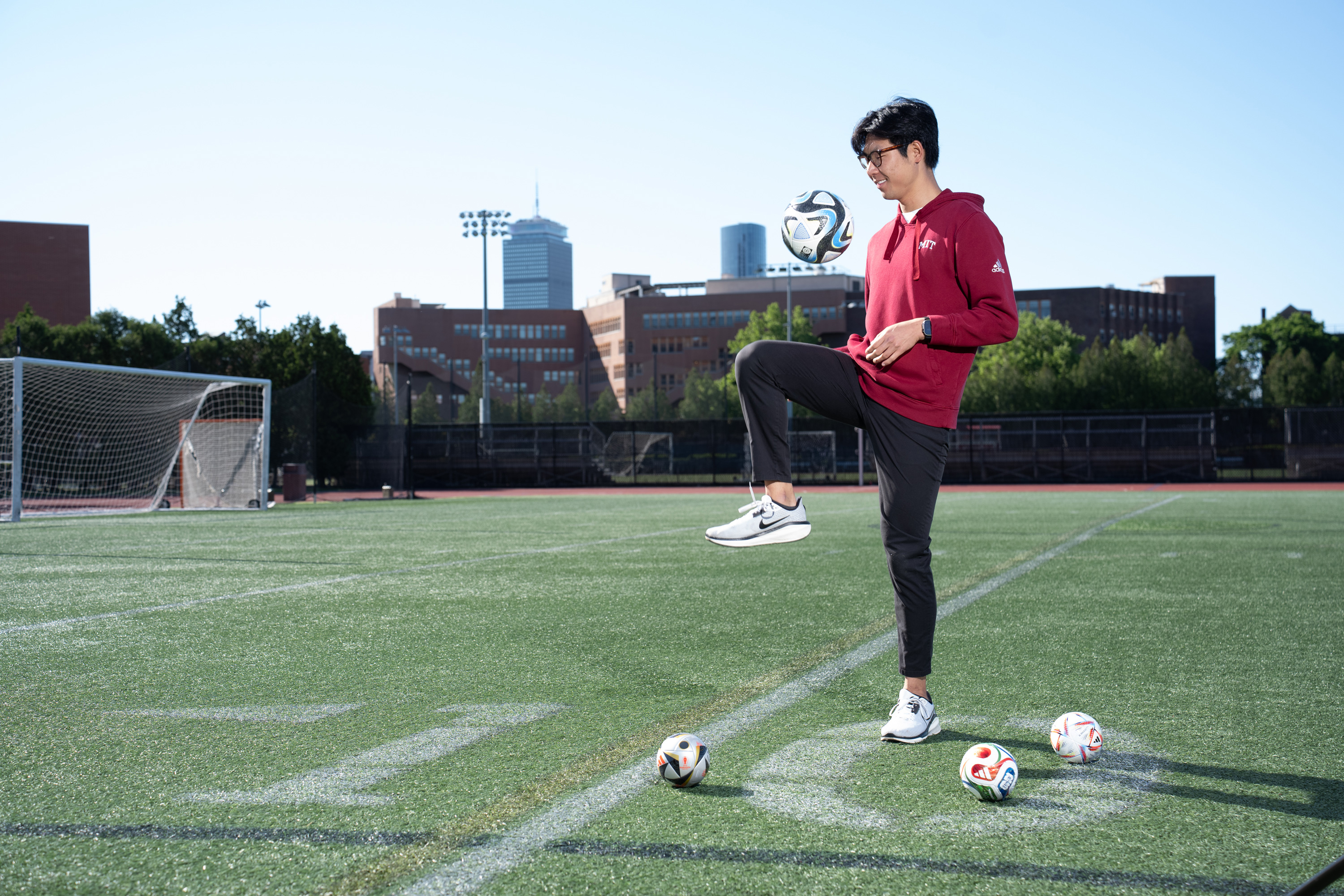
When Henry Wang was diagnosed with asthma as a child, his pediatrician gave him a simple prescription: swim. It was meant to strengthen his lungs. What no one expected was that those early laps in a Dallas pool would one day lead him to help referee the World Cup.
Today, Wang is a fourth-year PhD candidate at MIT in Cambridge, Massachusetts, working on technology that could change how soccer games are officiated. In collaboration with FIFA, soccer's global governing body, he develops systems designed to help referees make faster, more accurate decisions without interrupting the flow of the game.
"The first ever sports game I remember watching was Super Bowl XLII in 2008," Wang says. "I was really drawn to the competition, and the way it was presented. It's this whole big spectacle."
That early fascination with sports has shaped his entire academic journey. Wang has spent nearly a decade at MIT, where he earned a double major in computer science, economics, and data science and business analytics in 2023 before continuing directly into his PhD program in social and engineering systems. Outside the classroom, he served as captain of the men's swimming and diving team.
His research now focuses on two questions: How can technology make sports fairer, and how can it give more people access to better data?
In one recent project, Wang helped create a semi-automated system that tracks players' movements and the ball to determine exactly who last touched the ball before it goes out of bounds. The goal is to assist referees on goal kicks and corner kicks while keeping the game moving.
"A ball goes out of bounds, and we can immediately tell the referee it's a corner kick," Wang says. "The fans don't even notice it."
Wang works with FIFA Innovation, the group that develops and tests match technology used on the field. His work aims to support referees without changing the experience for fans watching at home or in the stadium.
His path to MIT's Sports Lab started with a cold email. As a first-year student, he reached out to MIT Sloan Senior Lecturer Ben Shields about helping with sports strategy research. That connection led to a project analyzing two-point conversion strategies for MIT's football team, which revealed the team could benefit from attempting them far more often.
Alongside his doctoral work, Wang gained real-world experience with professional teams. He spent two years working with the Boston Red Sox's baseball sciences team. After graduating, he's moving to the Philadelphia 76ers as a senior data scientist in basketball research and development.
Despite his demanding schedule across research, athletics, and professional sports, Wang says the work rarely feels like a chore.
"I enjoy it so much," he says. "I really don't know what else I would be doing."
For Wang, the ultimate measure of success is simple: referees find the tools helpful, and the game stays exactly as exciting as it should be.