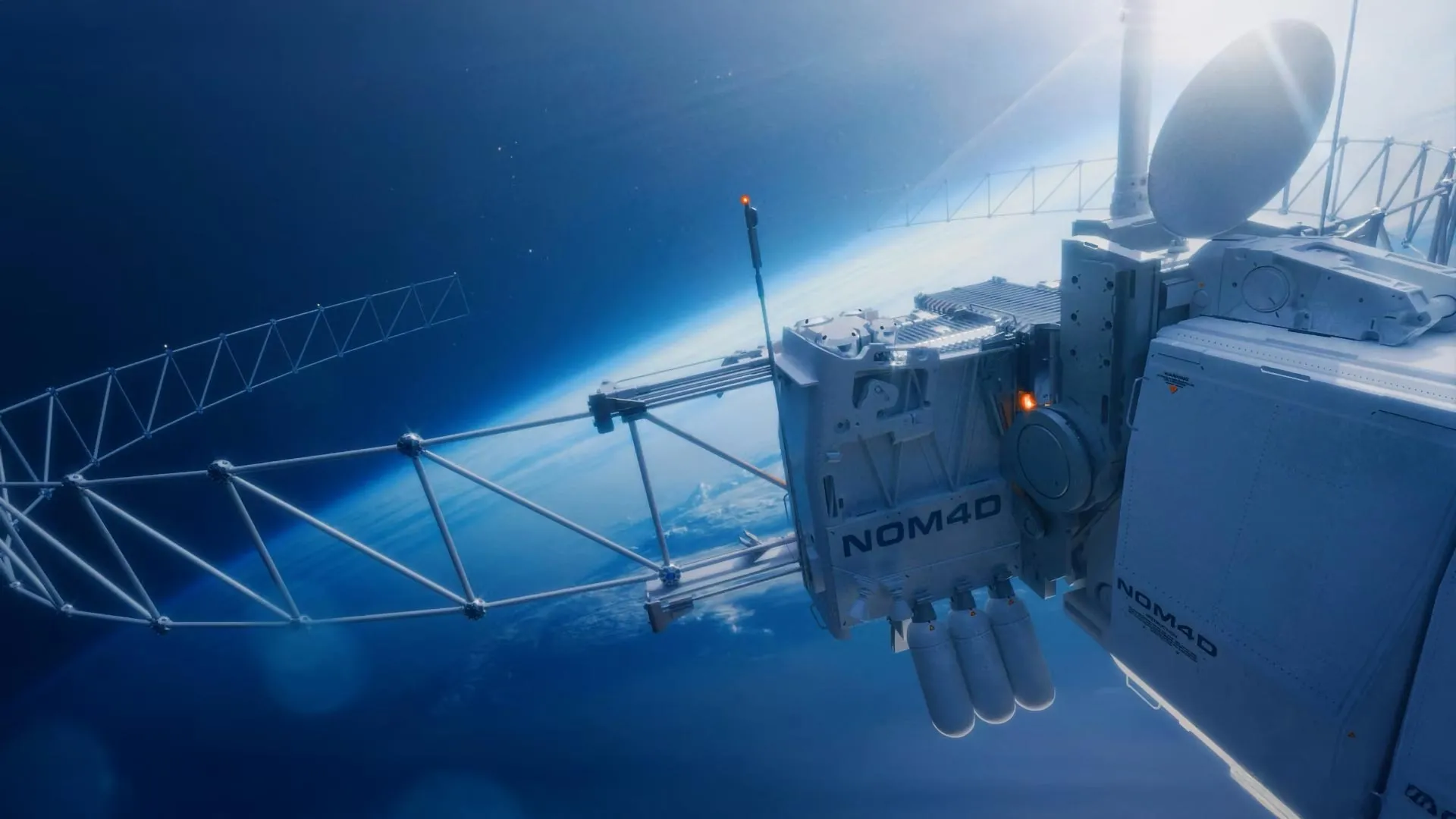
A robot aboard an orbital spacecraft spent six months trying to build a 1.4-meter-wide reflector antenna—and, for the first time, it assembled part of a structure in space without astronauts.
The test, led by researchers at the California Institute of Technology (Caltech), tackles a basic problem in space engineering: rockets have limited room. Their protective payload enclosure, called a fairing, can only hold structures up to a certain size. Engineers have worked around that limit by folding equipment for launch or sending separate parts for astronauts to connect in orbit. Both methods can restrict how large and complex a finished structure can be.
Caltech’s Autonomous In-Space Tensioned Reflector Assembly, or ASTRA, offers another path. Its robotic arm collects structural tubes and connecting joints from nearby storage dispensers, then joins them into repeating sections called bays. Those sections form a supporting framework known as a truss. The antenna design uses composite fiber tubes, aluminum connectors and a light reflecting surface made from Kapton, a durable polymer film often used on spacecraft.
“This is the first time that a structure has been autonomously constructed in space,” said Sergio Pellegrino, who leads the ASTRA demonstration. He is a Caltech professor of aerospace and civil engineering and a senior research scientist at NASA’s Jet Propulsion Laboratory, which Caltech manages.
The robot did not finish the whole antenna. Technical problems and scheduling limits got in the way. But it successfully assembled an initial section, showing that the basic approach can work in orbit. That is an important result for a project designed to test robotic construction, not simply to deliver a finished antenna.
The work is part of the Defense Advanced Research Projects Agency’s NOM4D program, short for Novel Orbital and Moon Manufacturing, Materials, and Mass-efficient Design. Launched in 2022, the program explores ways to make and assemble very large structures in space. Caltech’s experiment is one of two projects selected for NOM4D’s third phase, which includes orbital demonstrations. Before launch, the team developed the idea, designed the system and tested it on Earth. It then had less than 12 months to build, test and deliver the hardware to Momentus Inc., which hosted the payload.
If robots can reliably assemble larger frameworks, future telescopes could carry much bigger mirrors or reflectors and collect more light from distant objects. Large structures could also support powerful radio antennas or space-based energy systems. Instead of squeezing a complete telescope or antenna into a rocket, engineers could send its materials up and put the structure together in orbit.
The first demonstration was modest in size and incomplete, but it gives researchers a starting point for that work. As the mission wraps up, Pellegrino said, the team can begin considering “the new avenues of research opened by this demonstration.”