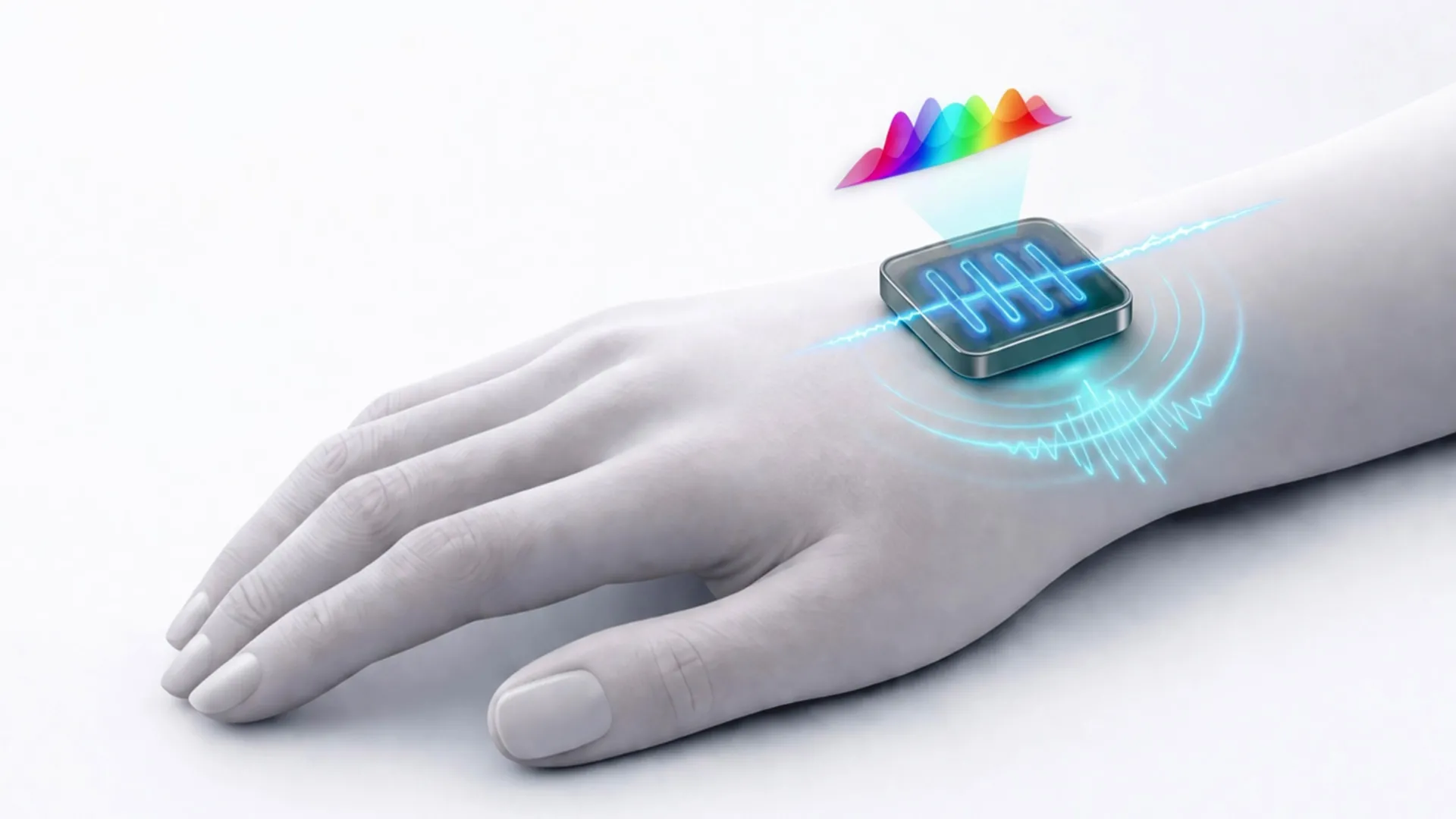
A $10 sensor built in Cambridge can read light across near-infrared wavelengths from 1,200 to 1,700 nanometers—and it is small enough to fit into portable electronics. The University of Cambridge team behind it hopes the device could one day bring some laboratory measurements to wearables and handheld tools.
The new instrument is an optical spectrometer: a device that studies how light interacts with a substance to reveal what it contains. Spectrometers are used in medicine, manufacturing, chemical testing and environmental research, but small versions have often sacrificed precision or the range of measurements they can make. The Cambridge researchers say their design could help avoid that trade-off, with possible uses ranging from checking food and materials to tracking health markers.
The team, which includes researchers from the start-up GlitterinTech, calls its design a convolutional spectrometer. Instead of separating light into its wavelengths in the usual way, or relying on complex calculations to rebuild the spectrum, it applies a mathematical operation called convolution directly to the incoming light. Repeating patterns in optical components produce controlled responses to different wavelengths; electronics then use a fast calculation to recover the spectrum.
The researchers built the device on a silicon nitride photonic platform and added onboard electronics. It can gather and process a measurement in less than a second. Its measured wavelength range is broad for a compact instrument, and the team says adding more optical components could increase its resolution. The system’s repeating patterns also mean its spectral bandwidth could, in theory, be extended without a fixed limit.
In tests, the sensor correctly classified every sample in a group that included plastics, medicines, coffee, flour and tea, achieving a reported 100% success rate. It also measured concentrations in water-based and organic solutions with accuracy of about 0.01%. In those experiments, the researchers said, it outperformed commercial benchtop spectrometers.
The team also tested the device on health-related measurements. It measured skin moisture, blood alcohol, blood lactate and blood glucose under conditions designed to reflect real bodily environments. In a demonstration with one participant, it tracked glucose without taking blood over an extended period. That result points toward a possible way to monitor blood sugar without repeated skin punctures, but it is an early demonstration, not a ready-to-use medical product. Further testing will be needed.
Lead author Dr. Chunhui Yao said the team returned to the mathematics to find a cleaner way to retrieve spectra, aiming for high precision, noise tolerance and low computing demands in a compact, low-cost system. Project leader Prof. Qixiang Cheng described the biomedical demonstrations as especially exciting. The device could also support food testing, industrial quality checks and environmental monitoring, though the researchers’ demonstrations do not yet establish how it would perform in every real-world setting.
For now, the most striking promise is a small, inexpensive instrument that delivered precise measurements in laboratory tests. If further development and testing support the early results, spectrometers could move beyond specialist equipment and into portable devices used to check substances—and perhaps monitor health—in everyday settings.