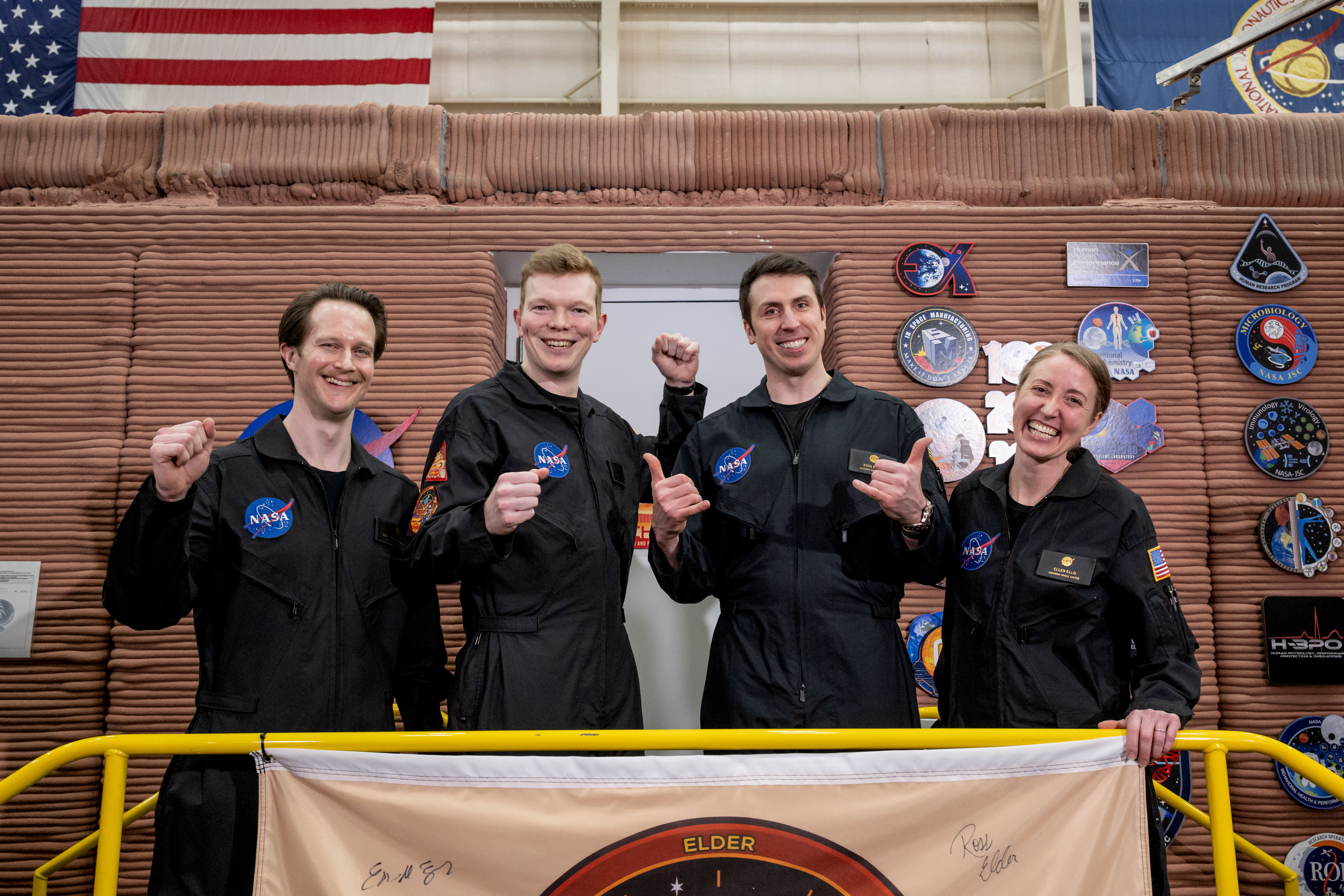
For 378 days, Ross Elder, Ellen Ellis, James Spicer and Matthew Montgomery lived without windows or real-time calls with family and friends inside a Mars habitat in Houston. When they stepped outside on Oct. 31, they had finished NASA’s second yearlong test of what life on the Red Planet might demand.
The volunteers took part in CHAPEA Mission 2, short for Crew Health and Performance Exploration Analog. The project studies how isolation, demanding work and limited supplies affect people, so NASA can better prepare crews for future space missions. The roughly 1,700-square-foot habitat, called Mars Dune Alpha, is a 3D-printed structure at Johnson Space Center. The crew entered it on Oct. 19, 2025.
Inside, they followed a schedule built around tasks planned for Mars explorers: simulated walks on the planet’s surface, robotic operations, habitat repairs, exercise and growing crops. They also faced communication delays of up to 22 minutes each way, along with limits on resources. Researchers and ground teams across NASA supported the mission and collected information about the crew’s health and performance.
The isolation unfolded while space exploration continued beyond the habitat. NASA astronaut Jack Hathaway spent 237 days on the International Space Station and returned to Earth during the crew’s time inside. Artemis II astronauts traveled around the Moon and set a record for the farthest humans have journeyed from Earth. On Nov. 2, 2025, NASA marked 25 years of people living continuously aboard the space station.
Elder, a U.S. Air Force experimental test pilot, led the crew. He said operating a drone and rover remotely to survey terrain and find or collect rock samples felt “uncannily similar” to working as part of a flight. Simulated Marswalks also showed how much time and stamina future explorers may need for suit preparation, airlock steps and long trips across the surface. Elder stressed that good food, exercise and rest would help crews keep up that pace. He said the greatest reward was seeing his crewmates become “one of the finest teams I’ve ever been a part of.”
Ellis, a U.S. Space Force officer and the mission’s medical officer, helped organize biological sample collection and prepare health research supplies. She said following procedures carefully mattered, even after they became familiar, and described finding solutions with the available tools as “tactical creativity.” Her experience also underscored that a Mars crew needs support from specialists on Earth. “A future Mars crew requires a highly integrated ground team,” she said.
Spicer, whose background includes satellite communications and spacecraft development, helped keep the habitat’s systems running. The crew tracked supplies ranging from dish soap to respirator filters and managed food and water. Spicer was surprised by how little he missed constant news and social media; shared stories and jokes around the kitchen table helped make the difficult year feel like “not a chore, but a joy.”
NASA Johnson Space Center Director Vanessa Wyche said the mission gathered knowledge needed to protect crew health and performance and could help pave the way to the Moon and, one day, Mars. The volunteers’ 378 days cannot reproduce every challenge of a real planetary expedition, but their records on health, teamwork and daily work offer researchers practical evidence to use as they plan for crews far from home.