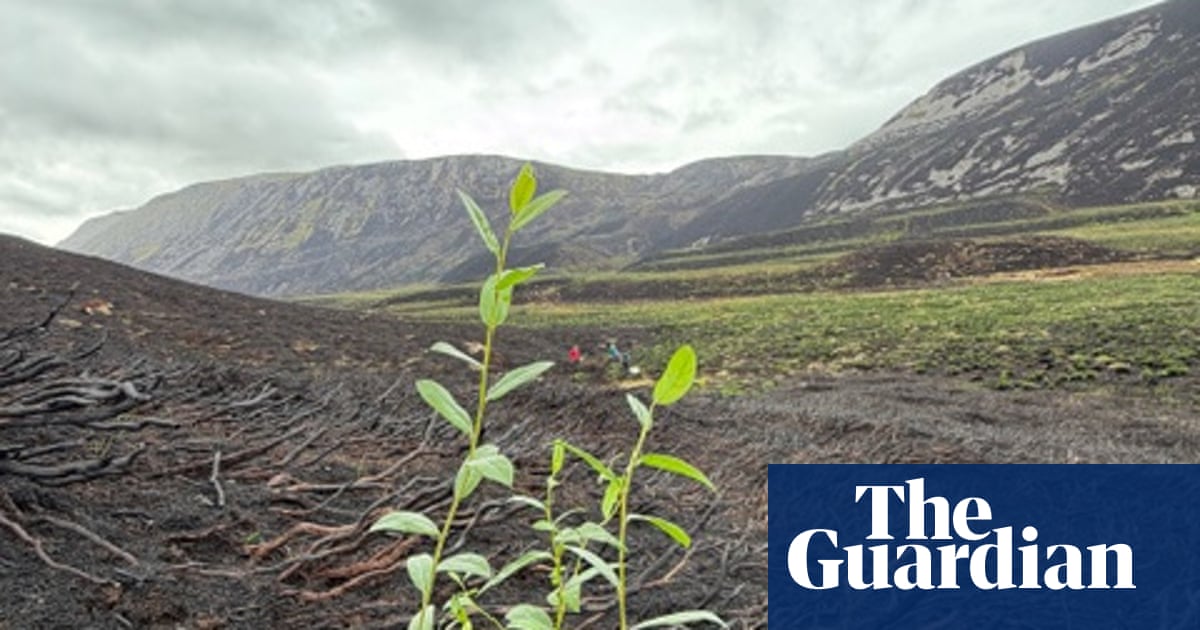
Three months after a fire blackened 25 square kilometres of the Cairngorms, tiny green bracken fronds and birch shoots are appearing through the dark ground. The first signs of recovery are small, but they are visible across a landscape where the damage still feels raw.
The fire swept across moorland and forest in Scotland’s Cairngorms National Park. When writer Amanda Thomson returned to see the affected area, she found hillsides marked by black pines and rust-coloured needles, with the charred trees stretching into the forest. In places, the fire had burned deep into roots and peat. Workers were still tackling hot spots and smouldering patches more than a month after the blaze began, and some areas remain closed because damaged trees could fall.
Thomson joined a group planting more than 3,000 native trees in one of the affected glens. The young plants included goat willow, creeping willow, downy birch and alder. These are mountain species, often naturally small, that once grew in this habitat but had been reduced by overgrazing. Their seeds came from nearby surviving groups of trees and shrubs, then were raised at the Cairngorms Connect Tree Nursery as part of a wider effort to restore the landscape.
The contrast between burned and untouched land could be startling. In one stretch, bog asphodel and scabious were in bloom, while black grouse continued their mating display. Just beyond, the scorched ground was open enough to walk across easily, unlike the thick heather that usually makes the moor difficult to cross.
And the black earth was not entirely bare. Tufts of deer-grass stood above the charred undergrowth. Fresh green fern and bracken fronds were unfurling, and birch shoots had begun to appear. Thomson also found pyrophilous fungi—fungi that grow after fires—in the burned area. They help create conditions that can support new growth, making them part of the natural recovery process.
The fire came close to the path to An Lochan Uaine, known as the Green Lochan, and to the nearby hill Meall a’ Bhuachaille and Ryvoan bothy. The path has since been widened into a firebreak, a cleared strip intended to slow the spread of future flames. The walk also showed how autumn’s change continued around the damage: birch and larch leaves were falling in recent storms, while blaeberry shoots dotted the charcoal-dark ground.
Restoration will take time, especially in the forest where the fire burned into peat and roots. The planted trees and early shoots do not erase the scale of the loss, and danger from weakened trees remains. But seeds gathered from local survivors are now growing back in the same landscape, alongside plants and fungi already responding on their own. Across the Cairngorms, recovery is beginning not as a sudden return, but as a patchwork of careful planting and first green signs.