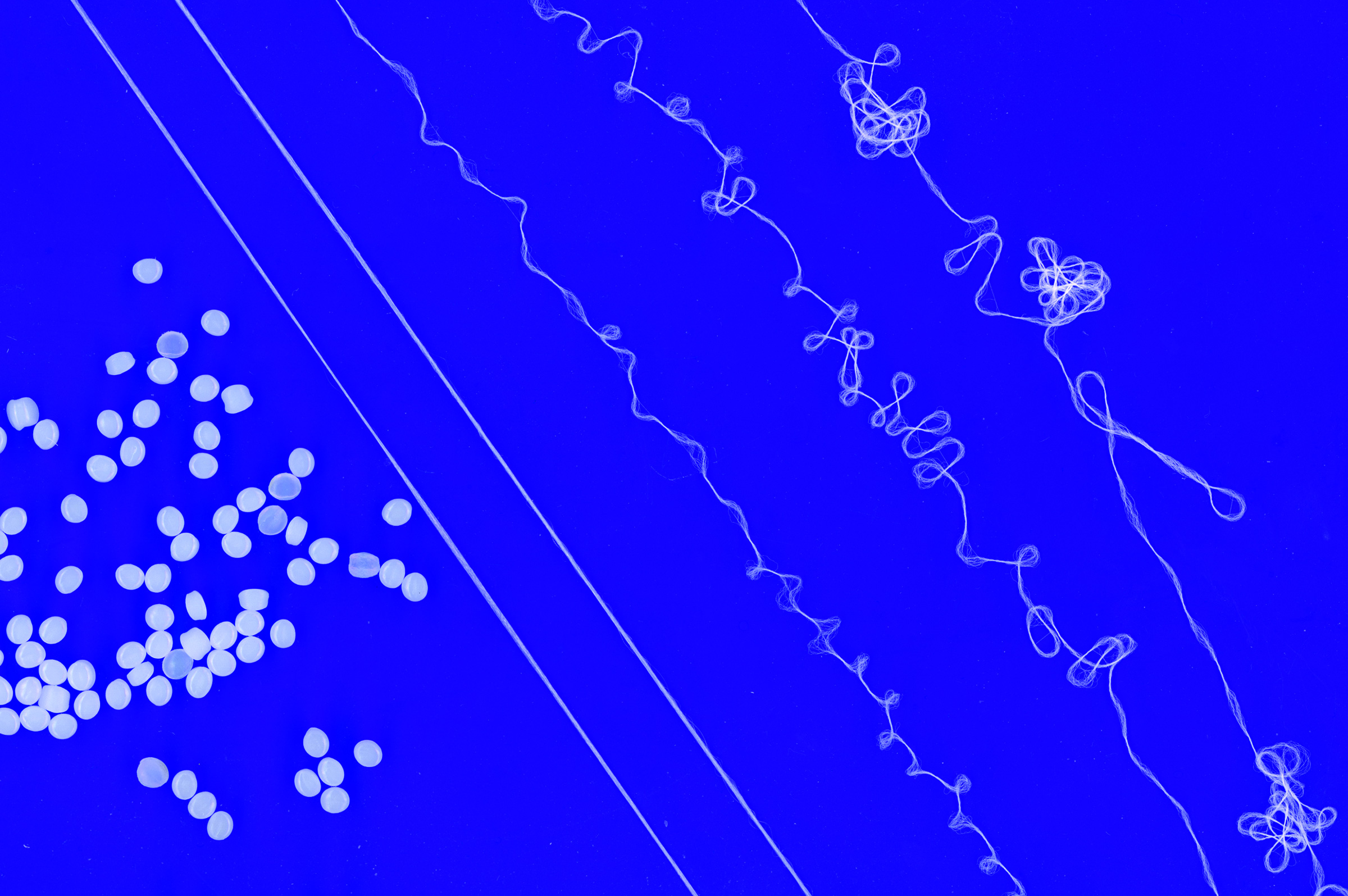
When Svetlana Boriskina tidies her closet, she thinks about trash. Not because she's messy, but because she knows most of the clothes she discards will end up buried underground or burned. Boriskina is a research scientist at MIT in Cambridge, and she and her team have just created something that could change what happens to old clothes forever: a yarn made from the same plastic in milk bottles and grocery bags that can be melted down and remade into new clothing, again and again.
The average American throws out about 81 pounds of clothing every year. That adds up to more than 11 million tons of textiles sitting in landfills or being incinerated annually. The main reason so much clothing gets tossed is that most stretchy fabrics cannot be recycled. About 80 percent of textiles sold in the United States contain spandex, the stretchy fiber found in yoga pants, leggings, and swimwear. Spandex is mixed with polyester or nylon to give clothes their — that means flexible and stretchy. But this combination makes the fabrics impossible to recycle using normal methods.
"There's no widely adopted technology now that recycles textiles into textiles," Boriskina says. "With our new yarn, we hope to change that."
The team designed their new yarn using polyethylene, the world's most common plastic. It shows up in grocery bags, water bottles, toys, and plastic pipes. Unlike spandex blends, polyethylene is a thermoplastic, meaning it can be melted and reshaped without breaking down into weaker materials. The researchers mixed two types of polyethylene resins — one stretchy for the yarn's core, one sturdier for its outer layer — to create something with the same bounce and strength as spandex fabrics.
To prove it works, the team melted down their yarn and spun it into new yarn, then did it again. They repeated this cycle 10 times and found the yarn stayed just as strong and flexible as before.
The new yarn could replace spandex-polyester and spandex-nylon blends in stretchy clothing. At the end of its life, a garment made from this yarn could be melted down and reshaped not only into new clothing but also into buttons, belt buckles, or other plastic items.
The team's study appeared in the journal ACS Materials Letters, with SeongHyeon Kim as the lead author alongside colleagues Duo Xu, Volodymyr Korolovych, Domingo Flores-Hernandez, Kaniz Moriam, and Daniel Braconnier.
Right now, separating spandex from polyester requires toxic chemicals and expensive equipment. Boriskina's group says their all-polyethylene yarn sidesteps those problems entirely. It's a small change in material that could mean big things for the mountains of clothes piling up around the world.