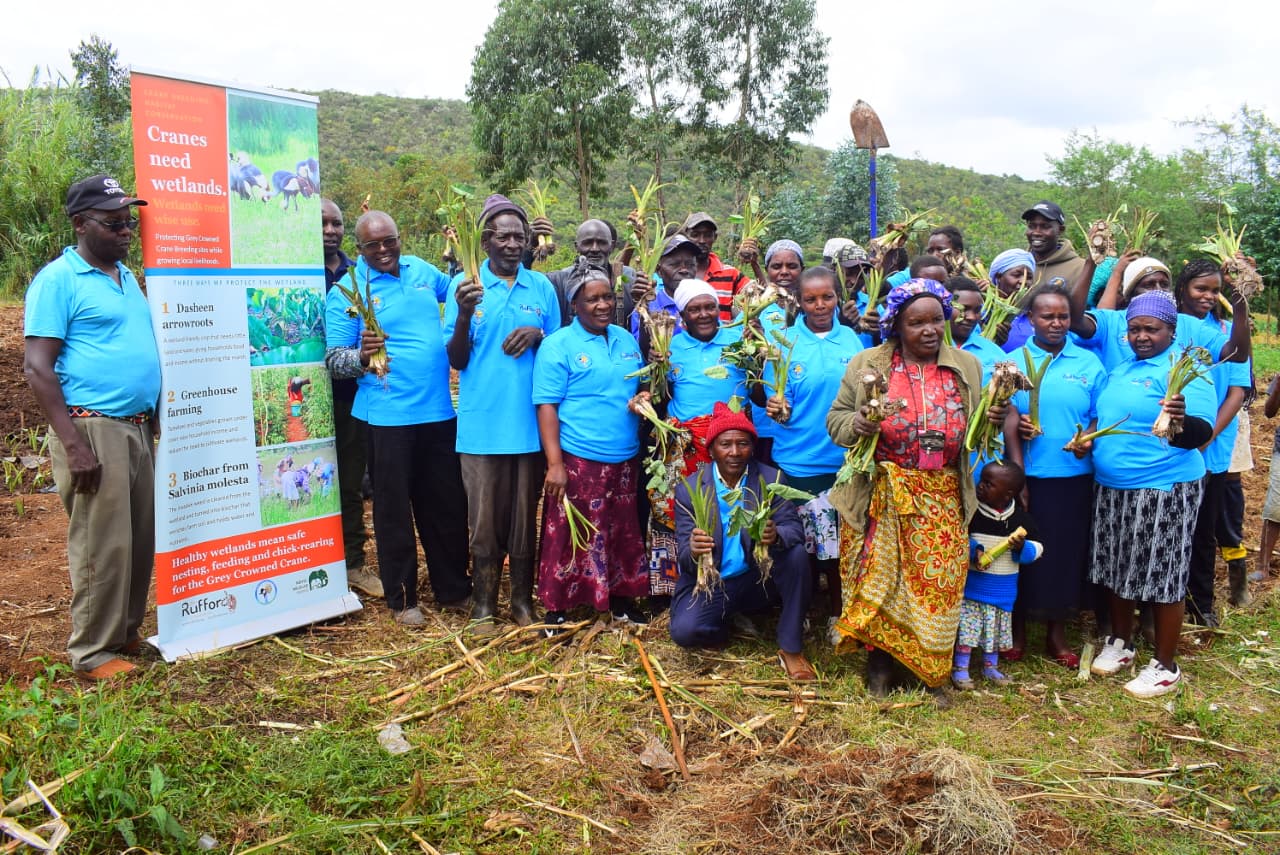
In Nyandarua, farmers are learning that arrowroots do not have to grow with their roots in a marsh. The Dasheen variety can grow on upland farms, offering a way to harvest the crop while leaving fragile wetlands less disturbed.
For years, many families planted indigenous arrowroots in wetlands because the plants needed a steady supply of water. But clearing wetland vegetation for farms can damage habitats, put aquatic life at risk and threaten the breeding grounds of the endangered Grey Crowned Crane. Wetlands also help protect water resources, making their health important beyond the birds and plants that live there.
Conservation experts are now encouraging farmers in Nyandarua, Nakuru and Laikipia to try Dasheen arrowroot away from marshes. In Nyandarua, the change is being supported by the UK-based Rufford Foundation and Cranes Conservation Volunteers (CCV), which provide technical help and farming equipment to encourage upland cultivation.
The two varieties differ in both where and how quickly they grow. Indigenous arrowroots need wetland conditions and take about nine to thirteen months to mature. Dasheen can grow on upland farms as well as in fairly wet conditions. Farmers who have tried it say that, with good rainfall, it can mature in five to eight months, giving them the chance to harvest sooner.
David Warui of CCV says moving arrowroot farms away from wetlands can help reverse environmental damage while improving livelihoods. He points to modern farming methods, organic soil enrichment and approaches that require less labour as ways to support better yields, multiple harvests and higher incomes without expanding into sensitive areas.
For Judy Wambui, the new crop has challenged the idea that arrowroots can only grow in marshes. Farmers can now plant them around their homes rather than depend on vulnerable wetlands. Paul Murage says he once cleared wetland plants to make room for arrowroots, without understanding the harm this caused to the ecosystem. His experience shows how a familiar farming practice can have costs that are hard to see until people learn more about the habitat around them.
Francis Mathaai, an experienced Dasheen farmer, says the benefits reach both farms and the surrounding landscape. He reports that upland cultivation has significantly increased his income, while wetlands in his area that had been degraded are gradually coming back to life. The account offers a local example of farming and conservation working in the same direction, though the source gives no figures for changes in income, yields or wetland recovery.
As climate change and human activity put more pressure on natural ecosystems, Dasheen arrowroot gives farmers a practical alternative to growing crops in marshes. The next step is to keep supporting farmers with the knowledge and tools to make upland cultivation work. If that shift continues, families may be able to harvest arrowroots sooner and earn more while allowing wetlands to recover and remain habitat for wildlife such as the Grey Crowned Crane.