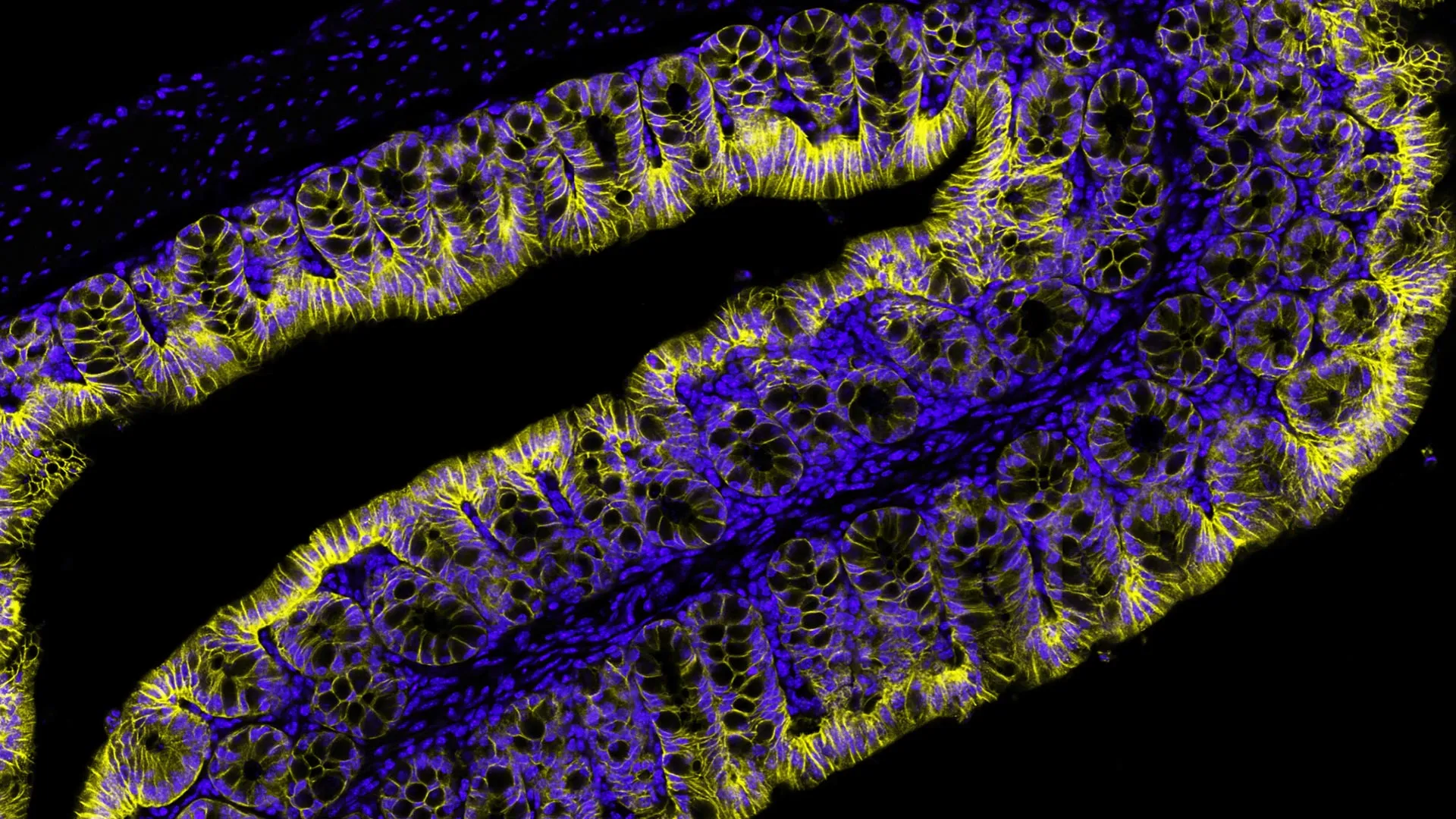
In Rockefeller University’s lab, mice missing one common gut antibody developed more than twice as many colon tumors as mice with normal levels of it. The antibody, called immunoglobulin A, or IgA, may help keep the cells lining the intestine from multiplying too quickly—a finding that points to a possible way to reduce cancer risk before tumors form.
Colon cancer often begins when cells in the intestinal lining grow out of control. Researchers have long known that IgA is abundant in the digestive tract, where it helps defend against harmful microbes. But its full role there has not been clear. The new study, published in Nature, suggests that this immune molecule may also help regulate the body’s own cells.
Gregory Donaldson, a former postdoctoral researcher at Rockefeller who is now an assistant professor at UCLA, led the work. He and his colleagues compared mice that could not make IgA with mice that had normal levels. The groups were raised together, helping the researchers control for differences in food and exposure to microbes. The mice without IgA developed more than twice as many colon tumors. The team saw the same pattern in several models of colon cancer, adding weight to the result.
The researchers also tested what would happen if they replaced the missing antibody. They gave IgA by mouth to mice that could not produce it. The animals no longer showed the increased tumor risk seen before treatment. That result suggests IgA itself plays a direct part in protection, rather than merely being linked to another process in the gut.
To learn how it might work, the team examined epithelial cells—the cells that form the inner surface of the intestine. Their findings indicate that IgA attaches to these cells and helps slow their growth. That may place the antibody at an early point in cancer development, before a tumor has formed.
Daniel Mucida, senior author and head of Rockefeller’s Laboratory of Mucosal Immunology, said the work highlights a natural defense that restrains cell division. “Most cancer research focuses on trying to destroy a tumor that already exists, but what if we could intervene before tumors form?” he said.
The findings may help explain why people with IgA deficiency face a greater risk of colorectal cancer. About 1 in 500 people in the United States have this condition, in which the body makes little or no IgA. The study also adds to evidence that gut bacteria, immune defenses and intestinal cells influence one another. IgA can bind many kinds of gut bacteria, and those microbes can shape health in different ways.
The research was done in mice, so it does not establish that giving IgA to people would prevent cancer. Still, the results offer scientists a new lead: understanding how this common antibody works could help reveal ways to protect the intestine before cancer begins.