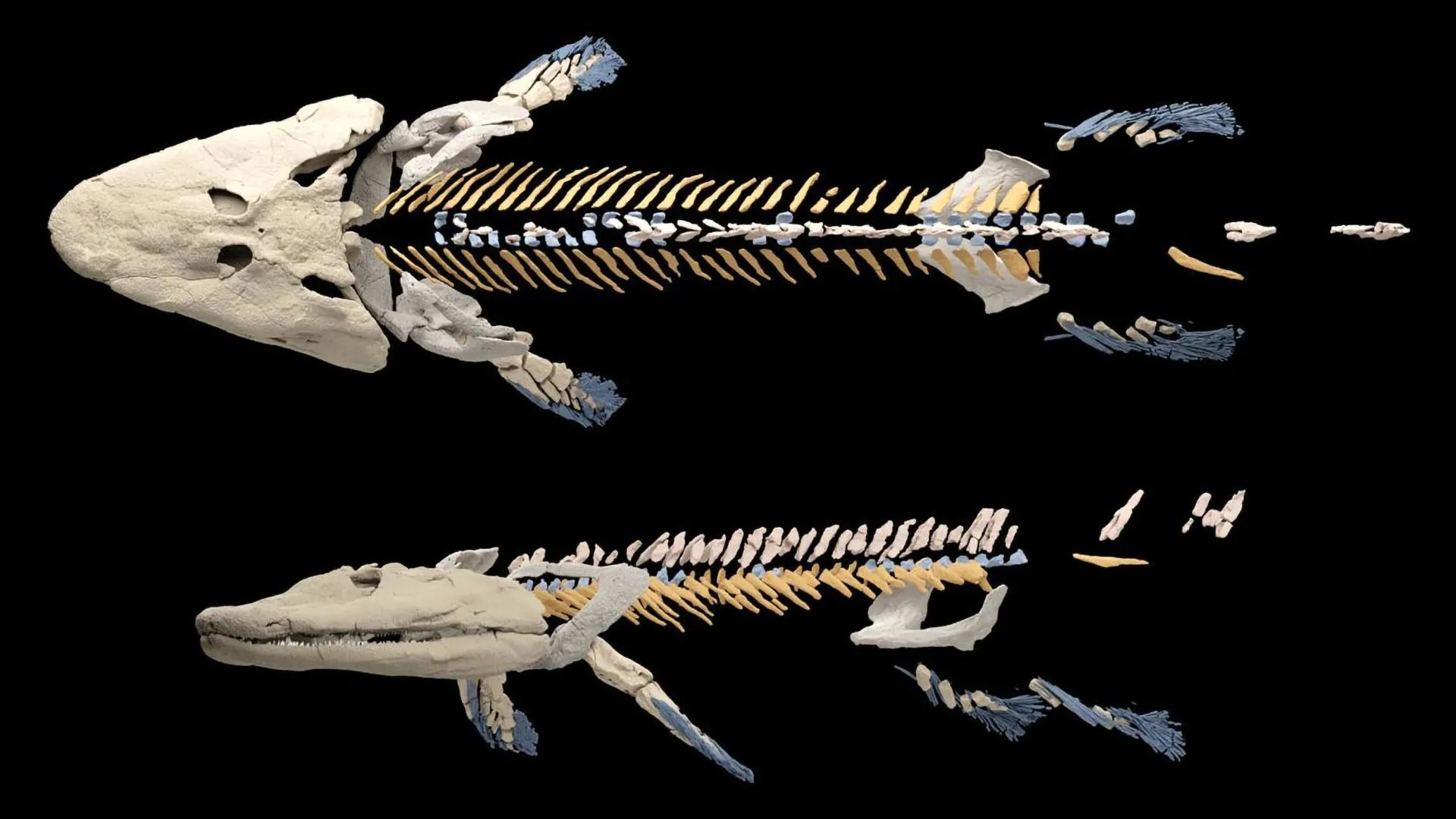
On Ellesmere Island in Canada’s Arctic, a fossil fish named Tiktaalik is helping scientists rethink what an early neck was for. The animal, first described in 2006, lived about 380 million years ago, when some of the first forests were forming and vertebrates were beginning the long move from water to land.
For decades, researchers thought necks first evolved to let animals move their heads more freely. A neck could help an animal look down for food or turn toward a threat without shifting its whole body. Most modern fish cannot do that: their shoulders connect directly to their skulls, so they usually turn their bodies to look in a new direction.
But new research suggests the first necks may have been stiff, giving early animals little ability to turn their heads. The change may instead have been part of a wider reshaping of the skeleton that helped animals use their front limbs to move. That idea challenges a decades-old explanation for a key step in the evolution of four-limbed vertebrates, the group that includes humans and other animals with limbs.
To explore how these ancient bodies worked, an international research team brought together new fossil evidence, experiments on living fish and computer models of ancient anatomy. The team’s findings were published October 14 in the journal Nature. The work addresses a major challenge: much of the backbone in early fish was soft tissue, which is rarely preserved in fossils. Researchers therefore also study living animals as clues to how extinct species may have moved.
Tiktaalik is among the most useful fossils for this question. Its remains were found on Ellesmere Island, in Nunavut, Canada. The fish had features suited to life in water, alongside stronger fins that may have helped it support its weight, lift itself from the bottom or push through shallow water. Its skull and shoulders were also separated, creating a distinct neck. Because Tiktaalik is closely related to the earliest vertebrates with limbs, its body offers a view of changes that took place between fish and land animals.
The transition involved more than necks. Tiktaalik and related fossils help researchers study how animals shifted from drawing food into their mouths by suction underwater to biting, and how swimming structures gradually changed into limbs used for walking. The new findings suggest the separation of the head and shoulders should not automatically be taken as evidence that head-turning drove the evolution of necks. Instead, it may have accompanied changes that made front-limb movement possible.
Tom Stewart, an assistant professor of biology at Penn State and a member of the research team, said many skeletal changes from about 380 million years ago are still reflected in human bodies today. By combining fossils with studies of living animals and computer models, researchers can piece together more of how those changes happened. Tiktaalik’s stiff neck may be a reminder that a feature’s first role is not always the one we might guess from looking at animals today.