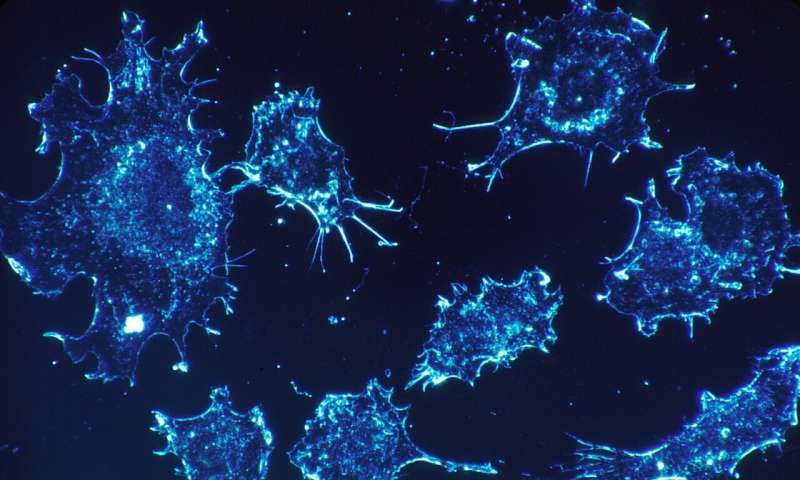
Liming Sun and his team in Shanghai are watching cancer cells die in a new way — not from drugs, not from radiation, but from pressure. In tightly packed 3D models that mimic real tumors, the researchers found that when cancer cells are squeezed for long periods, they stop spreading and begin to self-destruct. This discovery, published in the journal Developmental Cell, challenges long-held assumptions about how cancer behaves under physical stress and opens a fresh path for future treatments.
Most lab studies of cancer use flat, two-dimensional layers of cells. But real tumors grow in three dimensions, pressing against themselves and surrounding tissue. Sun’s team wanted to know what happens to cancer cells when they’re trapped in these crowded, high-pressure environments — the kind found inside growing tumors. They focused on a specific shift in cancer cells called the mesenchymal-to-amoeboid transition (MAT), where cells become more flexible and better at slipping through tight spaces. Scientists thought this made them more dangerous. But Sun’s team found the opposite: prolonged squeezing turns this survival tactic into a death sentence.
The key lies in a protein called MLKL. When cells are under sustained mechanical pressure, MLKL triggers a form of programmed cell death known as necroptosis — a controlled self-destruct mode. The study showed that physical confinement alone, without any drugs or genetic changes, was enough to activate this process. That means the body’s own physical environment might naturally fight cancer in ways we’ve overlooked.
This finding could change how doctors predict cancer spread. Tumors with low levels of MLKL may be more likely to metastasize because they can’t activate this pressure-induced death pathway. In the future, measuring MLKL could help identify high-risk patients earlier. Even more exciting, therapies that boost MLKL activity might help trap and kill cancer cells from the inside.
The team plans to dig deeper into how MLKL works under pressure and how to turn this natural defense into a treatment. For now, the message is clear: sometimes, the most powerful weapon against cancer might be the squeeze.
As Sun puts it, "The hope is that by using experimental systems that better reflect the physical conditions that cells experience in living tissues, we can learn more about what fundamentally determines whether a cell lives or dies." This work doesn’t just reveal a new death pathway — it reminds us that the body’s physical landscape plays a role in life and death, one we’re only beginning to understand.