Yongda Zhu spent one long night scrolling through hundreds of galaxy spectra on his computer screen, searching for a faint chemical whisper from the edge of time. What he found in three distant galaxies — carbon, oxygen, and silicon swirling in space just 500 million years after the Big Bang — is rewriting how we understand the universe’s earliest chapters.
For decades, astronomers believed the early cosmos was mostly untouched, filled with only hydrogen and helium — the lightest elements forged in the Big Bang itself. Heavier elements like carbon and oxygen were thought to take billions of years to spread beyond galaxies. But new observations from the James Webb Space Telescope (JWST) show that process began shockingly fast.
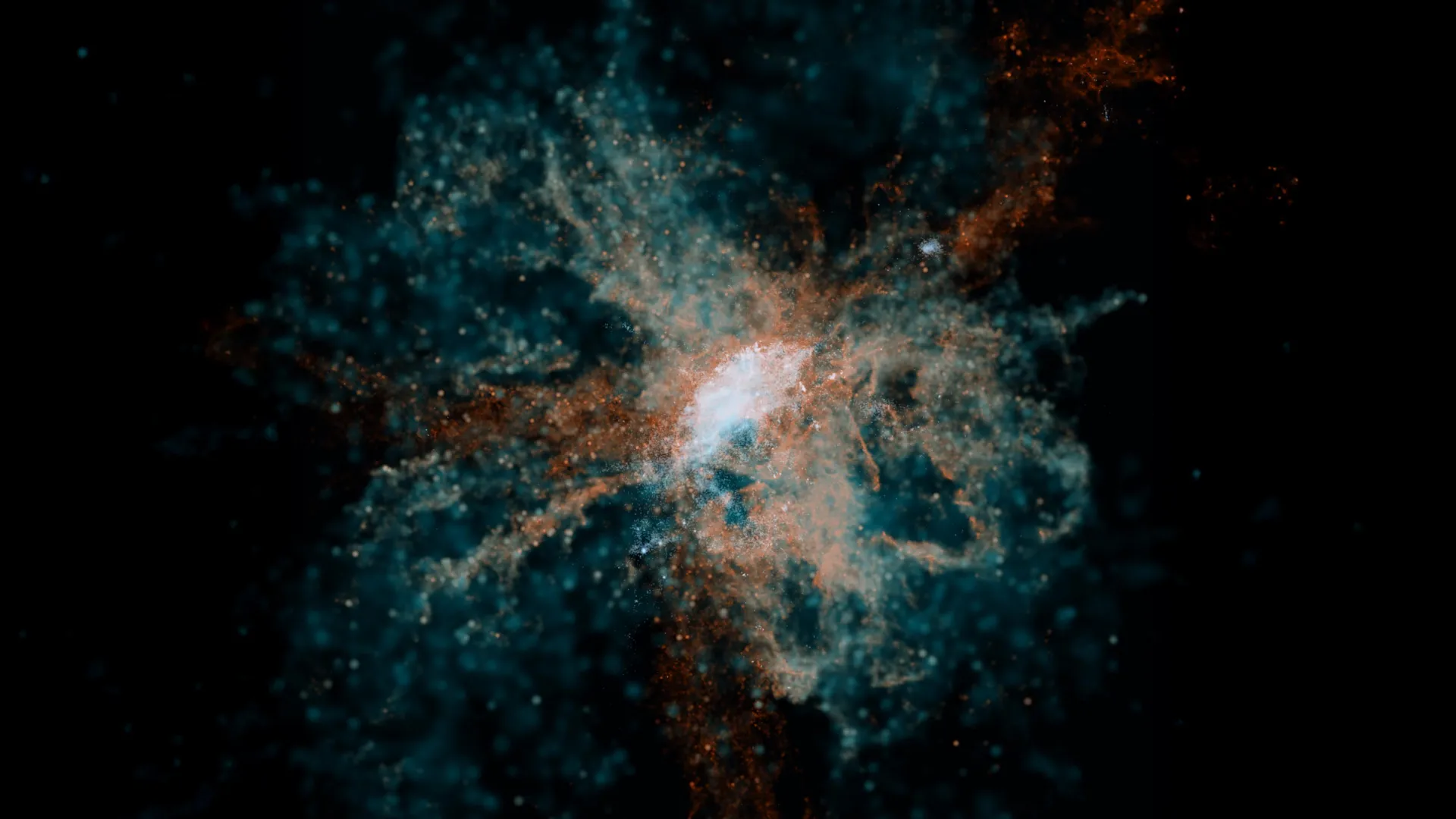
Zhu, a postdoctoral researcher at the University of Arizona, led a study published in Nature Astronomy analyzing light from galaxies more than 13 billion light-years away. As that ancient starlight traveled toward Earth, it passed through surrounding gas clouds. By studying how specific wavelengths were absorbed, the team detected clear signs of heavy elements outside the galaxies themselves. Crucially, these absorption lines were blueshifted — meaning the gas was moving outward, carrying elements into intergalactic space.
This discovery reveals that early galaxies weren’t sealed off. Instead, they were already part of a dynamic cosmic cycle called baryon cycling, where material flows in and out over time. Stars inside these infant galaxies forged heavier elements in their cores, then expelled them through stellar winds or supernova explosions. Those elements later seeded future stars, planets, and possibly life.
Even more surprising, the chemical fingerprints around these young galaxies resemble those seen around mature galaxies much later in cosmic history. That means the universe began enriching its surroundings almost as soon as stars could form.
"Think of these elements, which originated from the galaxies' stars, as food dye dropped into a cup of water," Zhu said. "The color begins to spread through the water, and, in a similar fashion, these heavy elements from early galaxies began to escape into space and 'enrich' their surroundings." This rapid dispersal may also help solve a mystery about Population III stars — the universe’s very first stars, born from pure hydrogen and helium — by showing how quickly their elemental legacy spread.
These findings don’t just shift timelines — they deepen our understanding of how connected the cosmos has always been. Galaxies didn’t evolve in isolation; they shaped, and were shaped by, the space around them from the beginning. With JWST peering deeper than ever before, we’re learning that even in its infancy, the universe was already hard at work building the ingredients for everything to come.