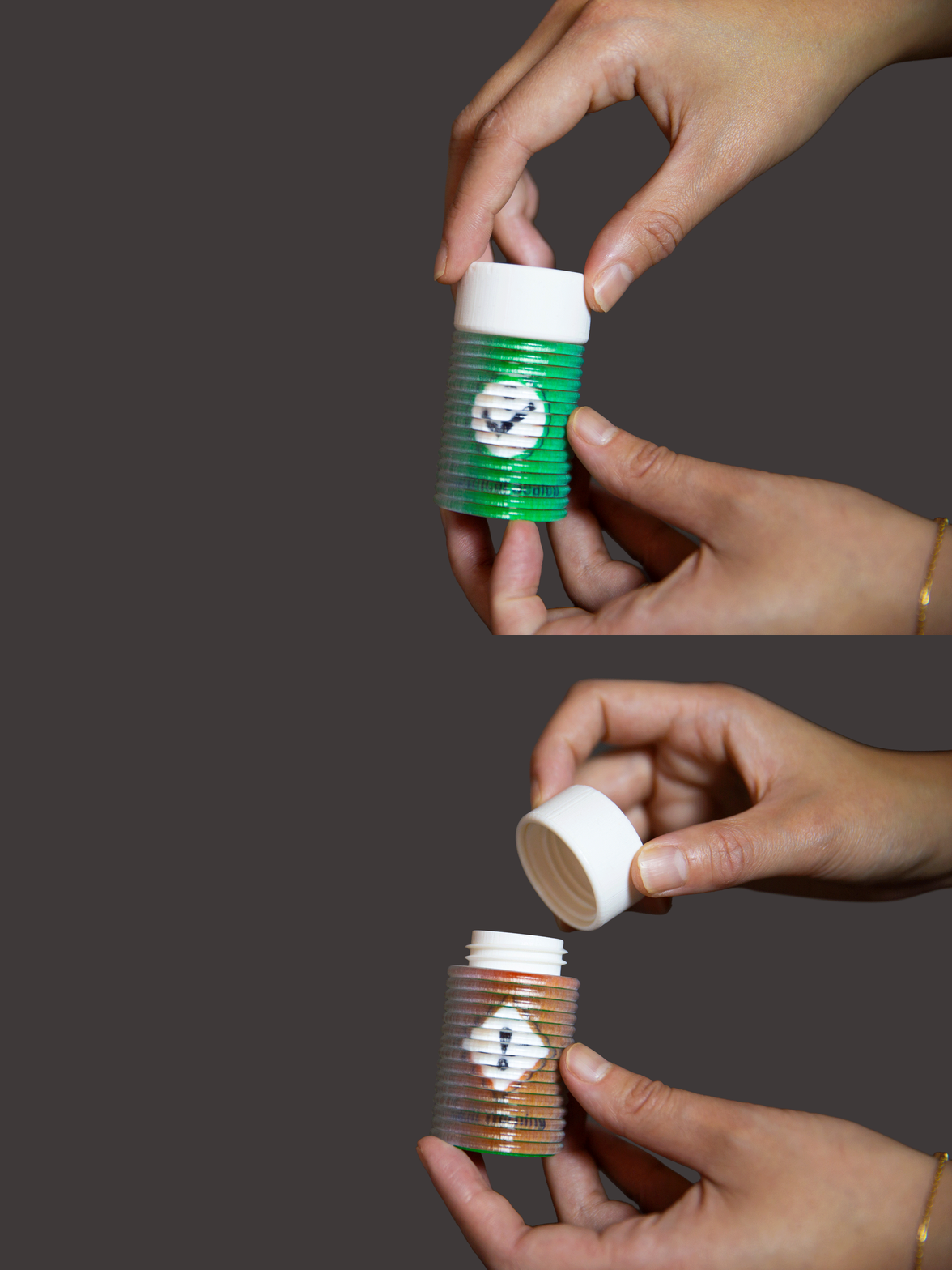
Imagine a bottle of cleaning spray that flashes a green check mark when you screw the cap on tight, but turns red with a warning sign the moment the cap comes loose. No batteries. No electronics. Just smart design. That's exactly what researchers at MIT have built with a new system called ShiftLens.
The team in Cambridge, Massachusetts created a 3D-printing method that makes objects change their appearance when people touch or move them. The whole system works without a single wire or circuit inside. Instead, it uses something called lenticular lenses, which are tiny curved lenses that bend light in different ways depending on where you're looking from. When two layers of these lenses shift against each other, the object reveals a completely different image.
"With our system, an object can tell you whether you are using it properly, without the need for sensors or any complicated electronics," says Yunyi Zhu, a graduate student in MIT's Department of Electrical Engineering and Computer Science. She led the research and is the main author of the study. "The interactive display is mechanical, so you can create a self-contained, multistate, interactive device that a user can control very intuitively."
The researchers say this could replace fragile screens and circuits in products that get wet, dirty, or roughly handled. Warning signs on construction sites could be made durable enough to survive storms. Packages could alert shipping workers if something broke open during delivery. Even everyday items like makeup containers or medicine bottles could give instant visual feedback.
To make the system easy to use, the MIT team built a design tool that automatically figures out how to shape and layer the lenses inside a 3D-printed object. Users just input the images they want the object to show and the shape they want it to be. The tool handles the complex math that makes everything line up perfectly.
"The biggest challenge in this project was to make sure all moving parts align," Zhu explains. "We need to make sure that the optical effect, mechanical linkages, and computational graphics align with one another."
The team tested ShiftLens by printing a chemical bottle that shows a green check mark when the cap is tight, but switches to a red exclamation mark when the cap loosens. They also made a tic-tac-toe game where players turn a knob to display either a red X, a blue O, or a blank square on each space.
Professor Stefanie Mueller, who supervised the work, says the system could eventually help factories and engineers design smarter products at scale. One idea: pipes that change color to show which connection is leaking. Another possibility: tools that let construction workers know immediately if a bolt was fastened correctly.
The research was done in collaboration with scientists from the Technical University of Munich and Northeastern University. The team plans to present their findings at the ACM Symposium on User Interface Software and Technology. While the tool is designed for makers and hobbyists right now, the researchers believe it could grow into something that helps industries build safer, more reliable products for everyone.