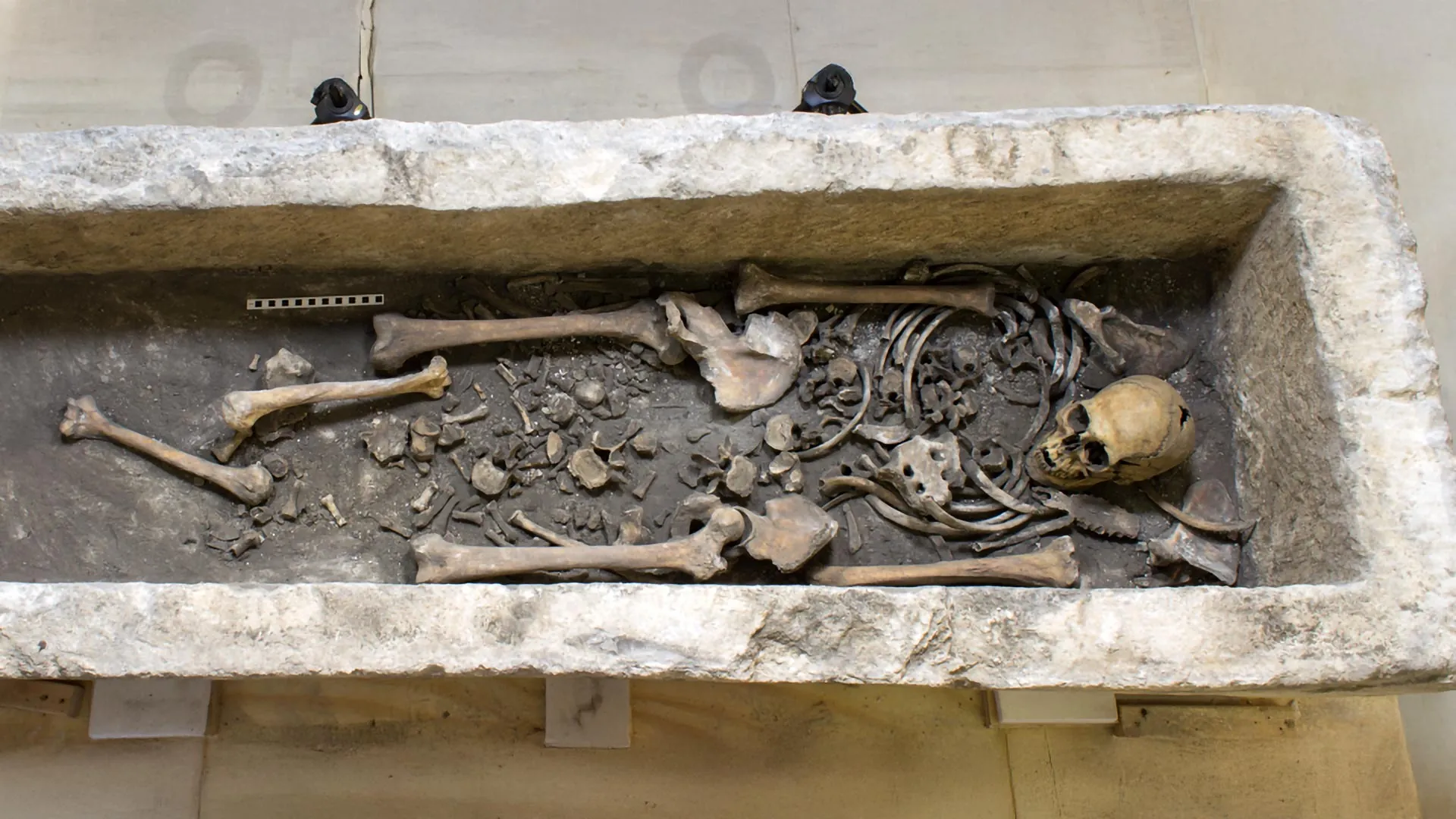
A 1,000-year-old skeleton resting inside a Roman stone coffin at Westminster Abbey may belong to one of two medieval abbots. The coffin was made for a man named Valerius Amandinus, but its later occupant appears to have lived centuries after him.
The limestone sarcophagus was formally excavated in 1869, though workers had stumbled upon it in 1820. Its inscription names Amandinus, a wealthy Briton who lived in London sometime between 300 and 400 AD. Yet a large Latin cross carved into the lid is thought to date from around the 10th or 11th century. That mark hinted that the coffin had been reused, leaving researchers with a question: who was placed inside?
New research by Warwick Rodwell, a consultant archaeologist at Westminster Abbey, narrows the possibilities to Aelfwig and Wulnoth, two men who led the Abbey when it was a Benedictine monastery. Rodwell’s findings appeared in the peer-reviewed Journal of the British Archaeological Association. He considers Aelfwig, who died around 1020, the stronger candidate. Aelfwig had been a monk at Westminster before becoming abbot. Wulnoth succeeded him and died in 1049. Both are believed to have been buried at the Abbey.
“We have two viable contenders for the occupant of the sarcophagus,” Rodwell said. He noted that Aelfwig’s earlier connection to the Abbey might give him an edge, but the evidence does not yet settle the question.
A fresh examination of the bones offers clues about the person’s age and build. James Young Langthorne, a human bone specialist at Pre-Construct Archaeology, found that the remains belonged to a man between 35 and 49 years old, about 5 feet 9 inches tall. An assessment from the 1800s had described him as a “robust young man” no older than 30 and about 5 feet 7 inches tall.
The most important clue came from radiocarbon dating. A bone sample tested at the Scottish Universities Environmental Research Centre gave a date range of 987 to 1052 AD. That places the burial in the late Saxon period and fits the lifetimes of both abbots. It also confirms that the Roman coffin and its lid were adapted for a new burial around 1,000 years ago.
The burial itself suggests the man was important. Rather than having a new stone coffin made, those who buried him placed his wooden coffin inside the Roman sarcophagus and carved a Christian cross into its lid. Rodwell believes the man was honored with a fine coffin, a distinction that would suit an abbot. The reuse also shows how an old, valuable object could be given a new purpose.
The research draws on several investigations, including work connected to Channel 4’s Time Team in 2009. Pre-Construct Archaeology completed a further excavation of the Abbey’s sacristy in 2025, ahead of construction of the King Charles III Sacristy, scheduled to open the following year. For now, the bones point to a likely identity rather than a final answer. Aelfwig remains Rodwell’s leading candidate, while the coffin continues to connect Roman London with the medieval monastery that grew up around it.