Latest News
Positive stories from around the world · Good news by country
Showing 2377–2400 of 37359 articles
Low-power 2D CFETs using single-crystal high-<i>κ</i> dielectrics
A transferable layer of single-crystal titanium dioxide created a high-quality interface with 2D semiconductors. The devices switched close to ideally and showed little signal lag. The team used them to make complementary transistors and inverters designed for very low power use.
Proposed approach for diagnosing obesity outperforms old method
An international study tested a proposed way to diagnose obesity in 844,108 adults. The approach includes waist measurements and related measures, rather than relying mainly on body-mass index (BMI). It also separates clinical obesity, which affects organ function, from preclinical obesity. Researchers found it better at diagnosing obesity and sorting people by their risk of death.
A plant RNA-binding protein senses 2′,3′-cNMP produced by insect effectors
A study in Nature reports that rice protein NIB1 detects small molecules made when insect saliva enzymes break down RNA. NIB1 then forms clusters in the cell nucleus and recruits another protein to trigger plant defenses. The finding reveals a messenger-based immune pathway in plants. The work could guide future ways to protect crops, though no field results are reported.
Human replisomes direct a dedicated leading-strand primase for fork restart
A study in Nature reveals how human cells can restart DNA copying when it stalls. The CMG helicase brings in an enzyme called PRIMPOL, which starts copying the leading DNA strand again. This can help reduce gaps left behind after copying. The finding adds detail to how cells protect and maintain their DNA.
Salty grains in Saturn’s outermost ring formed from the slow freeze of plumes from the moon Enceladus
A study proposes that salty grains in Saturn’s outermost ring began in plumes from the moon Enceladus. As the icy spray slowly froze, it may have formed grains with different mixes of salt, ice, and rock. The idea offers a possible explanation for the ring’s varied materials. The short article does not give measured amounts or confirm the process.
Non-halogen aqueous electrolytes for four-electron iodine conversion
Researchers report a water-based battery electrolyte that contains no halogens. It enables iodine to switch reversibly through a four-electron reaction, a process that may support better battery chemistry. The team tested the approach in metal–iodine batteries. The article excerpt gives no performance figures or research location.
Extraordinary materials shaped by the principles of complex networks
Complex network science is inspiring new material designs. Some materials spread the effects of force instead of concentrating them in one spot. Their stiffness can be tuned, and they can control how vibrations travel. These features could support new ways to build and manage materials.
Bistable regulation of adipocyte heterogeneity governs thermogenesis
A Nature study describes how immune cells help regulate brown fat. Neutrophils and macrophages release IL-1β, a signaling molecule that keeps nearby brown fat cells in a low-UCP1 state. Cold activates sympathetic nerves and lowers IL-1β, moving cells toward a high-UCP1 state that produces more heat. Warmer conditions have the opposite effect.
DeepMind's ultra-powerful AI for genome mapping wows scientists
DeepMind introduced AlphaGenome 2, an AI tool for studying DNA. It can predict the types of cells where a DNA variant is likely to act. This may help researchers understand how genetic changes affect the body. The report gives no performance figures or confirmed medical uses.
Independent interferometric observable confirms black hole shadow in M87*
Researchers used a new method to study radio telescope data for M87*. The method recovered the black hole's ring-like shadow and estimated its mass. It does not rely on the usual calibration and image-making assumptions, offering an independent check of earlier findings.
Glycosylation and importins liquefy the FG barrier in live nuclear pores
A Nature study describes how proteins in nuclear pores keep their barrier fluid and organized. Sugar molecules and importins, proteins that carry cargo, work together to shape this barrier. The result helps explain how cells select what can enter and leave the nucleus, and may resolve competing ideas about pore structure.
Suppression of epithelial proliferation and tumorigenesis by IgA
Experiments in mice found that immunoglobulin A, or IgA, in the gut helps regulate the renewal of colon lining cells. Mice with this immune protein were less likely to develop colorectal cancer. The results point to a possible link between gut immunity and cancer risk, but they do not show that IgA prevents cancer in people.
Metasurface waveguides for all-day augmented reality glasses
A prototype uses two layers of tiny optical patterns, called metasurfaces, to guide images into the eye. Three matched grating patterns help it show a 30-degree field of view. The viewing area is 8 by 8 millimeters, with high light efficiency. The advance could help make augmented reality glasses easier to wear all day.
The molecular basis of replication fork restart via repriming by PRIMPOL
A Nature study explains how PRIMPOL helps restart DNA copying when replication stalls. It works with the cell's replication machinery, then passes the primer to polymerase epsilon, a more accurate enzyme. This handoff may limit mutations during DNA copying.

Li Ka-Shing Backs Asia’s First Kidney Cancer Trial of Ultrasound Treatment - Caixin Global
Billionaire Li Ka-Shing's foundation is paying for Asia's first clinical trial of histotripsy for kidney cancer. Histotripsy uses ultrasound sound waves to break down tumors from outside the body. No scalpels or needles are needed. The foundation will fund 30 patients to take part in the study.
Biotech innovations are an opportunity to limit climate change
Agricultural biotechnology was once seen as at odds with environmental science. The article argues that new biotech tools could reduce the climate and nature harms caused by food production. It presents biotech as a possible way to make farming and food systems more sustainable, though the brief does not name specific tools or results.
How I balance my life as a professional surfer and a university researcher
Cliff Kapono describes how he manages life as a professional surfer and university researcher. He offers advice on growing two careers at once. The brief description does not give specific research findings, outcomes or locations.
Hideki Shirakawa obituary: chemist who showed that plastics can conduct electricity
Hideki Shirakawa’s work revealed that some plastics can conduct electricity. The discovery opened a new field of materials research. These materials later found uses in light-emitting diodes, or LEDs, and solar cells. The article is an obituary for the Nobel Prize-winning chemist.
Brilliant Noskova dismantles Gauff to reach WTA Finals last four
Linda Noskova defeated Coco Gauff at the WTA Finals in Riyadh. The win made Noskova the first player to secure a place in the last four. The short report does not give the score or match date.
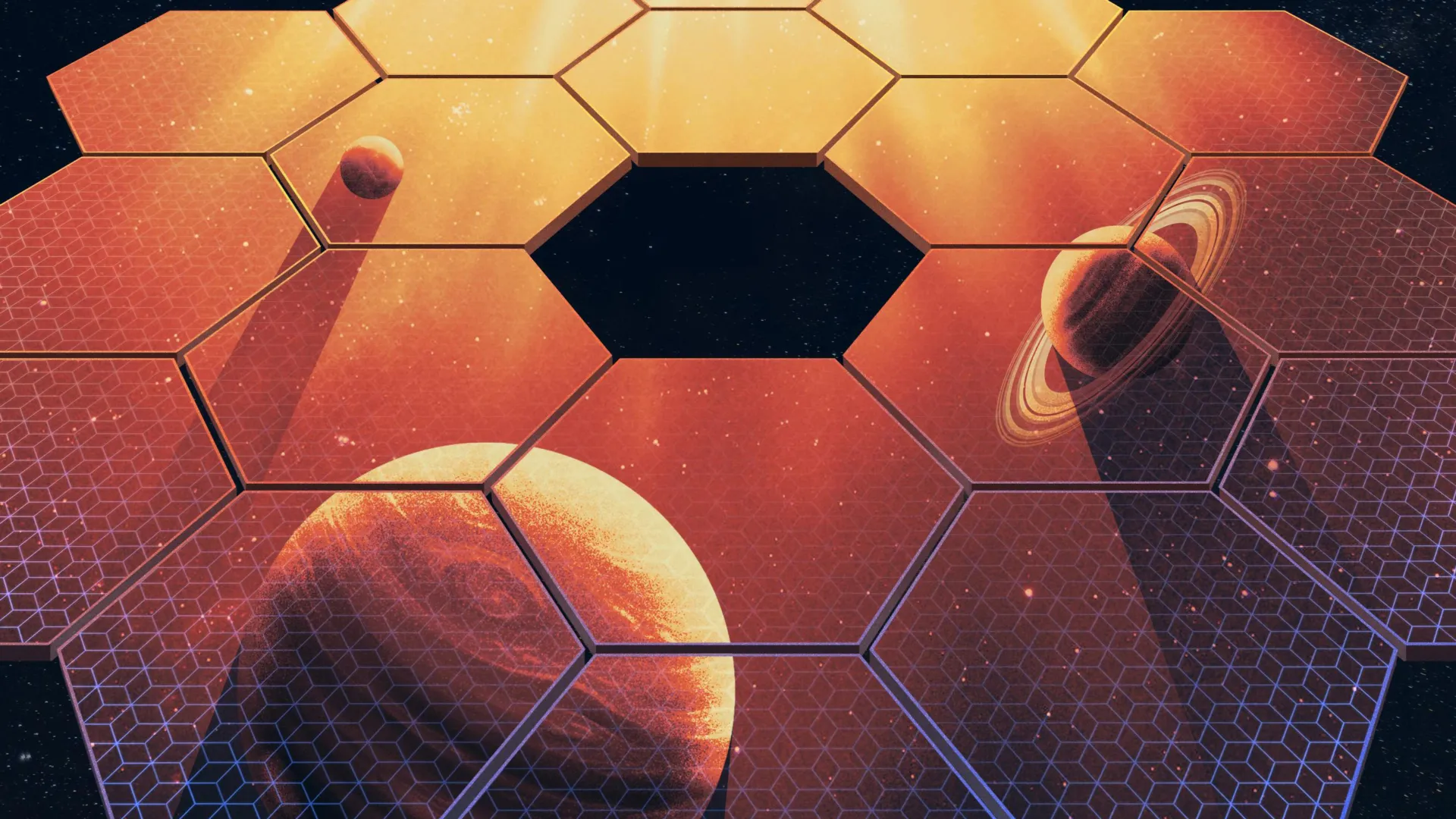
Astronomers discover hidden alien planet in James Webb images
Scientists created a digital copy of the James Webb Space Telescope to remove the glare from bright stars in its images. The method makes faint exoplanets 2 to 15 times easier to detect than older methods. It has already found a planet hidden in existing data and may help uncover many more.

Scientists anchor first scientific animal name to a modern-day spider
The original specimens that defined Araneus angulatus disappeared sometime between 1858 and 1965. Scientists compared new spiders from Sweden with old descriptions and drawings, then checked their identity using DNA. They named one specimen as the new official reference, linking this historic species name to a physical spider again. It will be kept at the Swedish Museum of Natural History.

Gamma radiation transforms brittle bioplastic into 'superstructure' hydrogel
Researchers at the University of Queensland made a new hydrogel from PHB, a bio-derived plastic that is usually brittle. They used gamma radiation to attach a hydrogel-forming polymer, making the material tougher and able to absorb water. Possible uses include wound care, drug delivery and surgical tools. The team says more research is needed, especially to test whether the new material biodegrades.

UK regulatory systems for food and drink identify only around half of processed/ultraprocessed products as unhealthy
Researchers found that current UK systems identify only about half of processed and ultra-processed foods high in fat, salt, sugar, or energy as unhealthy. A new scoring method based on official dietary advice flags more than 90%. The study says one shared system could help regulators apply clearer, consistent rules.
[Comment] A digital intervention to strengthening parenting in Tanzania
A Lancet commentary discusses a digital program that supports parents in Tanzania. The program aims to stop child abuse and neglect before it starts. Child abuse is linked to lasting health problems and to violence against women later in life. Researchers say parenting support is a promising way to prevent it.