Latest News
Positive stories from around the world · Good news by country
Showing 34129–34152 of 37370 articles

By cutting selected synapses, brain circuit 'editing' could make memory stronger and rewire how learning works
Scientists in Korea built a new tool called SynTrogo that acts like a tiny editor for the brain's wiring. The tool tells brain support cells called astrocytes to nibble away weak connections between neurons in a specific circuit. When researchers tested it on a memory region in mice, cutting 27% of synapses paradoxically made memories form and stick better. The remaining synapses grew larger and stronger, boosting long-term potentiation—a key brain process for learning.
Positive Results From the Phase 2b Study of BPL-003 in Patients With Treatment-Resistant Depression | Psychiatric Times
Beckley Psytech's BPL-003 drug succeeded in a Phase 2b trial for people with treatment-resistant depression. A single 8mg or 12mg dose produced rapid and lasting symptom improvement. The drug showed favorable safety with minimal side effects. Researchers say the treatment could offer new hope for patients who have not responded to existing therapies.
How telehealth is reshaping access to mental health care in America | Health | mesabitribune.com
Telehealth is changing how Americans get mental health care. Digital therapy platforms let people meet with counselors from home, removing old barriers like distance and high costs. The technology also helps reduce the stigma some people feel about seeking mental health support. More people can now get the help they need without traveling far or spending a lot.

Bolivian mummy rewrites scarlet fever's past, suggesting killer bacterium circulated centuries before colonization
Researchers in Bolivia uncovered scarlet fever bacteria in a naturally mummified tooth dating back 700 years. The discovery shows the disease-causing germ was circulating among indigenous people long before Columbus arrived. Scientists used a special DNA method to rebuild the ancient bacterial genome from tiny fragments. The well-preserved genetic material came from a young man who lived between 1283 and 1383 AD on the Bolivian Altiplano.

Novel brain architecture simulated for fast and flexible decision-making
Scientists in the Netherlands created a new computer model of the brain that uses two pathways working in parallel. Most AI today only copies the slow, layered part of the brain called the cortex. But this new model also includes faster subcortical regions, like a shortcut for simple decisions. Testing showed the model can handle both quick reflex-like choices and more complex tasks. The researchers say this design could make future AI smarter and more like a real brain.

3D brain tumor organoids provide new scientific opportunities for research community
Scientists at St. Jude Children's Research Hospital in Memphis have developed 3D brain tumor models called organoids. These tiny lab-grown tumors accurately copy the real tumors they came from, including medulloblastoma and other childhood brain cancers. Traditional research models can take months to develop and cost a lot. These new organoids work faster and are now available to researchers everywhere for free.
'He's done it!' - Diaz scores stunner to earn Bayern late win
Bayern Munich secured a dramatic 2-1 victory over Real Madrid at the Bernabeu stadium in Madrid on Tuesday. The win came in the first leg of their Champions League quarter-final tie. Colombian forward Luis Diaz scored the winner with a powerful strike from the edge of the box. Madrid had been reduced to 10 men earlier in the match, making Bayern's late winner even more surprising.

E-cigarette taxes reduce vaping without increasing adult smoking, new study finds
Ohio State University researchers studied 700 US adults who vape and found that higher e-cigarette prices cut purchases by 30-33% at mid-range prices and 49-51% at the highest prices. The study found no evidence that pricier e-cigarettes led adults to switch to regular cigarettes. The researchers suggest tiered tax designs could be more effective than one-size-fits-all taxes.

Color test 'sniffs out' dangerous staph strains fast
Australian scientists at RMIT University have developed a rapid color-changing test that spots dangerous golden staph bacteria in minutes. The test uses tiny gold particles (acting like artificial enzymes) combined with DNA molecules to create unique color "fingerprints" for each strain. This helps doctors quickly identify which infections are most aggressive and hardest to treat. Golden staph causes over a million deaths worldwide each year, making fast, accurate diagnosis crucial for saving lives.

Machine learning accelerates analysis of fusion materials
Researchers at Oak Ridge National Lab in Tennessee are using AI to solve a big problem in fusion energy research. They trained a machine learning model on 3,200 scanning electron microscope images of tungsten samples damaged by extreme heat. The AI learned to create new fake but realistic images showing cracks, pores, and other damage patterns. These virtual images let scientists run experiments on a computer instead of in expensive labs, helping design longer-lasting fusion reactor parts.
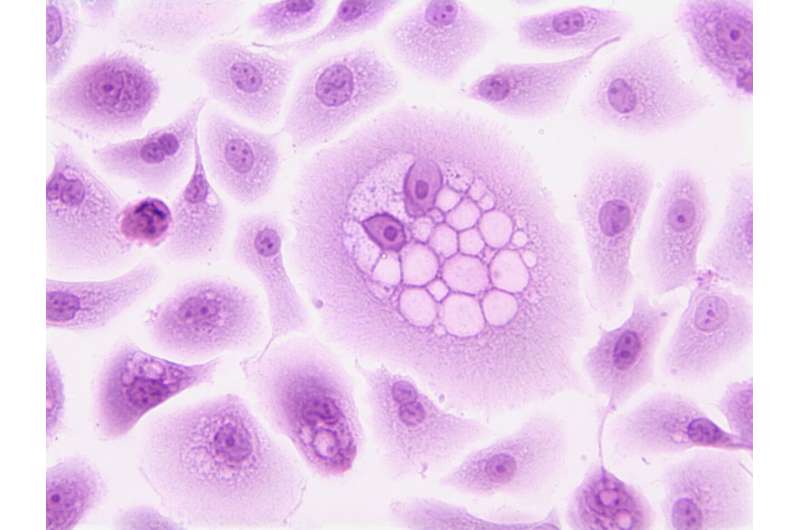
A major cancer protein hijacks RNA editing, exposing a new weakness in prostate tumors
Northwestern Medicine scientists discovered that EZH2—a protein already linked to cancer—also controls RNA editing in prostate tumors. This editing process lets cells alter genetic messages after they're created. The team found EZH2 works with another protein called ADAR1 to change which RNAs get edited, helping tumors grow. By removing ADAR1, cancer cells became much more vulnerable to drugs that degrade EZH2, suggesting a two-pronged attack could work better.

Quantum simulations reveal spin transport in 1D materials
Scientists at Oak Ridge National Laboratory have achieved a first in quantum physics: using a quantum computer to simulate how 'spin' travels through 1D materials. The team ran a 40-qubit simulation on IBM's Heron quantum processor to model the Heisenberg quantum system. This method lets researchers watch spin form and flow in real time, rather than guessing from indirect measurements. The work demonstrates that today's quantum computers can tackle real materials science problems previously out of reach.
Arsenal through to semi-finals with cagey draw against Sporting
Arsenal played out a goalless draw at home against Sporting Lisbon in the Champions League quarter-final. The cagey match saw neither team score, but Arsenal's first-leg advantage was enough to see them through. The Gunners now advance to face Atletico Madrid in the semi-finals. The performance was described as unconvincing by observers.
How PSG's 'engine room' were the key to Liverpool win
PSG secured a 2-0 victory over Liverpool at Anfield, completing a 4-0 aggregate win in the Champions League quarter-finals. The French champions will now face Arsenal in the semi-finals. BBC pundit Stephen Warnock praised PSG's midfield trio of Joao Neves, Vitinha and Warren Zaire-Emery as "the best three midfielders in the world". PSG dominated both legs, with Liverpool failing to score across 180 minutes.
Atleti hold off Barca comeback to reach semi-finals
Atletico Madrid have progressed to the Champions League semi-finals after a dramatic 3-2 aggregate victory over Barcelona. Despite losing the second leg 2-1 at home, their 2-0 first-leg win proved decisive. Barcelona played most of the second half with ten men after a red card. This result ends Barcelona's Champions League campaign for the season.

Community garden project gets underway in area | News, Sports, Jobs - Times Observer
Warren County Conservation District in Pennsylvania is offering garden plots for $25 at Hatch Run Conservation Demonstration Area. Each plot measures 25 by 25 feet and comes with free water from rain barrels. Gardeners must use only biodegradable methods like newspaper or straw to control weeds. The program makes gardening possible for families without yard space.

New anti-clotting medication lowers risk of stroke without added bleeding
Scientists have developed a new drug that could change stroke prevention forever. The international trial showed that asundexian reduced the chance of another stroke by 26% compared to a placebo. Most importantly, unlike existing treatments, it did not increase dangerous bleeding. Researchers called this a breakthrough that doctors, patients, and families have been waiting decades for. The drug works by blocking a protein called Factor XIa, which helps form harmful clots but plays only a small role in bleeding.

Emerging in Alaska, dominant H5N1 strain spread continent-wide through migratory birds
An international team led by St. Jude tracked a new strain of bird flu (H5N1 D1.1) spreading across North America in 2024. The strain first appeared in Alaska, then moved south and east via migratory bird routes. The researchers found existing vaccine stockpiles will likely protect humans if needed. They also classified the virus as low risk for human-to-human spread in its current form.

Ancient charcoal sheds new light on how early humans fueled their lives
Researchers examined charcoal fragments from a single occupation layer at Gesher Benot Ya'aqov, an archaeological site in northern Israel where Acheulian hunter-gatherers lived approximately 780,000 years ago. By studying 266 charcoal pieces using microscopic techniques, they identified the remains of at least 14 plant species including ash, willow, grapevine, oak, and pistachio. Most surprisingly, they found pomegranate charcoal—the earliest evidence of this fruit tree in the entire Levant region.

Watching junk food videos may help dieters resist snacks, experiments show
Scientists at the University of Bristol discovered that viewing social media videos of unhealthy foods helps dieters control their appetite, contrary to popular belief. In three experiments with 840 participants aged 19 to 77, researchers found that people watching their weight spent more time looking at indulgent treats like chocolate desserts. However, these dieters later ate significantly less chocolate when offered the real thing.

For future heart health, body fat in late teens may be more important than during childhood
Researchers tracked 1,803 children from age 9 to 24 using gold-standard DXA body scans and heart imaging. The study found that body fat gained between late adolescence and early adulthood predicts declining heart health by young adulthood. Crucially, fat accumulated during childhood showed no harmful heart effects. Age 17 emerged as a turning point when fat accumulation begins damaging the heart—possibly because teenagers often leave home around this age, changing diet and lifestyle.

Ancient seabird guano reveals how climate change may shape future populations
Researchers have developed an innovative method to study seabird populations by analyzing mercury levels in ancient guano trapped in peat on Bird Island, South Georgia. They found that the first seabird colonies were established between 6,800 and 6,100 years ago—over 1,000 years earlier than previously believed. Four major periods of population growth coincided with weaker Southern Hemisphere westerly winds.

Why this single-chip LED advance could shrink AR glasses and boost quantum links
Scientists in Japan created a special LED that makes circularly polarized light from a single tiny chip. Old designs could only convert half the light into the right form, but this new design reaches 68% efficiency by using a patterned silicon nitride surface on top of an indium gallium nitride LED. The device works at room temperature and is made of durable inorganic materials. The team says this breakthrough could help build smaller AR glasses, better 3D displays, and more secure quantum communication networks.

New method advances efforts to overcome bias in AI tool for children with anxiety
Researchers at Cincinnati Children's Hospital have found a way to make AI tools fairer for children's mental health. Their study of nearly 20,000 pediatric anxiety cases revealed that AI models were more likely to miss anxiety in female adolescents. The team discovered that clinical notes about male patients averaged 500 words longer, which influenced how the AI learned. By adjusting the training data—using gender-neutral pronouns and removing less informative text—they reduced diagnostic bias by 27% while keeping accuracy high.