Latest News
Positive stories from around the world · Good news by country
Showing 385–408 of 37342 articles

Quantum ingenuity can sidestep limits of conventional chips—while using commercially accessible components
Researchers at the University of Maryland are working on quantum computers that use light. Their chips can be made in the same factories that build everyday electronic chips, which could lower costs. In 2024, the team showed that one small device can handle many qubits, the basic units of quantum information. They did this by using extra "synthetic dimensions" inside the light itself.
China launches Shenzhou 24 spacecraft carrying 2 Chinese and a Pakistani astronaut
China launched the Shenzhou 24 spacecraft carrying three astronauts. One of them is from Pakistan, the first foreign crew member sent to China's space station. This marks a new step in international cooperation in space.

Prior authorization limits help expand opioid addiction treatment where approvals were a frequent roadblock, study finds
State laws that limit prior authorization rules helped more people get opioid addiction medicine. Prior authorization means a doctor must get insurance approval before a patient gets a drug. A new study led by University of Michigan researchers found that buprenorphine use in Medicaid rose after these laws. The gains appeared only in states where approval rules had often blocked patients.

Laser light reveals where electrons accumulate in atomically thin semiconductor stacks
Researchers in Japan studied a tiny diode made from two atomically thin semiconductor layers. A diode is a part that keeps electricity flowing in one direction. Using a laser and measuring the light the device gives off, they found exactly where electrons collect. Their method is harmless to the device and could help design more efficient, low-power electronics.

Underwater robots reveal first salp species known to live exclusively in deep sea
Salps are barrel-shaped sea animals that help move carbon through the ocean. Researchers at MBARI, a marine research institute, used underwater robots to study a deep-sea salp first seen more than 20 years ago. The glass salp, Vitreosalpa gemini, lives between 280 and 2,200 meters deep. It is the first salp found only in the deep sea.
China's Shenzhou-24 lifts off with Pakistan's Zeeshan Ali on board - World - DAWN.COM
Pakistan's Zeeshan Ali launched to China's Tiangong space station on the Shenzhou-24 spacecraft. He is expected to spend about a week in orbit. The Chinese crew plans around 90 experiments during the mission. The team will also swap crews with the earlier Shenzhou-23 mission and maintain the station.

Myanmar earthquake reveals how fault history could help anticipate future slip
Scientists studied the 2025 magnitude 7.8 earthquake near Mandalay, Myanmar. They used supercomputers to run 180 computer models of the quake. The models matched real data from GPS, satellites, and seismic recordings. The work shows that some features of future large quakes can be predicted from fault history.

FDA approves bezuclastinib in combination with sunitinib as new second-line therapy for patients with GIST
The U.S. Food and Drug Administration (FDA) has approved a new treatment for adults with advanced gastrointestinal stromal tumors (GIST). GIST is a rare cancer that forms in the stomach, small intestine, and large intestine. The drug combination is bezuclastinib plus sunitinib, given after the first drug, imatinib, stops working. In a trial of 413 patients, the combination cut the risk of tumor growth or death by 50%, and more patients responded to treatment.

New workflow advances programmable chromosome editing in plants
Researchers at the Chinese Academy of Sciences published a detailed protocol in Nature Protocols. It explains how to make precise changes to large sections of plant chromosomes. The method leaves no leftover marks in the DNA. It could help scientists breed better crops faster.

Species down to the last 50 animals can recover, but rarely without help
A study looked at 141 species that were down to 50 animals or fewer. It found that recovery is possible, but it rarely happens without human help. The Mauritius kestrel fell to just four wild birds in 1974. Captive breeding, predator control, and releases brought its numbers back into the hundreds.

Catalysts come alive—electron microscopy reveals the secret dynamic life of nanoparticles
Researchers at the University of Nottingham and Cardiff University tracked individual catalyst nanoparticles, tiny particles that speed up chemical reactions. They watched them as they turned carbon dioxide into methanol, a clean fuel. The particles move, merge, grow, shrink and wrap themselves in thin protective shells with tiny pores. The findings could help scientists design better catalysts for sustainable fuel production.

Coastal areas in England at risk of erosion to receive £11m in new funding
The UK government is giving more than £11m to 12 council-led projects in England. The projects aim to spot coastal erosion earlier, where the sea wears away land and cliffs. Plans include laser drone surveys, restoring sand dunes, and moving roads inland. The goal is to help residents prepare before their homes are lost.
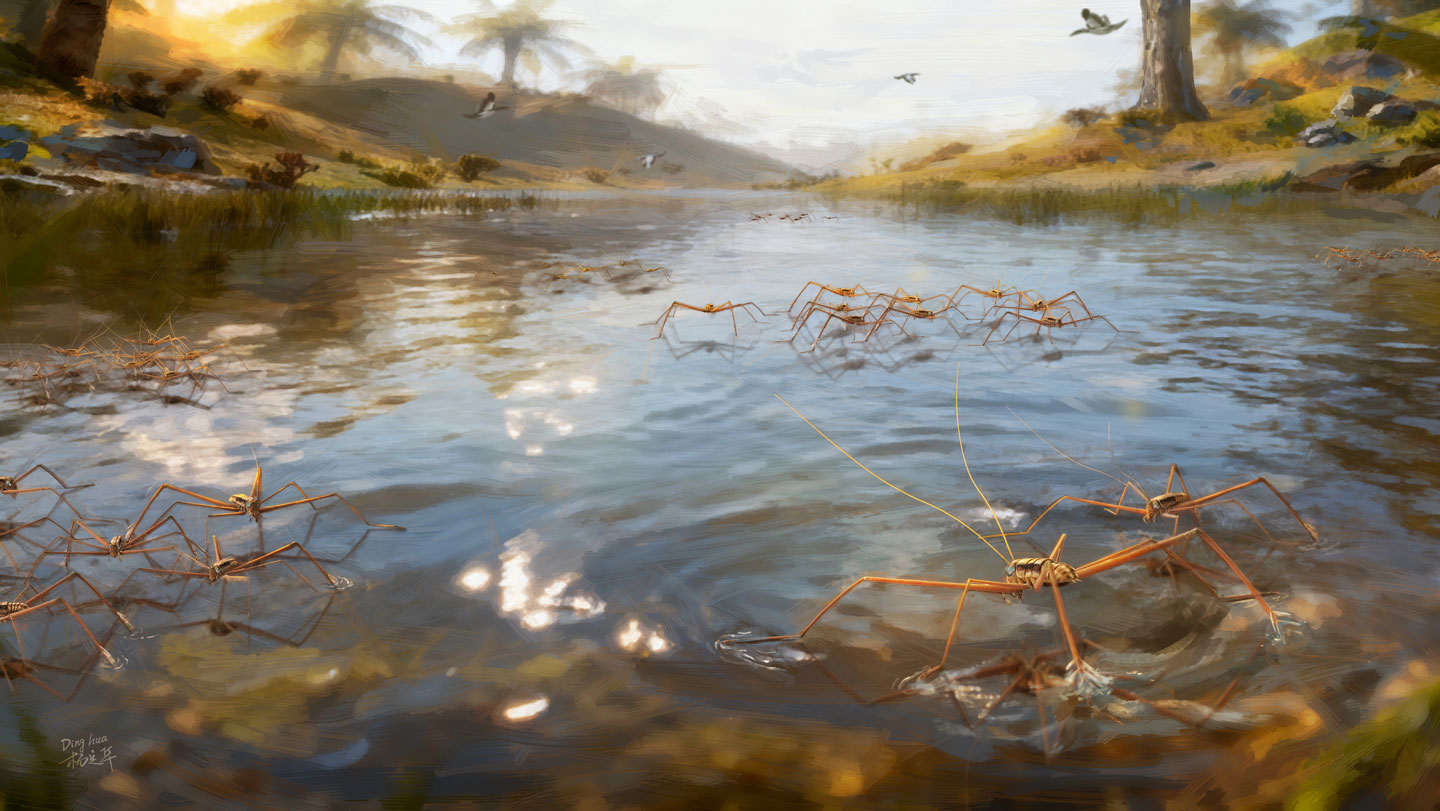
Extinct, long-legged grasshoppers walked on water alongside dinosaurs
Tiny clues trapped in 99-million-year-old amber, which is hardened tree sap, reveal something surprising. Scientists think extinct long-legged grasshoppers could sit on water and paddle across it. They lived alongside dinosaurs. The find shows how ancient insects moved on water long before today's species did.

Miki Kawamura: a 19-year-old’s peace network brings ice cream to a Nobel summit
Miki Kawamura, a 19-year-old from Japan, started the Youth Peace Ambassadors network in June 2025. It now has more than 2,000 members aged 14 to 30 in over 100 countries. At the 20th World Summit of Nobel Peace Laureates in Rome, her PeaceCream pop-up lets visitors build ice cream cups that stand for values like love, hope, and compassion.

Reducing or quitting smoking linked to lower risk for developing psoriasis
Researchers in South Korea studied 1,536,170 current smokers using national health records. People who cut down or quit smoking were less likely to develop psoriasis, a long-lasting skin condition. In a follow-up check, quitters had a 42% lower risk for the palm-and-sole form of the disease. Doctors are now urged to counsel patients on both quitting and cutting down.
London’s people-first approach to smart-city development
London is using digital twins, which are virtual 3D copies of the city, to plan better services. Open-data platforms also share city information freely with the public. The aim is to use new technology in ways that help citizens directly.
The leading cities in the world for high-quality research in 2025
Nature has published a ranking of the leading cities for high-quality research. It is based on a decade of data from the Nature Index, which tracks published science papers. The list shows which cities produce the most influential scientific work. The article gives no specific numbers in the provided text.
Helsinki puts trust at the heart of its smart-city model
Helsinki, the capital of Finland, is building a smart city that people can trust. The city shares open data so anyone can see how it is used. It also reuses heat from data centres to warm homes, and it keeps a public register listing the AI tools it uses. Together, these steps aim to make city technology fair and responsible.
The world has a golden chance to improve HIV prevention: don’t squander it
Generic versions of an effective HIV drug have now been approved, making it easier for more people to get it. An HIV vaccine is also on the horizon. A Nature editorial says funders must keep pushing rather than step back. The message is that this is a rare chance to cut new HIV infections.
A powerful HIV vaccine is finally within reach — thanks to these super antibodies
Scientists have found powerful antibodies that can respond to many different strains of HIV, the virus that causes AIDS. These "super antibodies" have renewed hope for a vaccine. Major hurdles still stand in the way before one can be made.
How Singapore has turned a nation into a smart-city testing ground
Singapore is a small city-state with a single, central government. This lets it introduce digital infrastructure faster and more consistently than larger countries. The country is becoming a testing ground for smart-city ideas. The article explains how these choices shape the country's approach.
Gut microbes can adapt to our ageing bodies
A study of more than 10,000 people looked at the tiny microbes living in our guts. It found that gut bacteria gain specific gene changes, called mutations, as people get older. Very few of these changes were linked to illness, which suggests the gut may adapt to ageing in fairly safe ways.
Middle–Late Pleistocene Denisovans and unresolved <i>Homo</i> in southern China
Researchers examined fossils from southern China using tooth shape and protein analysis. Some fossils match Denisovans, an ancient human relative, while others do not. This shows that many different human groups lived in the region during the Middle to Late Pleistocene, roughly 774,000 to 11,700 years ago. The findings reshape how scientists see early human history in Asia.
Enzymatic reactions adapted to make ‘living’ chains of sugars
Scientists have adjusted enzymes, which are natural helper proteins, so they link sugar molecules in precise chain lengths. They do this by tuning how the enzymes grip the starter molecules that begin each reaction. Exact sugar chains are useful for studying how cells talk to each other and how living things work. The method could make these tools easier to produce.