Latest News
Positive stories from around the world · Good news by country
Showing 4057–4080 of 37379 articles

NASA's Voyager 1 conserves power, resolves brief communications pause
NASA's team completed a months-long effort in September to stretch Voyager 1's limited power supply. On Oct. 20, the spacecraft unexpectedly stopped communicating with Earth. Contact returned on its own after 48 hours, before the team sent troubleshooting commands.

Music paired with beats may cut stress hormone more than twice as much as pink noise
A randomized trial at Toronto Metropolitan University in Toronto tested a 24-minute listening session. Music paired with auditory beat stimulation lowered cortisol, a stress hormone, more than twice as much as pink noise. Yet people said they felt equally calm after both options. The result suggests that stress changes may not always match how relaxed people feel.
Joint Statement: The European Union and Canada building together an Alliance for the future
At the 21st EU-Canada Summit in Montreal on October 30, 2026, leaders announced the Alliance for the Future. The joint statement describes a new partnership between the EU and Canada. The excerpt does not explain its specific goals or programs, so its expected effects are not yet clear.

Marine fossils in Colombia reveal possible evolutionary transition without mass extinction
A diverse marine fossil site in central Colombia preserves animals from different stages of Earth’s history. Older Jurassic groups appear alongside newer Cretaceous lineages. Researchers at McGill University and Colombia’s Centro de Investigaciones Paleontológicas say the fossils point to a large evolutionary transition without mass extinction.

Award-winning research helps companies keep products where they're needed most
The excerpt explains the many steps in a deodorant supply chain, from sourcing materials to delivery at stores. The headline says award-winning research helps companies keep products available where needed. But the excerpt does not explain the research, its results, or its location, so the claim cannot be assessed further.

AI May Quickly Generate Ideas—but Teams of People Are Still More Creative
Cognitive scientists ran an experiment on AI, creativity, and collaboration. The article says AI can generate ideas quickly, but teams of people may still produce more creative results. The provided excerpt does not include the study's details or measures.
People snatching up homes in South African town getting its own R600 million medical school – BusinessTech
Construction began in 2025 on North-West University’s Desmond Tutu School of Medicine. The school is being built at the university’s Potchefstroom campus in South Africa. The R600 million facility is expected to become the country’s 11th medical school. It may also support the town’s property market over time.
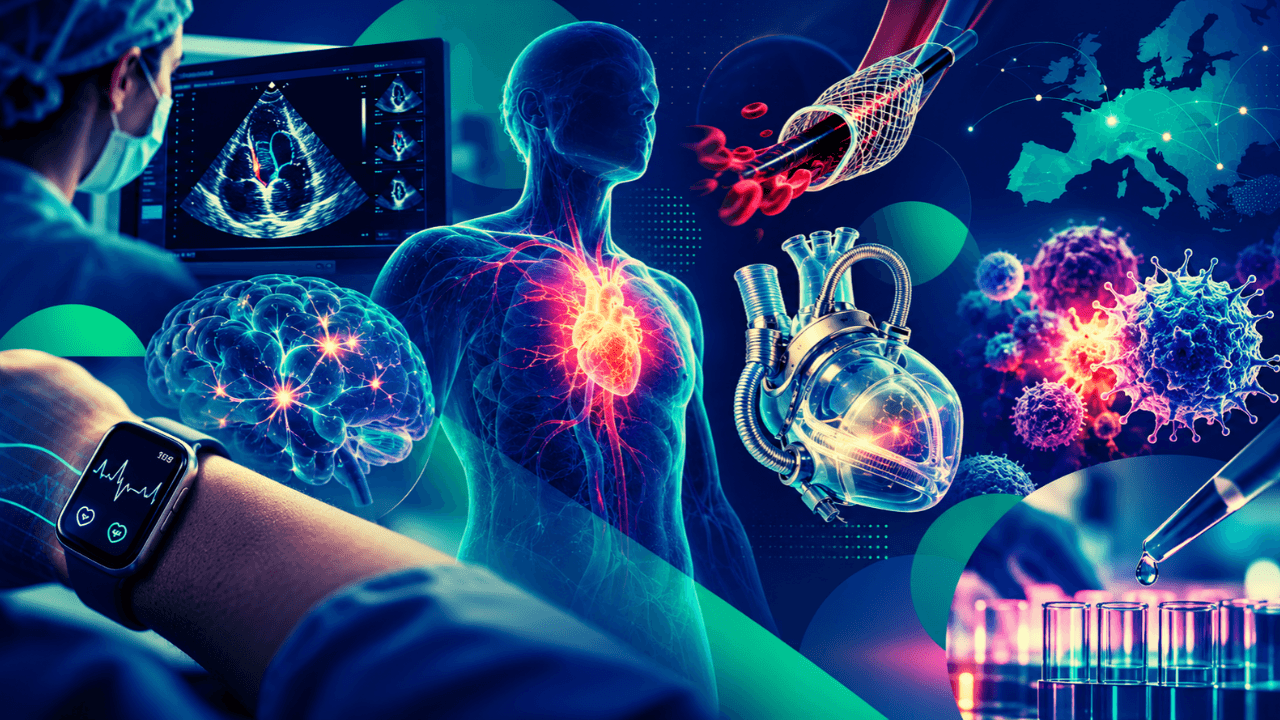
Beyond the lab: eight European healthtech scaleups taking on medicine’s biggest challenges - Tech.eu
The article profiles European healthtech scaleups working on hard medical problems. Their tools include AI software for heart scans, remote patient monitoring and new tests for gynecological disease. One firm says it has supported more than 95,000 acute patients. The companies still need clinical validation, regulatory approval and funding to reach more patients.

Review finds no evidence that testosterone improves brain fog during menopause
Researchers at University College London reviewed evidence on testosterone for thinking and memory problems during menopause. They found there is not enough evidence to know if it helps. The treatment is often prescribed in the UK, so the findings point to a need for better research and clearer advice.

Breeding advance could help protect East African rice harvests from bacterial blight
Bacterial leaf blight harms rice crops across Asia and Africa. A breeding advance may help protect East African harvests from the disease. The bacterium has many regional strains, so breeding for local resistance matters. The brief report does not name the rice variety or give trial results.

WaterPuzzle uses magnets to model water's hydrogen bonds for hands-on classroom exploration
Water's molecules connect through tiny attractions called hydrogen bonds. These bonds help explain how water behaves and how ice forms. WaterPuzzle uses magnets to model those links, giving students a hands-on way to explore the science. The article excerpt does not say where it is used or give details about its design.

Angola designates Serra do Pingano as a protected area amid rapid forest loss
Angola designated the Serra do Pingano Conservation Area in April. The move aims to protect rare forests and wildlife in Uíge province. Central Serra do Pingano lost 43% of its forest over two decades, and the wider ecosystem lost 536 square kilometers. Forest clearing for farming and charcoal remains a serious threat.
Refugee athlete to make history for second time at Youth Olympics
Yiech Pur Biel led the first refugee team to compete at the Youth Olympics. The event was held in Buenos Aires, Argentina. His participation helped bring attention to refugee athletes and their place in international sport.

Cancer-promoting proteins may make tumors easier to spot... but also help them evade immune attack
A study led by Hiroshima University examined YAP and TAZ, proteins that can help cancer grow. Their activity was linked to more tumor mutations, which may help immune cells spot cancer. It also raised PD-L2, a signal that can weaken T-cell attacks. This may help explain why some Hippo pathway changes were linked to better outcomes among 1,662 patients treated with immune checkpoint drugs.

A proof-of-concept test can spot bladder cancer in urine
Researchers tested a method that looks for RNA fragments in urine to detect bladder cancer. The early proof-of-concept work suggests urine may carry signs of the disease. More research is needed before the test can be used in routine care.

Extraterrestrial detection inspired by firefly communications could distinguish alien signals from pulsars
Researchers led by Cameron Brooks at Arizona State University built a simplified model inspired by firefly flashes. It tests how a possible alien signal could differ from regular signals made by pulsars while using little energy. The study does not search for real firefly-like signals, but offers a new way to think about what scientists might look for.
IPCC Invites Experts to Review Draft Methodology Report on Carbon Dioxide Removal Technologies, Carbon Capture, Utilization and Storage
The IPCC has invited experts to review the first draft of a new methodology report. It covers carbon dioxide removal and carbon capture, use and storage for national greenhouse gas inventories. Registration is open, and the review period runs from 2 November to 20 December 2026. The review is an early step in the report's development.

Brain circuit helps mothers wake up when their pups call
Researchers studied sleeping mother mice and females that had never cared for pups. Mother mice showed stronger brain responses to recorded pup calls. The team identified a brain pathway that appears to help trigger waking. The study offers clues about maternal sleep, but it does not yet show a way to improve sleep in human mothers.

Confirming altermagnetism: A geometric twist offers experimental proof
Researchers led by SLAC National Accelerator Laboratory found direct evidence that manganese telluride is an altermagnet. This material combines traits of two known forms of magnetism. The team observed a twist in its magnetic structure, called chirality. The discovery may help researchers develop future memory devices and other electronics.

Florida nonprofit secures $53 million to turn unused land into 100 affordable homes
Touching Miami with Love secured $53 million for an affordable housing project in Homestead, Florida. The plan is to build a five-story complex with 100 apartments on unused land. The homes will add affordable options for local residents.
Type 2 diabetes breakthrough as 54% achieve remission in just 6 months
A study found that 54% of participants under age 45 with type 2 diabetes reached remission after six months on a low-calorie diet and structured exercise plan. Only 4% receiving usual care did. The results suggest lifestyle support may help younger adults manage the disease, though the article provides no study location or sample size.
England thrash Wales to begin World Cup defence
England began defending its Wheelchair World Cup title with a 98-18 win over Wales in Wollongong, Australia. Rob Hawkins scored 11 tries and 52 points. England scored 18 tries, while Wales scored three. Ireland also set an international points record with a 110-10 win over the United States.

Long-standing Indigenous practice of adding shells to sand helps young clams withstand ocean acidification
Researchers mixed crushed shells into sand where young Pacific littleneck clams grew at UC Davis’s Bodega Marine Laboratory in California. Over 90 days, clams in shell-rich sand grew larger on average. The shells also lowered acidity in water between sand grains. Their gene activity stayed closer to clams raised in normal seawater, supporting an Indigenous practice used to care for coastal ecosystems.

Cold shower routine may reduce sick days while cutting carbon emissions
A psychologist studied whether cold showers could encourage greener habits. Participants who kept up the routine reported fewer sick days. Cold showers also use less energy than hot showers, which may lower carbon emissions. The brief article does not give study numbers or details.