Growing More Than Electrons
In the sun-drenched fields of Batangas, Philippines, something unexpected is happening beneath the gleaming rows of solar panels: lettuce is thriving.
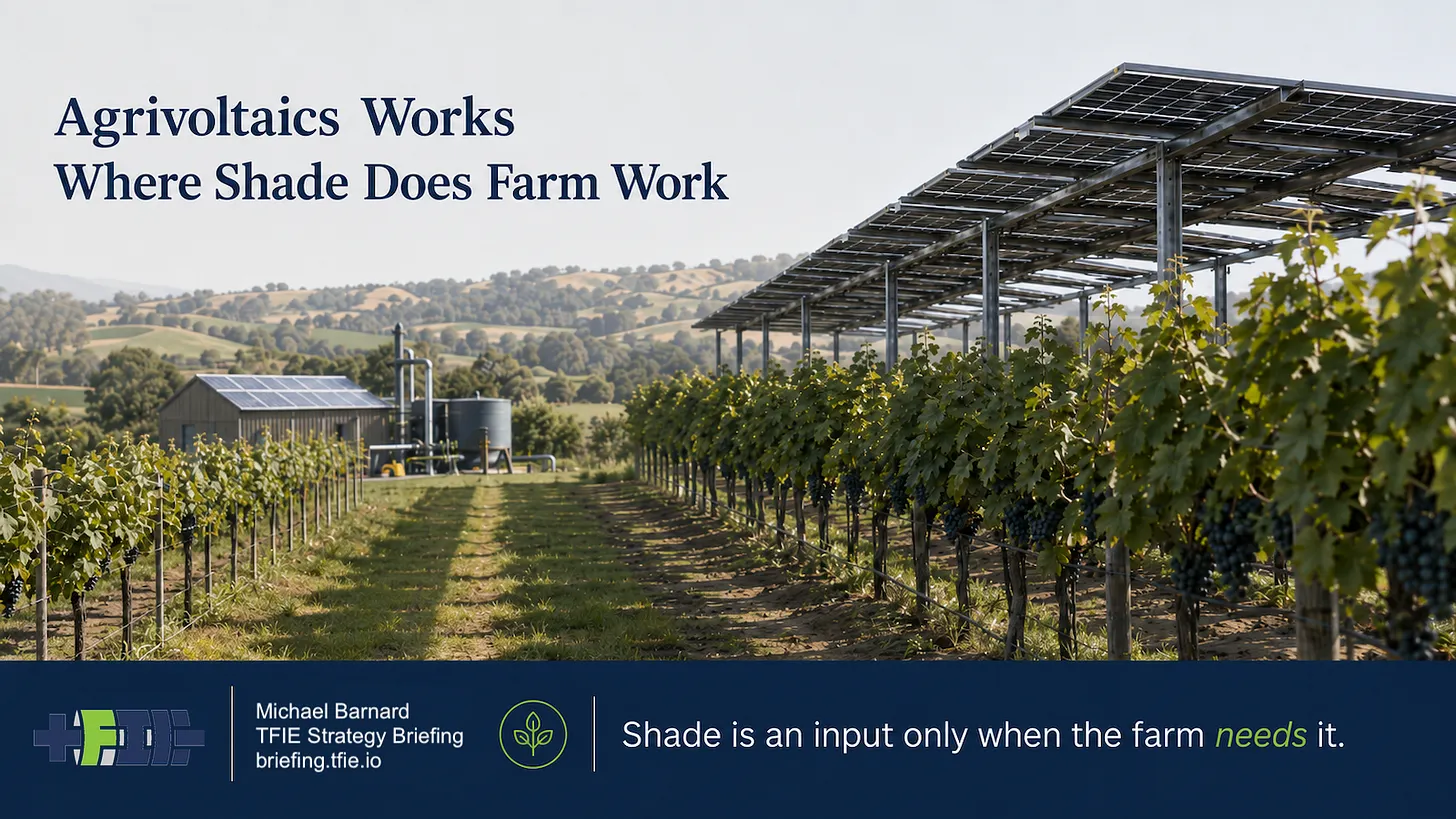
Not surviving — thriving. Citicore Renewable Energy Corporation's nearly 200-megawatt agrivoltaic facility has become Southeast Asia's largest commercial proof-of-concept that solar farms and farms don't have to be adversaries. The panels hover above crops, casting protective shade that actually improves yields during brutal summers while generating enough electricity to power tens of thousands of homes.
This convergence of food and power production is more than a clever land-use solution. It's emblematic of a broader transformation underway: clean energy is no longer just aboutpower plants and wind turbines on remote ridgelines. It's creeping into classrooms, city buses, apartment parking lots, and the spaces where people actually live and work.
Consider Long Island, New York, where Mount Sinai School District is wrapping up an ambitious solar rollout across its high school, middle school, and elementary school. By the end of 2027, rooftop panels totaling roughly 1.6 megawatts will be generating live energy data for STEM lessons while saving the district an estimated $202,000 annually. Ameresco, the infrastructure firm behind the project, projects the systems will still be performing at 87.4% capacity after 30 years — longer than many of today's students will spend in the workforce.
"We're getting ahead of the passenger car market," noted Australian Bus News when reporting that electric buses crossed the 50% threshold of new deliveries in the first quarter of 2026. The numbers tell a clear story: 9 electric buses delivered in January, 45 in February, 67 in March. By April, that figure hit 72 out of 158 total deliveries. Manufacturers like Volvo, BYD's Nexport, Yutong, and Custom Denning are scrambling to keep pace with demand that diesel shortages are only sharpening.
The New Geography of Clean Energy
The shift isn't happening in a vacuum. In Manila this June, the Asia Clean Energy Forum brought together governments, developers, and financiers at the Asian Development Bank's headquarters to confront a region at an inflection point. ADB President Masato Kanda told delegates the region faces "one of its most serious energy challenges in decades" — a reality sharpened by geopolitical fuel disruptions, AI-driven electricity demand, and the stark fact that more than 400 million people across Asia still lack reliable power.
What's striking is the tone. Asia isn't debating whether to transition anymore. The conversation has moved to how fast, how interconnected, and how intelligently the grid can manage the complexity of a renewable-heavy future. GCL, China's largest private energy producer, is operating 8.2 gigawatts of installed capacity — over 97% clean — and actively expanding into Southeast Asia. The company plans to ramp its battery storage deployments from roughly 2 gigawatt-hours per year today to nearly 16 by 2032.
The practical challenges remain substantial. Boston's Loop Global completed a 64-port Level 2 EV charging installation at a Hyde Park multifamily complex in May — a project over a year in the making from initial design through commissioning. "There aren't enough EV chargers at multifamily structures," acknowledged Rob Kutner, Loop's chief commercial officer. "It's worth reporting on some of these developments to show they are happening, just slowly."
Similarly, agrivoltaics only works, analysts caution, when solar structures genuinely perform farm functions — providing shade that relieves real agricultural constraints, protecting crops, preserving water — rather than existing mainly as a land-use narrative for electricity projects.
Building the Future in Pieces
In India, Tata Motors recently partnered with Welspun Renewable Energy on an 86-megawatt wind-solar hybrid project designed to power four manufacturing plants across Jharkhand, Uttar Pradesh, Uttarakhand, and Karnataka. The project will generate 200 million units of clean electricity annually and offset over 140,000 tonnes of CO2 each year — a concrete step toward the company's RE100 target.
These aren't headline-grabbing megaprojects or political promises. They're the unglamorous, essential work of threading clean energy into the fabric of everyday life: children learning under solar-shaded classrooms, commuters boarding silent electric buses, residents plugging in overnight without hunting for public stations, manufacturers quietly decoupled from fossil fuel volatility.
The clean energy transition was never going to be a single dramatic flip. It's a accumulation of decisions — by city councils, school boards, bus fleets, farmers, and corporations — made in the span between now and 2030. And right now, those decisions are adding up faster than ever.
Sign in to join the conversation.
Comments (0)
No comments yet. Be the first to share your thoughts.