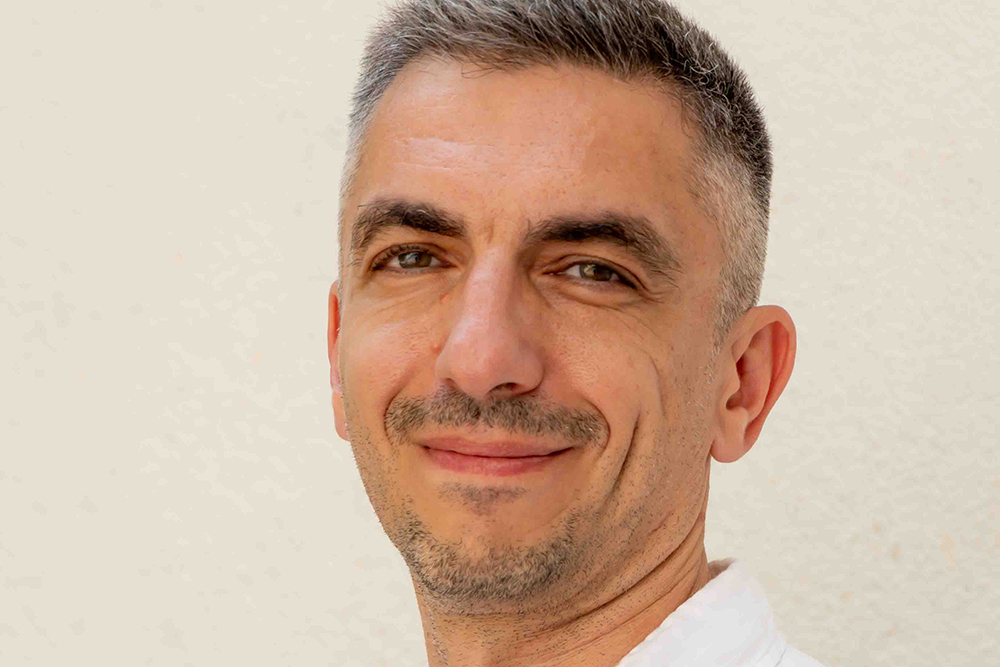
Alexander "Sasha" Rakhlin has spent more than two decades fascinated by the way machine learning weaves together statistics, probability, and algorithms. Now he will lead one of the world's key centers for advancing exactly that kind of work.
Rakhlin, a professor at MIT with a joint appointment in the Department of Brain and Cognitive Sciences and the Institute for Data, Systems, and Society (IDSS), was named director of the MIT Statistics and Data Science Center (SDSC) this month. He succeeds Ankur Moitra, who had led the center since 2021, and takes over from Philippe Rigollet, who served as interim director in 2024-25.
The SDSC brings together researchers from across MIT to tackle fundamental questions in statistics, machine learning, and artificial intelligence. Rakhlin has been part of that community since 2016, when he first joined as a visiting professor. He formally came to MIT in 2018, and went on to become the inaugural holder of the Distinguished Professorship in Data, Systems, and Society, an endowed chair created in 2025 by Richard "Dick" Larson.
Rakhlin was the initial chair of the Interdisciplinary PhD in Statistics program at the SDSC. Under his guidance, more than 75 doctoral students have successfully defended their research across a wide range of departments, from the Social and Engineering Systems program to physics and engineering.
Fotini Christia, director of IDSS, described Rakhlin as one of the sharpest theoretical minds working in statistics and machine learning today. "He has helped train an entire generation of interdisciplinary scholars," she said, "while his own research keeps pushing the boundaries."
Rakhlin earned his bachelor's degrees in mathematics and computer science from Cornell University before returning to MIT for his doctorate. He later spent time as a postdoctoral researcher at the University of California at Berkeley, then joined the University of Pennsylvania as an associate professor and co-director of the Penn Research in Machine Learning center before coming to MIT.
Looking ahead, Rakhlin said he hopes to deepen the interdisciplinary connections that make the SDSC unique. He sees statistics as a shared language across MIT that can accelerate discovery in fields from biology to nuclear fusion.
"The recent revolution in AI is extending this web into the sciences," Rakhlin said. "It promises to accelerate discovery, and it raises new questions for statistics." He believes that as AI becomes more central to medicine, energy, and public life, ensuring its safety and security will come down to core statistical and mathematical work: quantifying uncertainty, understanding failure, and resisting manipulation.
"Statistics is a shared language across MIT," he said. "The center connects students and faculty from economics and political science to physics and engineering."