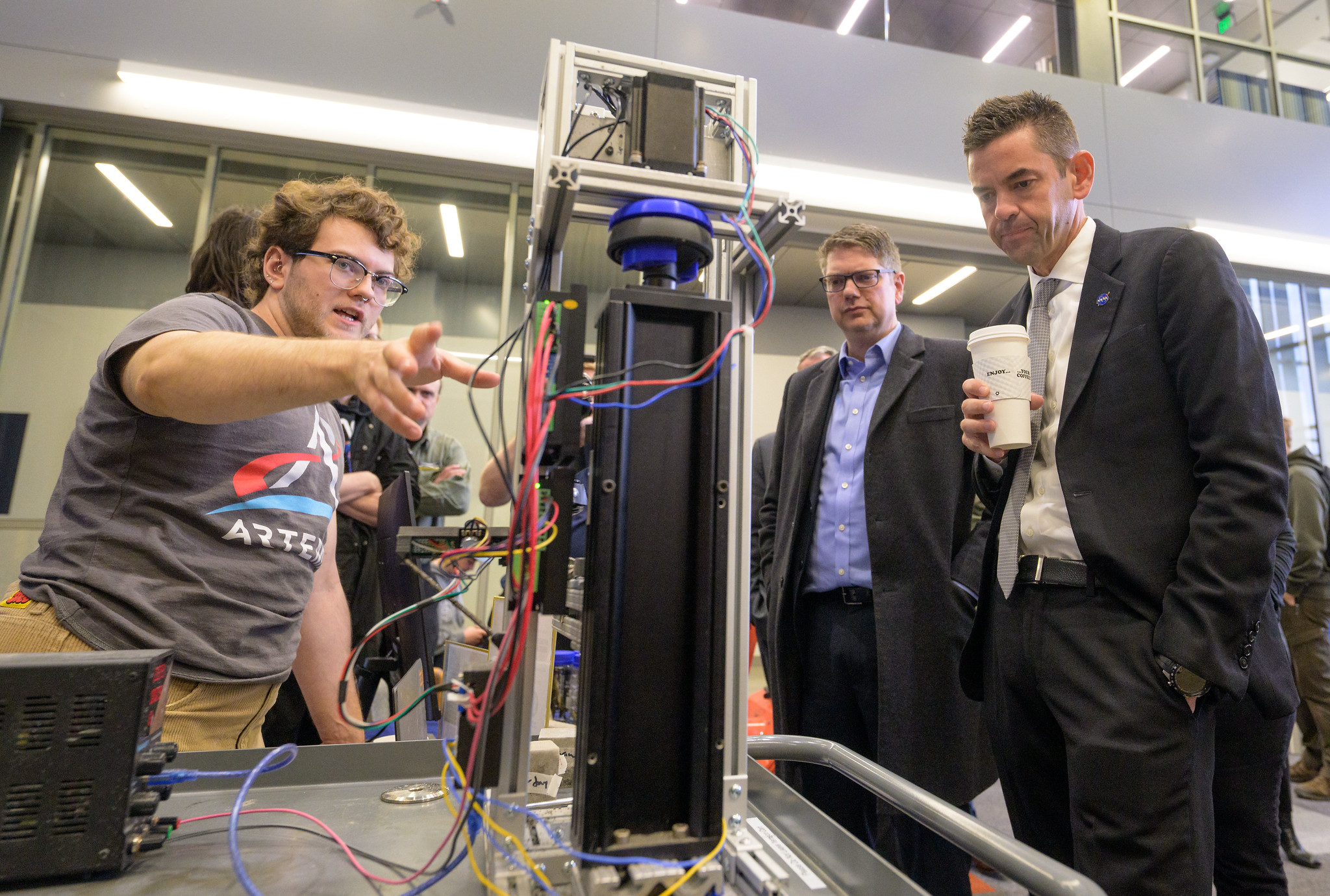
At Iowa State University, students showed NASA Administrator Jared Isaacman the machines and projects behind their space ambitions, from a student-built satellite to a team preparing to mine the Moon. Their work was part of a nationwide NASA Inspiration Tour that brought space research out of mission control and into university labs, classrooms and public events.
The tour connected students and communities with the people and technologies shaping space exploration. A key part of that effort was NASA Space Grant, a network of university-based programs that supports learning and research. The visits gave students a chance to present their work directly to NASA leaders, hear about the agency’s plans and ask how they could take part in future missions.
In Iowa, Isaacman toured Iowa State’s Make to Innovate lab. Students from the Iowa Space Grant Consortium’s Mission Moon program presented research alongside members of student groups Cardinal Space Mining, CySat and CyLaunch. At a town hall, NASA experts explained the agency’s Moon Base efforts and discussed how student research could contribute to future exploration. Iowa Space Grant director Sara Nelson said the visit showed how work happening in the state could help advance Artemis, NASA’s program for returning people to the Moon.
At the University of Arizona, students shared projects ranging from satellite communications tests and deep-space optics to high-altitude balloon payloads and small satellites. Isaacman also answered questions from local high school and college students. Ella Miller, a mechanical engineering junior, said Arizona Space Grant gave her hands-on experience with the full mission design process each semester. She said that experience helped her pursue space research and earn internships in the field.
The Alaska stop took Isaacman to two University of Alaska Fairbanks Geophysical Institute facilities: Poker Flat Research Range, a scientific rocket launch site, and the Alaska Satellite Facility. At an Alaska Space Grant science fair, students presented research on hibernation biology and displayed advances in CubeSat technology, a class of small satellites. They also heard about NASA’s Moon Base program and asked about opportunities for future explorers and innovators.
In North Dakota, student fellows and NASA interns at the University of North Dakota discussed projects on supercell mergers seen through satellite imagery, the magnetic conditions linked to the northern lights, and ways to use local materials in space. North Dakota Space Grant STEM ambassadors also demonstrated robotics and drone activities through Mission Moon, a statewide effort bringing Artemis-related work together with educators and other colleges and universities. Research fellow and ambassador Malissa Reinhardt said Isaacman listened closely to students and their research.
The tour is set to culminate in MAX POWER, a public showcase of air and space innovation on Nov. 7 and 8. The visits offer a glimpse of how NASA’s plans depend not only on spacecraft and launch sites, but also on students learning to design, test and explain new ideas. As Space Grant programs expand opportunities across the country, more students can connect their studies with aerospace work—and help shape what comes next in space exploration.