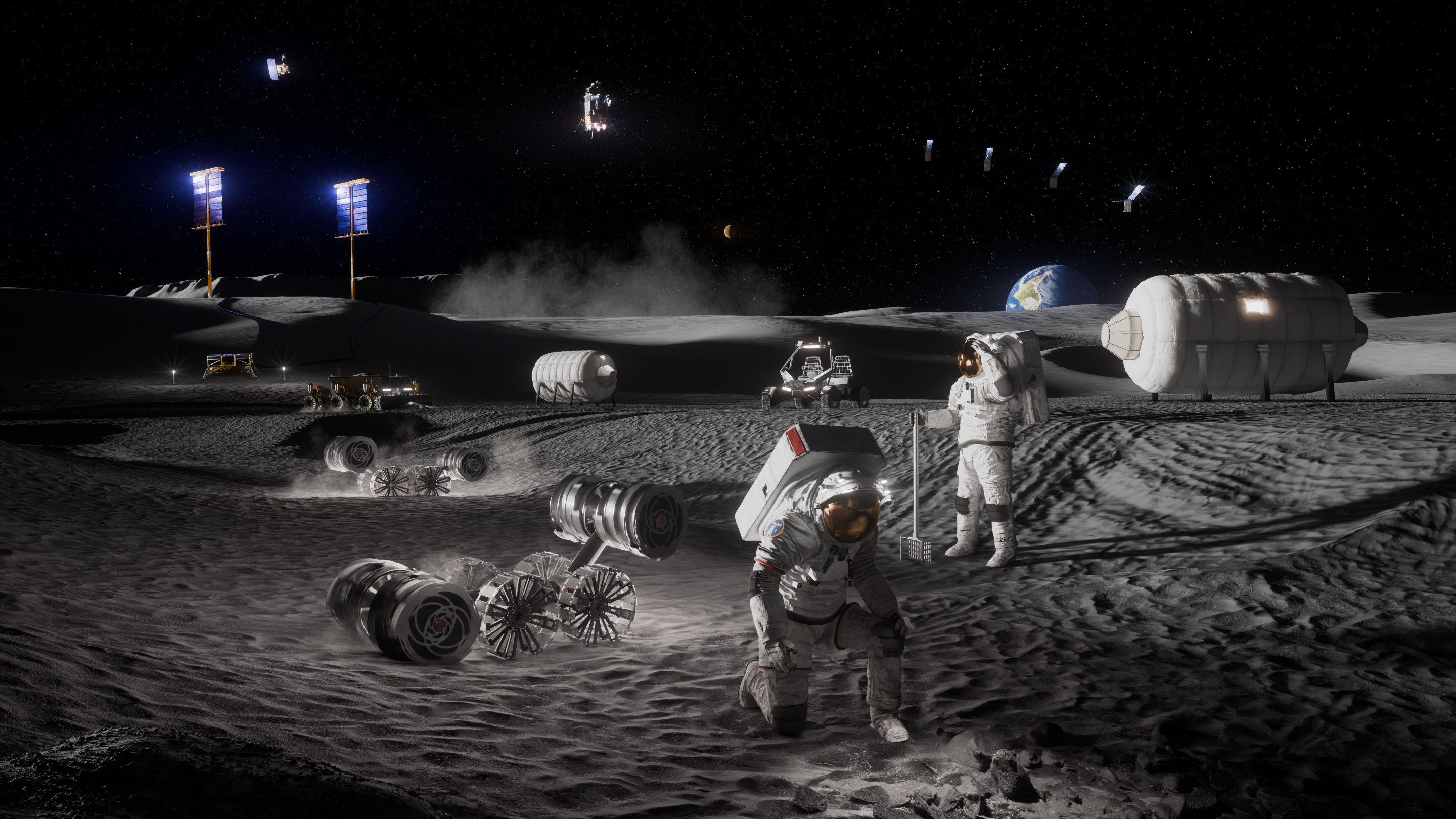
At Kennedy Space Center Visitor Complex in Florida, NASA opened a $1 million challenge that asks students to help imagine how people could live and work on the Moon. The Moon Base Student Challenge was announced Sunday during a MAX POWER event, inviting teams from high schools and post-secondary schools across the United States to put forward ideas for NASA’s lunar plans.
The effort comes as NASA works toward building a Moon Base near the lunar South Pole, where astronauts could live, work and explore. A lasting human presence on the Moon could also help prepare for future crewed missions to Mars. Designing for that future means solving practical problems, from keeping a habitat powered to protecting people in a harsh environment. NASA is looking beyond its own workforce for useful ideas and fresh points of view.
Student teams will develop solutions in six areas: power generation and storage, construction, life-support systems, surface mobility, communications networks and astronaut safety. The competition has several phases and is built around real environmental and mission needs for living and working on the lunar surface. NASA says participants can produce work such as trade studies, concept proposals and stakeholder briefings—the kinds of tasks used in industry to compare options, explain designs and share plans with people involved in a project.
The challenge is intended for students on technical, vocational and other academic paths, and participants do not need prior specialized engineering or technical experience. Along with contributing ideas for Moon Base technologies, students can practice skills that may help them pursue careers in the space industry.
“ You do not have to wait until graduation to contribute,” NASA Administrator Jared Isaacman said, describing the qualities the agency hopes to see: curiosity, creativity, teamwork and a willingness to tackle hard questions without obvious answers. Carlos García-Galán, manager of NASA’s Moon Base Program, said students could help NASA consider what future explorers will need to live and work there. Elaine Ho, associate administrator for NASA’s Office of STEM Engagement, also pointed to students’ perspectives as a way to help imagine a future beyond Earth.
NASA’s Office of STEM Engagement developed the challenge with the Moon Base Program. The Institute of Competition Sciences will administer it under a contract with NASA’s Center of Excellence for Collaborative Innovation, within the agency’s Research and Technology Mission Directorate. Teams must register through the NASA STEM Gateway by Jan. 25, 2027. Full eligibility requirements and official rules are available at moonbasechallenge.org.
The prize funding gives the competition a clear headline, but its larger promise is a chance for students to work on a problem that NASA says is connected to its future plans. Their designs will not build a lunar base on their own. They can, however, help students learn how large space projects are planned—and give NASA another source of ideas as it works toward a human presence on the Moon.