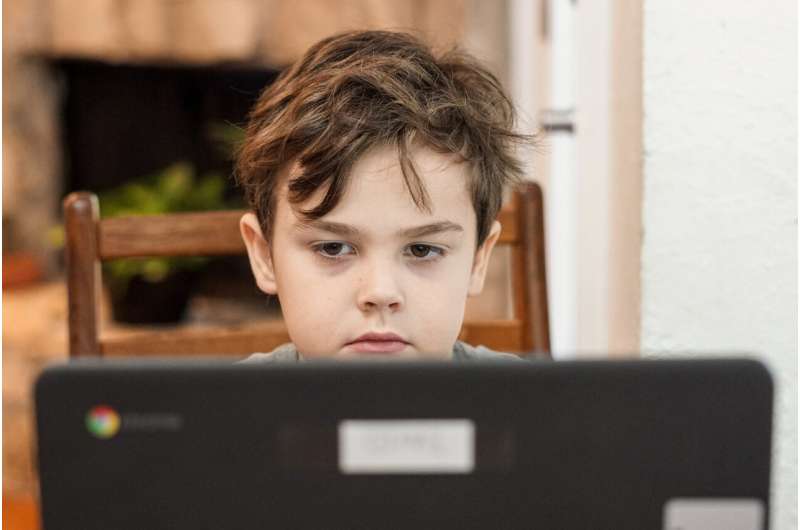
When stay-at-home orders shut down plans for in-person lessons in Western Sydney, a group of autistic children kept working on reading through a screen—and made gains compared with children who received no intervention.
The feasibility study, led by Flinders University Professor Joanne Arciuli, began with a different plan: small-group, face-to-face literacy teaching for autistic children in an area facing socioeconomic disadvantage. Pandemic restrictions forced the researchers to change course midway through. Lessons shifted to one-to-one sessions delivered online, using telepractice, or health and learning support provided at a distance.
The change brought real challenges. Children were at home during lockdown, and families faced complex personal pressures. Still, Arciuli and her team continued the study because they had an ethical duty to keep providing services to the participants. The results offer evidence that online instruction can support learning even when normal services are disrupted.
Children in both instruction groups made gains in reading abilities compared with a control group. The intervention groups made significant gains, the researchers reported, despite the disruptions. The source does not give a participant count or the size of the gains, so the finding is best understood as promising evidence from a feasibility study, not a measure of how much every child can improve.
The lessons used ABRACADABRA, a free interactive web application with 33 activities. The program supports several parts of literacy: letter sounds and phonics, reading fluency, vocabulary and comprehension strategies, as well as spelling and writing. It was developed in 2002 by the Center for the Study of Learning and Performance at Concordia University in Montreal. Its modular design lets instruction be adjusted to a child’s needs.
That flexibility matters because autistic children do not all learn to read in the same way. Some may have more difficulty understanding what they read than accurately reading words. Arciuli points to a 2021 review of 26 studies involving more than 1,200 autistic children. On average, those children scored higher in word reading than in reading comprehension. A program that works on both skills can help teachers address a wider range of needs.
The study was published in 2025 in the International Journal of Speech-Language Pathology under the title “ABRACADABRA literacy instruction delivered by speech-language pathologists to children with autism during the COVID-19 pandemic.” Its findings suggest that online tools may help extend literacy support beyond places where in-person sessions are easy to reach. Arciuli says the approach could be especially useful for autistic children in rural or remote communities who cannot access face-to-face instruction.
The pandemic did not make online teaching simple, but this study showed that it could keep literacy support going and help children make progress. Further research can test how well the approach works in other settings and for more children. For families separated from services by distance or disruption, a carefully designed online lesson may offer another way in.