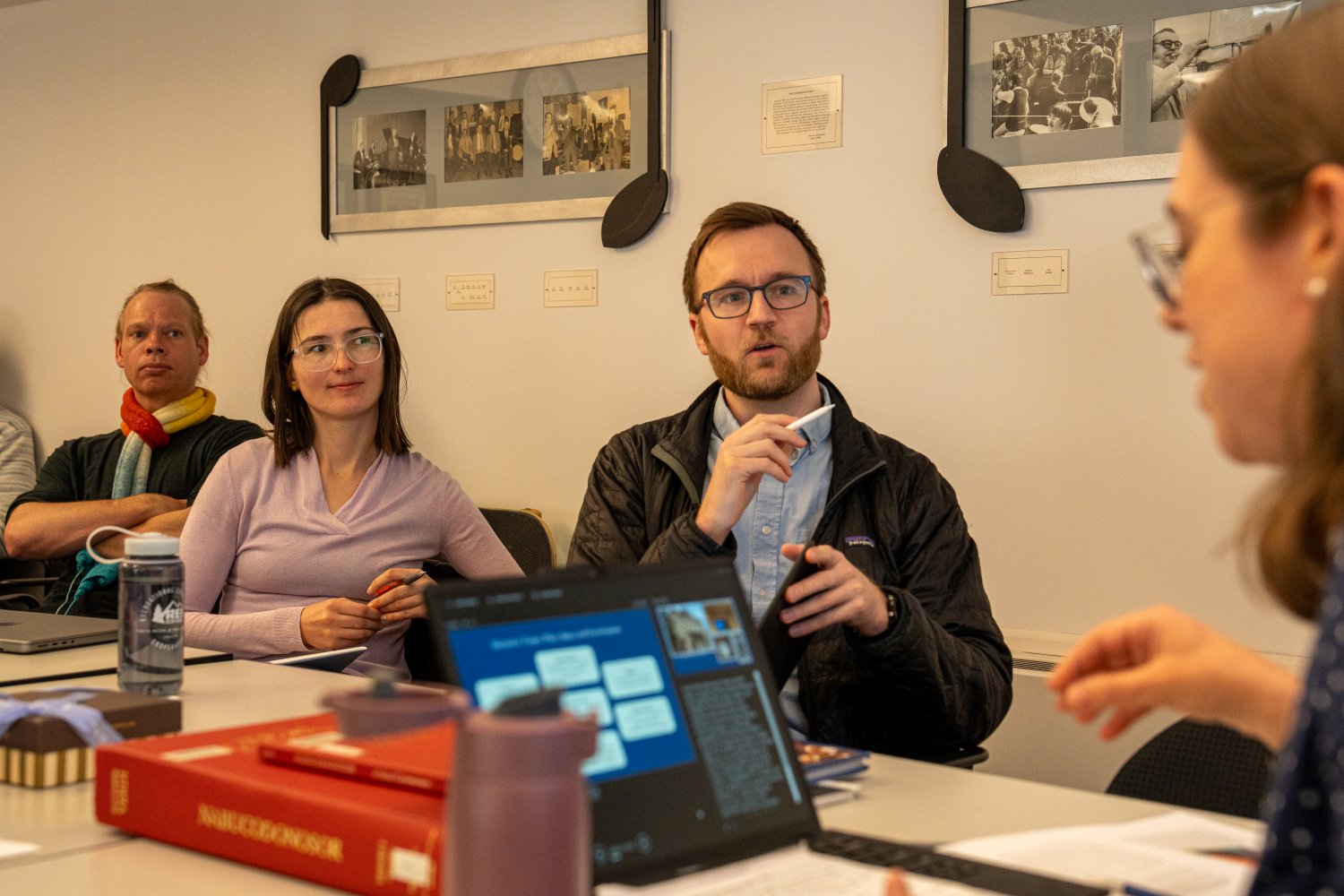
On a Wednesday afternoon in April, seven professors gathered around a table in MIT's Lewis Music Library, sharing a meal and a common goal: supporting each other's scholarly work. These seven faculty members are the first-ever SHASS Faculty Fellows, an inaugural program launched this spring by MIT's School of Humanities, Arts, and Social Sciences. They meet biweekly to discuss their research, challenge each other's ideas, and build connections across different fields of study. One of the fellows, Emily Richmond Pollock, associate professor of music, presented a chapter about an opera festival in Sarasota, Florida. She says her work started from "my own curiosity about how American institutions relate to opera's traditions and practices." The group offered feedback on her writing, asking questions and sharing thoughts — exactly the kind of scholarly community the program was designed to create. "A small group of people coming from diverse scholarly backgrounds meeting regularly to share a meal and sustained conversation can have a truly outsized impact on their scholarship," says Anne McCants, the Ann F. Friedlaender Professor of History and chair of the Faculty Fellows Program Committee. Arthur Bahr, a literature professor, also helps guide the discussions by asking probing questions and pushing participants to examine their assumptions. Faculty must apply to join the program, and a committee selects the fellows each semester. The program is run by MITHIC, the MIT Human Insight Collaborative. Fellows also share their work with students. Volha Charnysh, the Ford Career Development Associate Professor of Political Science, presented her research on humanitarian aid to the Burchard Scholars — a program connecting MIT faculty with promising sophomores and juniors who excel in humanities, arts, or social sciences. Some fellows are working on book manuscripts, others on scholarly articles. Pollock is writing a book called "Opera on Uncommon Ground: Five American Festivals," about opera festivals held outside major cities, in unusual spaces, where rare repertoire is performed alongside classic works. She says the program gave her time to focus. "This semester in the program has been wonderful so I could get back to drafting and really concentrate on a book I am excited to write." Richard Nielsen, associate professor of political science, is working on a book called "Fighting War with Divine Intervention," examining how beliefs about divine intervention affect whether fighters keep going even when they seem likely to lose. He says the program provides something valuable: the chance to think deeply alongside colleagues from different fields. "We understand a lot about how religion might shape the conditions for war and peace, but religion matters during wars, too, and we understand surprisingly little about how religious claims affect leaders and fighters in combat," he says. Heather Paxson, associate dean for faculty in SHASS and the William R. Kenan, Jr. Professor of Anthropology, says the program has two main goals: enriching fellows' scholarly work and building community within the school. "Participants in the program gain a better sense of the breadth and depth of our school's scholarly contributions, and some may forge lasting connections with colleagues they might not otherwise have gotten to know," she says. The program is now accepting applications for future semesters, offering more MIT scholars a chance to connect, learn, and grow together.
7 Fellows in inaugural cohort
Biweekly Meetings held per semester
Spring 2024 Program launch
2 fellows Books in progress
Burchard Scholars Students engaged