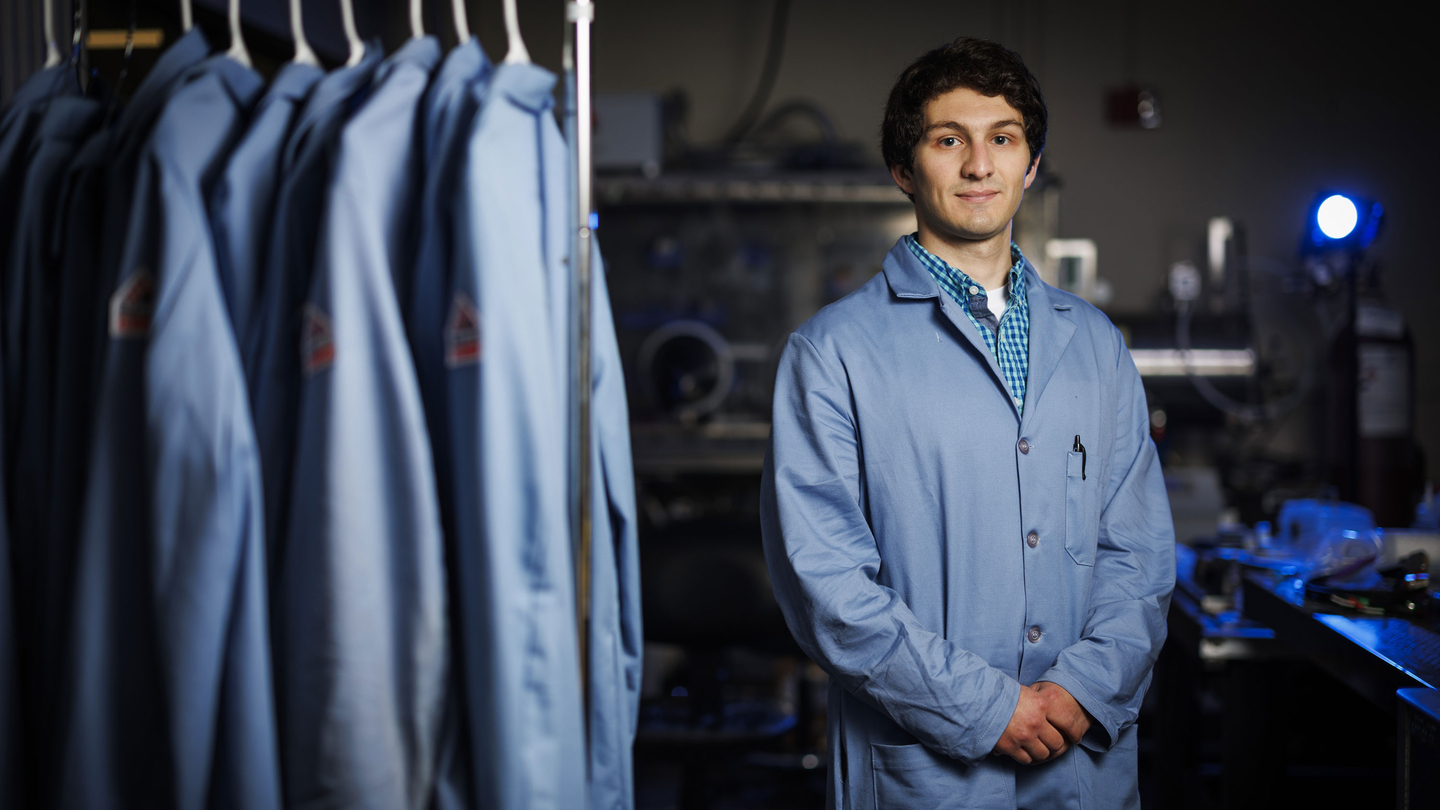
Hugh Smith isn't trying to build the world's best battery. He's trying to build the right one for the job.
Smith is a fifth-year PhD candidate at MIT in Cambridge, Massachusetts, and he's working on an alternative to the lithium-ion batteries that power smartphones, electric cars, and more. His focus is sodium-ion batteries, which swap expensive and hard-to-find materials like lithium, nickel, and cobalt for more common elements like sodium, iron, and manganese.
"I've believed for a very long time that the biggest engineering problem humanity faces is the transition to clean energy," Smith says. "Batteries are a critical bottleneck in that transition."
Growing up in Albany, New York, Smith fell in love with materials science because it combined two of his favorite subjects: chemistry and math. But what kept him hooked was the field's real-world impact. "Anytime you interact with a solid material, there are people who intentionally designed that material for a specific purpose," he says.
That mindset led him to batteries. After earning his undergraduate degree from Case Western Reserve University, he came to MIT to explore how new battery designs could cut costs without losing performance.
The challenge is that improving one battery feature often means giving something else up. A phone battery needs to be small, hold lots of energy, and last for years. But a battery that stores electricity for the power grid doesn't need to be lightweight or compact—it just needs to be cheap and reliable.
Smith's approach is to find the right balance for each use. "It's trying to balance everything," he explains. "It's not catering extremely to some properties and then abandoning others."
Sodium-ion batteries could eventually offer cheaper options for electrical grids or more affordable electric vehicles. A key advantage: they can largely be made using the same equipment already built for lithium-ion batteries, which means an easier path to getting them into people's hands.
Smith's journey at MIT has shaped him as much as his research. He joined Professor Iwnetim Abate's brand-new lab as its very first graduate student, helping set up the space with no senior students to guide him. "I learned not to be fearful of new things," Smith says. "Just because I didn't know how to do something didn't mean I couldn't figure it out."
That independence is now central to how he tackles one of the world's hardest problems: making clean energy work for everyone.
And for Smith, that work isn't about perfection. It's about progress—one balanced battery at a time.