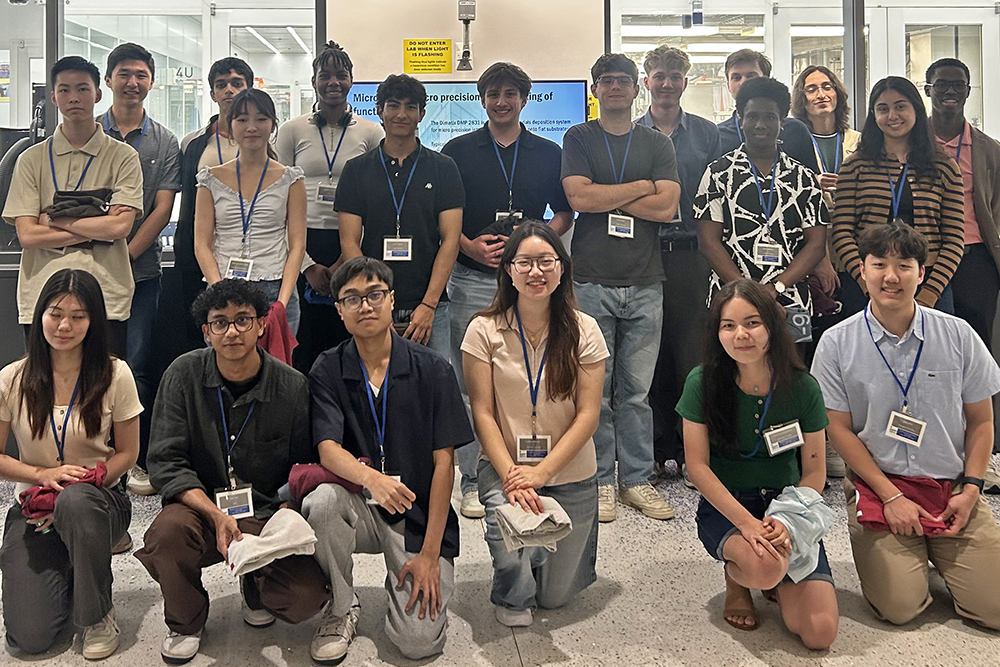
When Shanti Visurakapalli arrived at MIT.nano on a Monday morning this past July, she had questions about her future. By Friday, she had answers — or at least, a much clearer sense of the questions to ask.
Shanti was one of 30 students chosen for the 2026 Northeast Microelectronics Internship Program, a week-long externship that took undergrads from classrooms to cutting-edge labs across the Northeast. Organized by MIT's Microsystems Technology Laboratories, the program ran July 13-17 and gave students a rare look inside the world of semiconductor technology — the tiny chips that power everything from phones to satellites.
"What will the next innovation in microelectronics look like, and what should the world of tomorrow focus on?" That was the challenge posed at the opening session by Vladimir Bulović, director of MIT.nano, and Farhad Varzhegoo, from the Northeast Microelectronics Coalition Hub. They pushed students to think beyond today's gadgets and consider how engineering could solve real-world problems.
The week that followed reads like a dream tour for anyone fascinated by tiny technology. Students visited MIT.nano, IBM Research, GlobalFoundries, Rensselaer Polytechnic Institute, and NY CREATES — five of the country's most advanced research and manufacturing sites. At IBM, they watched High-NA EUV lithography in action, a technique used to carve impossibly tiny circuits onto silicon. At GlobalFoundries, they toured a state-of-the-art 300-millimeter semiconductor fabrication facility — the kind of place where raw sand becomes the brains of computers.
Between visits, students heard from MIT grad students presenting research on integrated circuits, quantum technologies, and advanced materials. They also sat in on an industry panel featuring professionals from Rage Systems, Cadence Design Systems, Analog Devices, and RTX. Susan Feindt, a fellow emeritus at Analog Devices and visiting research scientist at MIT, helped organize the conversation about moving from college to careers in semiconductors.
For Sean Kim, a Princeton University student, the highlight was simple: "The externship gave me a behind-the-scenes look at the advanced technologies driving the microelectronics industry while allowing me to connect one-on-one with researchers and industry professionals."
Preetha Kingsview, who helps run the program, says the magic happens when students from different schools realize they share a passion. "The friendships they build, the conversations they have with researchers and industry leaders, and the excitement they bring to every visit create an experience that extends far beyond the technical program," she said.
For Shanti, who is herself an MIT undergraduate considering a PhD, the week clarified her thinking. "I think this experience, complemented with the industry panel, gave many of us in the program the perspective we needed to weigh future graduate and professional options," she said.
As technology becomes increasingly central to national security, artificial intelligence, and everyday life, programs like NMIP aim to grow the next generation of engineers and innovators. Judging by the students' reactions, the pipeline looks healthy.