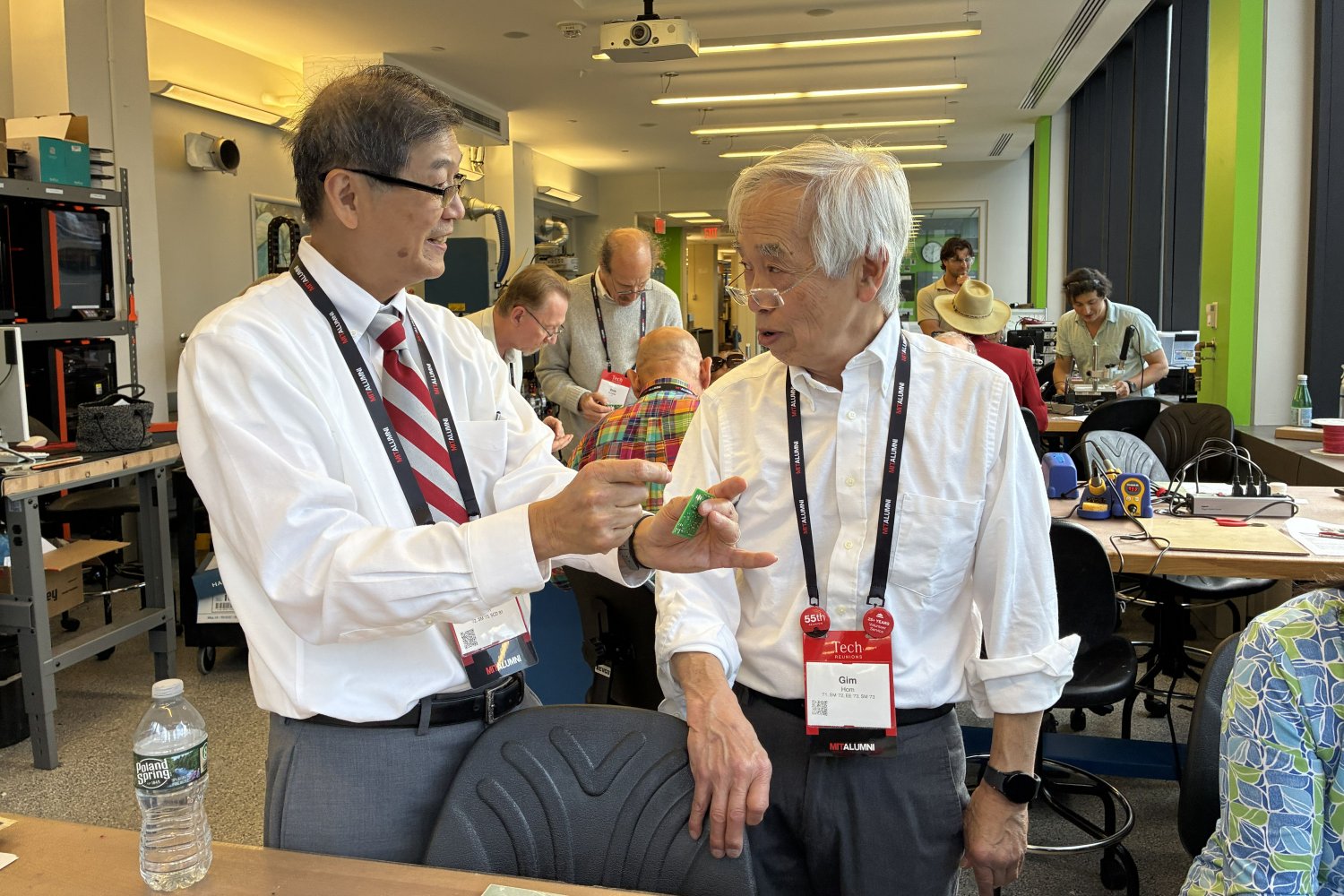
When Gim Hom's MIT classmates gathered for their 55th reunion this spring, they didn't just catch up over coffee. They grabbed soldering irons and got to work.
Hom, a senior lecturer at MIT's Department of Electrical Engineering and Computer Science, hosted around 15 of his classmates from the Class of 1971 at the Cypress Engineering Design Studio — a makerspace where students learn to build real electronic devices. The visit marked a full 55 years since they first walked through MIT's doors as wide-eyed undergraduates.
"It was wonderful to see alumni leave with a working board with big smiles on their faces," Hom said.
The group chose between two hands-on projects. About half built a simplified electrocardiogram (ECG) — a device that reads the electrical signals of your heartbeat. They soldered circuit boards, attached electrodes, and then rolled up their sleeves to watch their own heartbeats appear on a screen. The other half constructed a small audio amplifier powered by a USB cable, the kind you could use to play music from your phone through speakers.
For Hom, the reunion was also his chance to teach what he called a "last class." Throughout his career, he used real problems and real tools to teach students about analog and digital design. This time, he stripped away the heavy theory and kept just the building.
Surprisingly, the alumni encountered one technology that didn't exist back in their day: surface mount soldering. Modern electronics use this technique to attach tiny components to circuit boards, but in the 1970s, it wasn't common yet. So the reunion doubled as a mini lesson in how electronics manufacturing has changed.
Two technical instructors — Anthony Pennes and Liam Ackerman — helped out during the event. Fun coincidence: both were also celebrating their own MIT reunions, at 10 years and 5 years out, respectively.
The Cypress Engineering Design Studio stays open from morning until nearly midnight during the school year, giving the EECS community plenty of time to tinker and experiment. Hom, who is stepping back from teaching, will continue part-time as an advisor to students.
For the Class of 1971, the day ended with working gadgets to take home — and proof that the hands-on skills they learned decades ago still have staying power.