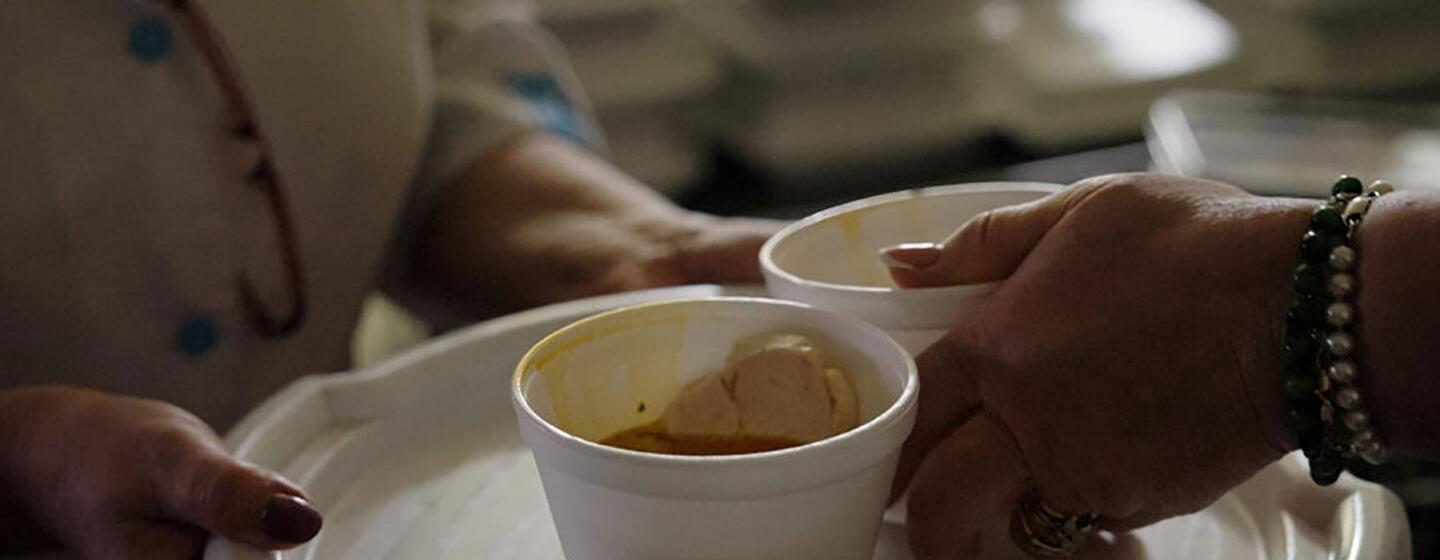
A bowl of chicken soup in a Kyiv hospital carried a meaning far beyond lunch for Olha, who had spent four and a half years in the war-hit town of Oleshky with food growing harder to find. When she and other evacuees arrived for medical care, hot meals were waiting: soup, bread and buckwheat porridge, served by the World Food Programme (WFP) and its Ukrainian partner, Iskra Dobra.
Hundreds of people were evacuated from Oleshky in late October during a brief ceasefire. The town, in Ukraine’s southern Kherson region, had been occupied since Russia’s full-scale invasion began in 2022. Located on the frontline, it was eventually cut off from humanitarian help. For families who remained, daily life became a struggle to find food and stay warm.
Olha remembers flour costing as much as $12 a kilogram, according to evacuees, before food deliveries stopped altogether in May. She and her husband, Serhii, faced searches, questioning and threats. By midday, people had to be inside. Their home was damaged by shelling and had no heating, so the couple slept in three layers of clothes. During short pauses in attacks, Olha planted cucumbers, tomatoes and zucchini in a garden, trying to grow enough to eat.
The hunger reached beyond what a garden could solve. Olha said neighbours had eaten every pigeon in the area. “I simply couldn’t understand how there could be hunger in the 21st century,” she recalled. Further along the hospital corridor, 78-year-old Valentyna described making soup from wild plants with elderly neighbours. “There was no bread, no flour, nothing at all,” she said.
WFP and Iskra Dobra were the first humanitarian responders to provide hot meals when the evacuees arrived. “This is the first proper meal they have had in years,” said Richard Ragan, WFP’s country director in Ukraine. Valentyna marvelled at the food, especially the borscht, a Ukrainian beet soup. “Here, you can eat until you’re full! I hadn’t seen so much food in years,” she said.
The journey to Kyiv brought another change: relief at reaching safety. Olha remembered people along the road holding signs and Ukrainian flags to welcome the evacuees. “We saw our people,” she said, describing a feeling of peace after they crossed the border.
The welcome does not erase what the group has endured, or answer what comes next. Many cannot return to homes left behind, and years of fear do not disappear with one meal. But a hot plate in a hospital offers immediate care while patients receive check-ups and treatment. It is part of a much wider effort: since February 2022, WFP says it has provided the equivalent of 4.1 billion meals in Ukraine. Each month, it reaches 357,000 people in frontline communities with emergency food and cash assistance, while about 200,000 students receive daily school meals. In Kyiv, for the newly arrived evacuees, the first step was simpler and essential: food, served hot, with enough to fill a plate.