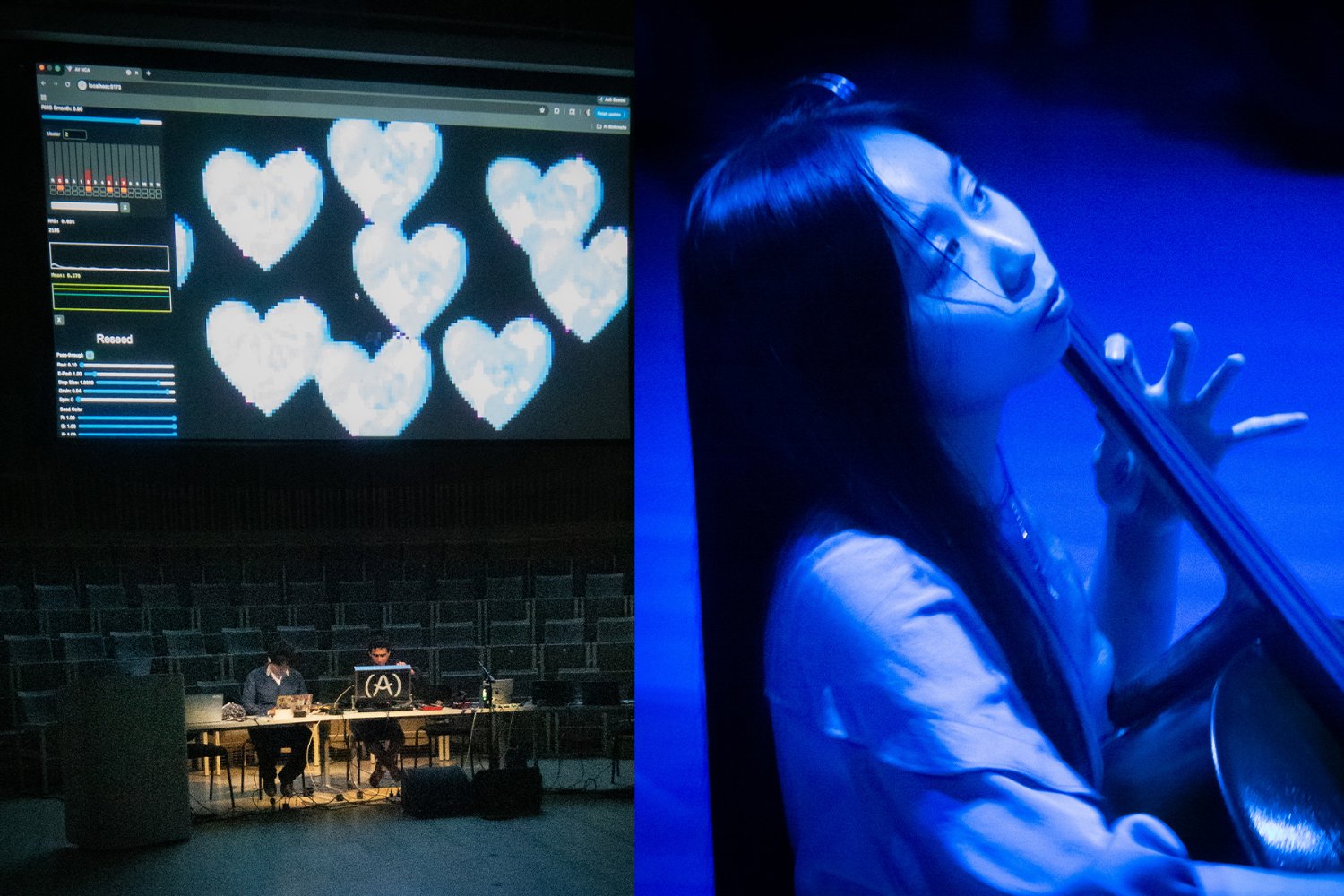
On May 13, something special happened at MIT. The university celebrated the first research showcase of its brand-new Music Technology and Computation Graduate Program — and the room was completely packed. Students, faculty, and visitors packed into the Thomas Tull Concert Hall in Cambridge, Massachusetts, standing room only to see what these pioneering students had created.
The program launched in fall 2024 as a partnership between MIT's School of Humanities, Arts, and Social Sciences and the School of Engineering. It was made possible partly because MIT opened the Edward and Joyce Linde Music Building in 2025, which gave students access to new classrooms, studios, and a dedicated music technology lab.
Five graduate students — all of whom were previously undergrads at MIT — showed off their work during the 90-minute event. Their projects were mind-bending in their creativity. One student built an AI that can improvise on piano, with a screen showing in real-time what the computer was about to play. Another created a sound installation using noisy network communication. One group even built a hip-hop dance circle where the music is generated directly from people's movements.
Then there was Claire Southard, a graduate student who developed something truly remarkable. Southard trained computer models to identify musical notes from brain signals using EEG — that's a method that measures electrical activity in the brain using sensors placed on the scalp. Her goal is to help musicians who have movement disorders like Parkinson's disease or injuries that prevent them from playing their instruments. "My work explores one strategy to help such musicians perform again by translating the music they're trying to play directly from their brain activity — bypassing the need for motor control altogether," she explained. She hopes her system can make music performance more accessible for everyone.
At the showcase, Paula Hammond, dean of MIT's School of Engineering, spoke about how music and engineering share deep connections. "Both rely on mathematical precision and are informed by defined structures, rhythms, and frequencies," she said. "Both demand hard work and technical know-how, paired with inspiration and imagination, to create something entirely new."
Eran Egozy, who directs the program, called the event a "harmonious hybrid of concert and symposium." He marveled at what the students achieved in just one year. "It's a little mind-boggling to see what our students have achieved in just one short and fast-paced year," he said.