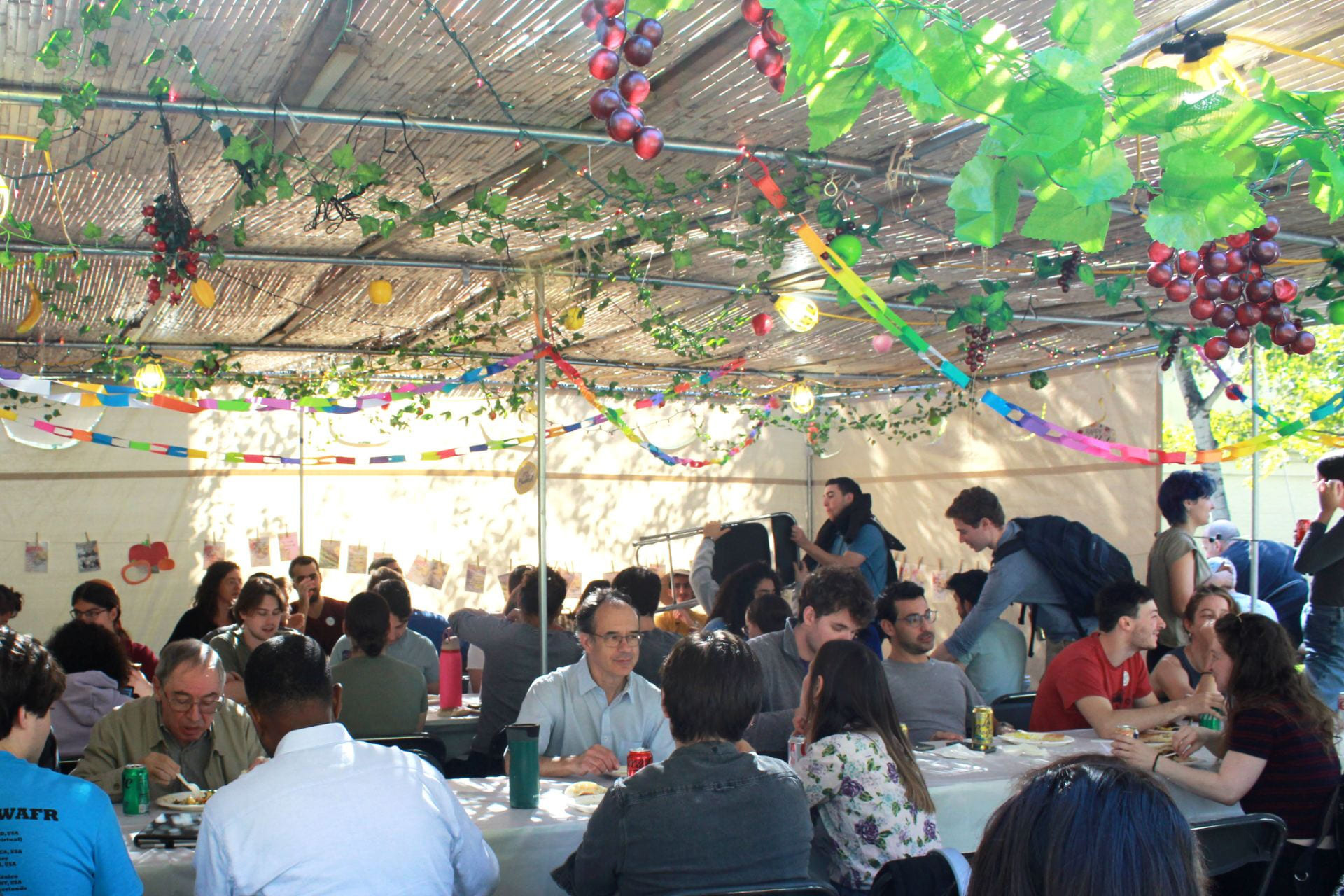
When Or Hen looks at the 11 new scholars joining MIT's Kalaniyot program this fall, he sees something remarkable: a community that grew from an idea just two years ago into something genuinely life-changing.
"I think MIT today is home to one of the most, if not the most, accepting and welcoming communities for Israelis," says Hen, an MIT nuclear physicist and co-founder of the program. "The way our community grew these past years is remarkable."
The Kalaniyot program — named after a wildflower that blooms across Israel — is now welcoming its second group of researchers to campus. Seven postdoctoral fellows and four sabbatical scholars (faculty on leave from Israeli universities) will work alongside MIT professors on topics ranging from quantum computing to behavioral economics to cellular biology.
What makes Kalaniyot special is how it came to be. Hen and Ernest Fraenkel, an MIT professor of biological engineering, dreamed it up as a constructive response to division. They wanted to build bridges through research, not debate.
"We designed Kalaniyot to strengthen MIT's research and its community at the same time," Fraenkel says. Today, scholars from the program work in all five of MIT's schools — math, engineering, science, architecture, and humanities. "The academic breadth shows our model is working."
The scholars come from all nine of Israel's state-recognized universities. They include both Arab and Jewish citizens of Israel. To join, applicants must find an MIT professor willing to host them — a rule that weaves newcomers directly into existing research teams.
"When they're here, they are treated exactly like anybody else in an academic unit at MIT," Fraenkel says. "They're embedded in these places."
The community aspect matters just as much as the science. Every week, everyone shares lunch together. Scholars give informal talks. Hen recently co-authored a paper that started from a conversation at one of those lunches.
Tal Cohen, an MIT civil engineering professor, helped Hen and Fraenkel develop the original concept. The pair credit MIT's leadership with believing in the idea early.
"This would be impossible to do the way we're doing it without the administration's support," Hen says. "The program is faculty-led and institution-backed. That's what you want."
This year also marks a milestone: the first teaching fellow hosted by MIT's History department, expanding the program beyond pure research into education.
For a program born from conflict, Kalaniyot has become something unexpected — a place where discovery and friendship grow side by side.