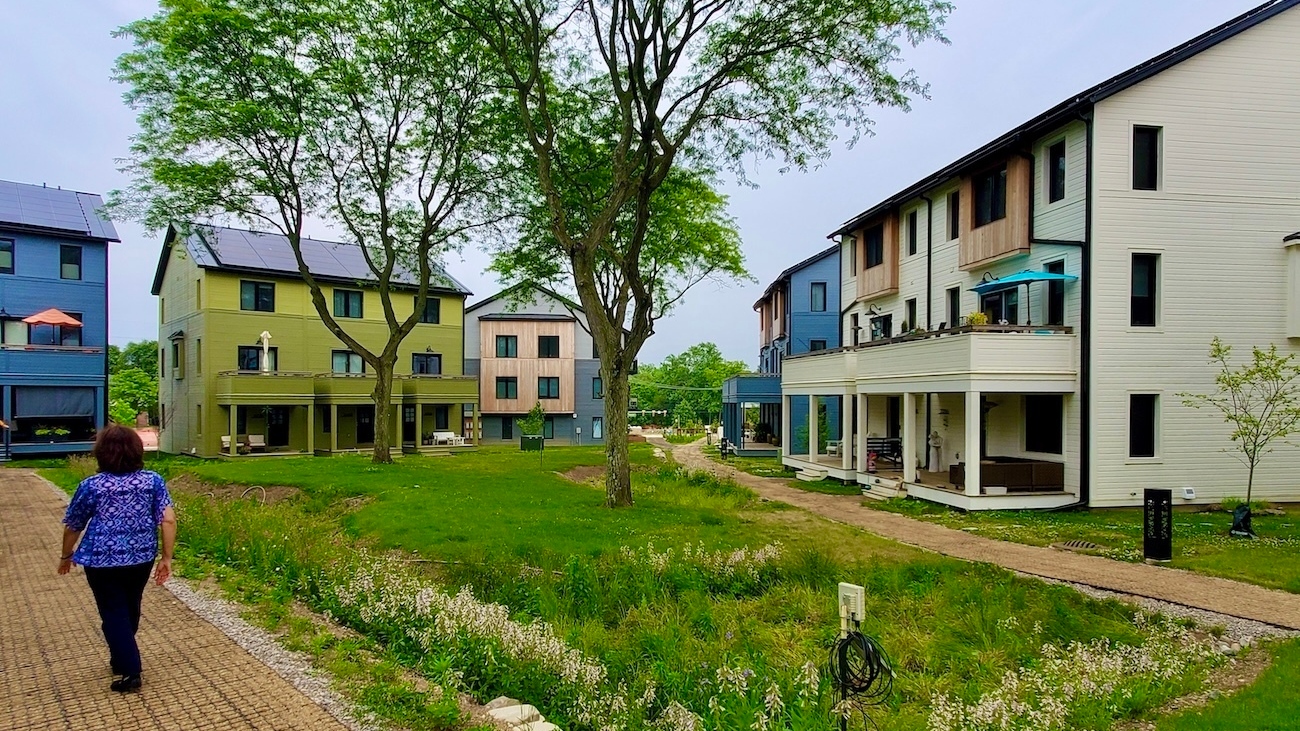
At Veridian at County Farm in Ann Arbor, solar panels and home batteries are being linked so that dozens of houses can help power Michigan’s electric grid. The neighborhood is set to host the state’s first residential virtual power plant, a system that lets a utility draw on stored energy from many homes at once.
Veridian is a fossil-fuel-free, net-zero-energy development: its homes are designed to produce about as much energy as they use over time. Solar panels generate electricity, and batteries store some of it for evenings, when the sun is down. Now, residents will have a chance to share that stored power beyond their own homes.
In the coming weeks, households will be able to enroll in the pilot. Detroit-based DTE Energy will remotely manage participating home batteries and send their stored solar electricity to the grid when demand is high or the system needs support. DTE expects nearly 100 battery-equipped homes to join eventually.
The project is still taking shape. Thrive Collaborative, the firm behind the development, says 44 market-rate homes with solar panels and batteries have been built so far, out of 120 planned. Another 50 affordable housing units have been built, but they do not yet have batteries. Sonnen USA, which made the installed home storage systems, is helping DTE run the pilot with its own software.
The system is expected to provide up to about 300 kilowatts for three hours. That is a modest amount compared with the needs of a large grid, but the test can show DTE how much power a group of home batteries can deliver and when. Joi Harris, DTE’s president and chief executive, said the trial could help test a lower-cost way to meet rising energy needs and improve reliability.
Virtual power plants, or VPPs, connect many small energy sources and storage systems so they can work together like a single power plant. By sending power during busy periods, they may help utilities avoid some grid upgrades and reduce the need to run expensive fossil-fuel plants that operate mainly during peaks. Residents could also receive payments for taking part. DTE had not provided exact compensation figures by the time the source report was published.
For Mitch Hall, who lives at Veridian with his wife, Lori, the appeal is that residents need not constantly manage the batteries themselves. DTE will handle the system and draw power when the grid is strained, he said, adding that the utility will pay participants “a little bit.” Matt Grocoff, Thrive Collaborative’s founder, said he began considering the pilot in 2019. He imagines the neighborhood working less like a one-way energy network and more like an ecosystem, where homes can produce energy and share it with one another.
The pilot also comes as electricity demand grows, in part because of wider electrification and new data centers. A Brattle Group estimate cited in the source report said 524 gigawatts of distributed energy resources in virtual power plants could save households an average of $122 a year by 2050. Veridian’s trial will not prove that outcome on its own, but it can give DTE practical evidence for deciding whether to expand the model. If the batteries work as expected, a neighborhood built to meet its own energy needs could also become a small, flexible source of power for the wider community.