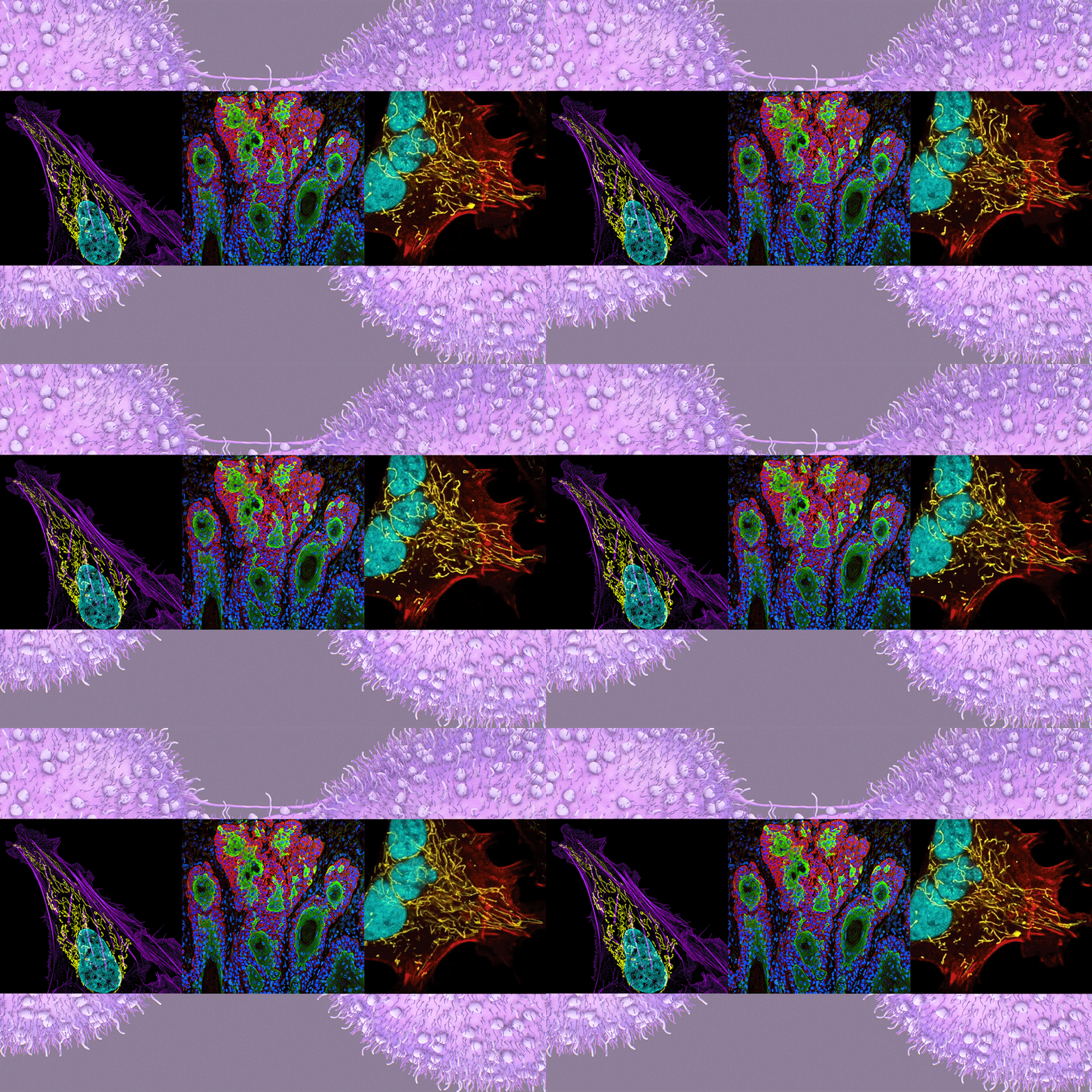
In laboratories across the United States, the United Kingdom, and the Netherlands, scientists have spent the last decade working toward something ambitious: building a bigger toolbox for fighting cancer. Now, that work has paid off in a major way. Researchers have created nearly 700 new cancer models from patient tumors, and they are making them available to scientists around the world for free.
The project, called the Human Cancer Models Initiative, brought together more than two dozen institutions, including teams from MIT's Koch Institute, the Broad Institute, and the Dana-Farber Cancer Institute. The effort was funded by the National Cancer Institute and the Wellcome Trust in the United Kingdom. A paper describing the work was published in the journal Nature.
Cancer researchers have long relied on small samples of cancer cells grown in petri dishes to test new drugs. But scientists realized that the roughly 1,000 cell lines available worldwide were not enough to represent the full diversity of human cancers. Many rare types of cancer had no models at all, and most existing models came from patients in Europe and Southeast Asia, leaving large gaps in understanding.
"We realized that a thousand wasn't enough, that the international community needed to invest in many more thousands to represent all cancers, all genotypes, all ethnicities," said Jesse Boehm, a research scientist at MIT's Koch Institute and a senior author of the study.
To fill that gap, participating hospitals collected more than 2,700 tumor samples with permission from patients. Scientists then worked to turn these samples into something useful: tiny 3D balls of cells called organoids. Unlike traditional cell lines, which grow as flat layers, organoids mimic the structure of real tissue more closely. The researchers managed to successfully convert about one-third of the samples they received into stable models.
These new models cover 25 different types of cancer, including about 150 rare varieties such as tumors of the gallbladder and small intestine that had been nearly impossible to study before. Once the models were established, the researchers verified that their genetic and molecular features matched the original tumors.
All of the new models have been deposited at the American Type Culture Collection, a nonprofit bank that supplies cell lines to researchers everywhere. Each model comes with detailed information about the patient's cancer, including inherited mutations, which can help scientists understand why certain tumors respond to treatment and others do not.
The hope is that these models will help researchers identify new drug targets and test potential treatments faster than ever before. Mushriq Al-Jazrawe, scientific director at the Koch Institute, said the work depended on careful teamwork across many institutions. "I'm especially grateful to the technical and scientific teams whose careful, expert work turns patient tumor samples into well-characterized models and data that researchers everywhere can use with confidence," he said.
For patients with rare cancers especially, this resource could open doors that were previously closed, giving scientists the tools they need to find treatments where none existed before.