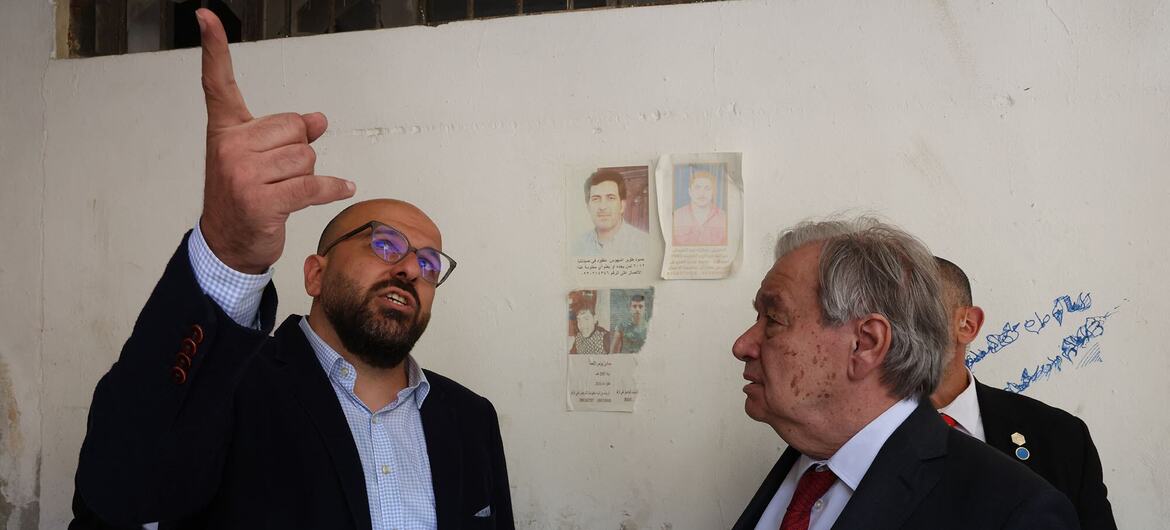
The corridors of Sednaya prison still hold echoes of unspeakable suffering. Built to silence thousands, the facility outside Damascus became synonymous with the worst of Syria's long conflict — a place where people were tortured and killed simply for their beliefs. Now, on a historic visit to the country, United Nations Secretary-General António Guterres walked those same corridors and heard survivors tell their stories of fear and loss.
For the UN chief, the visit to Sednaya was the most haunting stop on a two-day trip to Damascus. But it was not the only one. He also met with President Ahmad Al-Sharaa, spoke with civil society groups, women, and young people, and sat down with members of Syria's diverse communities — from different faiths, backgrounds, and traditions — all of them looking for a stake in their country's future.
After years of war that forced millions from their homes and shattered lives across the nation, Syria now stands at what Guterres called a "historic turning point." His message to the country and to the world was clear: this moment of transition is rare, and it must not be wasted.
"After so much suffering, this period of transition is a rare moment in the life of a nation," he told reporters. "A moment of responsibility, possibility and choice."
Guterres acknowledged the deep wounds still visible across Syrian society — the pain, the displacement, the fear that lingers. But alongside those scars, he said, he also found something unexpected: resilience and optimism.
"I have felt a profound sense of hope," he said.
Throughout his visit, the Secretary-General repeatedly pointed to Syria's diversity as one of its greatest strengths. The country has long been a crossroads of civilizations, cultures, faiths, and ideas, he noted, and that richness must be honored in whatever comes next. Success, he argued, will depend on making sure every Syrian — regardless of background — feels represented and included.
But political change alone will not be enough. Guterres made an urgent appeal to the international community: the world must match Syria's rebuilding efforts with real economic support. He called for all remaining sanctions on Syria to be lifted, saying recent steps to ease restrictions were welcome but incomplete. The country will need sustained investment to restore basic services, rebuild roads and schools, and revive jobs and livelihoods.
Most importantly, he said, the burden of recovery cannot fall on Syria alone.
"The Syrian people have shown extraordinary resilience through years of hardship," Guterres said. "They should not have to carry the burden of recovery alone."
Looking ahead, the Secretary-General acknowledged the road forward will not be easy and that setbacks are inevitable. But he insisted that a rare opportunity now exists — and that the United Nations stands ready to help Syria seize it.