Latest News
Positive stories from around the world · Good news by country
Showing 1609–1632 of 37354 articles
NASA Receives 16th Consecutive ‘Clean’ Financial Audit Opinion
NASA received a "clean" audit opinion for the 16th year in a row for its fiscal year 2026 finances. This is the best rating an outside auditor can give. It means the agency's money reports follow the rules and show its financial position accurately. The year also included the Artemis II Moon flight and the first X-59 flight faster than sound.

Root and mycelium pathways shape soil carbon dynamics in hyper-arid regions
Scientists at the Xinjiang Institute of Ecology and Geography studied tree planting in very dry desert land in China. They found that plant roots and mycorrhizal fungi (threads that grow with roots and share nutrients) each help soil hold carbon in different ways. The results were published in New Phytologist. The findings can guide better tree planting in dry places.

Oregon Zoo baby elephant Tula-Tu is making a full recovery - KTVZ
Tula-Tu, an Asian elephant calf at the Oregon Zoo in Portland, is on the road to a full recovery. She survived a life-threatening viral illness called EEHV, which is a herpes virus that can deadly harm young elephants. The calf was diagnosed about two weeks before the report. Zoo care teams are helping her get stronger.

Liver cells activate scarring-linked genes in stiff surroundings but favor repair signals in softer conditions
Scientists at Science Tokyo studied how liver cells called hepatic stellate cells behave during injury. They found that the stiffness of the tissue around them changes what they do. Soft surroundings favored repair, while stiff surroundings triggered genes linked to scarring, known as fibrosis. This insight could help future treatments aim to reverse liver damage.

Daytime brain waves resembling deep sleep could explain hallucinations in Parkinson's disease
Researchers studied 84 people with Parkinson's disease and 30 healthy older adults using EEG, a brain activity test. People with Parkinson's had far more deep-sleep-like brain waves while awake. The more of these waves they had, the lower their memory and attention scores tended to be. The findings may help explain hallucinations and point toward future treatments.

Written in sand: How dunes reveal the secrets of planetary winds
Stanford University researchers found that the median size of sand grains in a dune shows how fast the wind was blowing when it formed. They studied 30 years of wind data from 24 dune fields around the world, including the Namib Sand Sea in Namibia. The same pattern held for a dune field on Mars. Scientists can now use sand as a wind speedometer for modern dunes and ancient sandstone up to 3 billion years old.

How woodcocks evolved to be the weird cousins of their family
Scientists used bird DNA to build a family tree of woodcocks and snipes. These birds are odd cousins of the sandpipers, a big bird family. Many woodcocks now live only on islands and some do not migrate at all. The study shows how these birds moved across oceans over 20 to 25 million years.

Songs from same genre or era evoke similar memories across listeners
A Princeton University study found that songs from the same genre or decade bring up similar memories in different people. Researchers played 30-second clips of popular pop, country and hip-hop songs to listeners. They then studied more than 1,000 memory descriptions using computer language tools. The memories were similar even though people feel they are personal. Lyrics alone did not cause the effect, the team found.

CAR T-cell therapy shows promise for patients with lupus
Researchers reviewed 31 studies covering 243 patients with lupus, a disease where the immune system attacks the body. The patients had not improved with two or more standard drugs. CAR T-cell therapy, which reprograms a patient's own immune cells, steadily reduced disease activity. Serious side effects occurred in a small share of patients, about 5% each for neurotoxicity and severe infections.

Navigating lunar orbit using nothing but shadows and a power meter
Deep space tracking networks like NASA's Deep Space Network are getting overloaded with requests. A new paper proposes a no-cost fix: use the drop in solar panel power during an eclipse to find where a spacecraft is. Eclipses happen when a planet or moon blocks the sun. Researchers tested the idea using historical records of Earth's shadow on the Moon.
NI want to play on the biggest stages - Price
Northern Ireland's young football team plays Hungary in Budapest on Tuesday. A win or draw would earn promotion to League A of the Nations League, a first for the team. Midfielder Isaac Price says the young side is fearless and wants to play on the biggest stages. The team has not conceded a goal in five matches.

New study reveals immune cells' ability to engulf and destroy amoebae
Researchers at the University of Louisville found that human macrophages and neutrophils, two types of immune cells, can engulf and destroy amoebae. Scientists had long believed these germs were too big to swallow. More than 100 million severe amoeba infections occur worldwide each year. The study, published in the journal mBio, could lead to better treatments.

AI and experiments reveal impurities hindering waste plastic pyrolysis oil recycling
Korean researchers studied how impurities affect turning waste plastic oil into light olefins, the building blocks of new plastics. They added 13 impurities to real waste plastic oil and tested a zeolite catalyst. Sulfur, chlorine, and oxygen compounds had small effects, but some nitrogen compounds cut performance sharply. The team says the results can help predict performance drops based on impurity type and amount.

First results published from the largest brain atlas ever created
Scientists have published the first results from a huge map of human brain cells. The project aims to map all of the roughly 200 billion cells in the human brain. Researchers at TU Delft and Leiden University Medical Center built the software that lets scientists explore the map. The work could help find new treatments for Parkinson's and Alzheimer's disease.

Elusive optical effect paves the way for advanced lidar and nanophotonic technologies
Scientists led by Skoltech, a Russian university, directly observed a tiny sideways shift of light. The light bounced off a single very small particle. The team first tested the idea with microwaves and says it works for visible light too. The finding could help build better lidar, radar, and light-based circuits.
US returns 337 looted antiquities to Italy after major investigations; collection includes a marble head of Alexander the Great stolen from a Rome museum in 1960 | World News - The Times of India
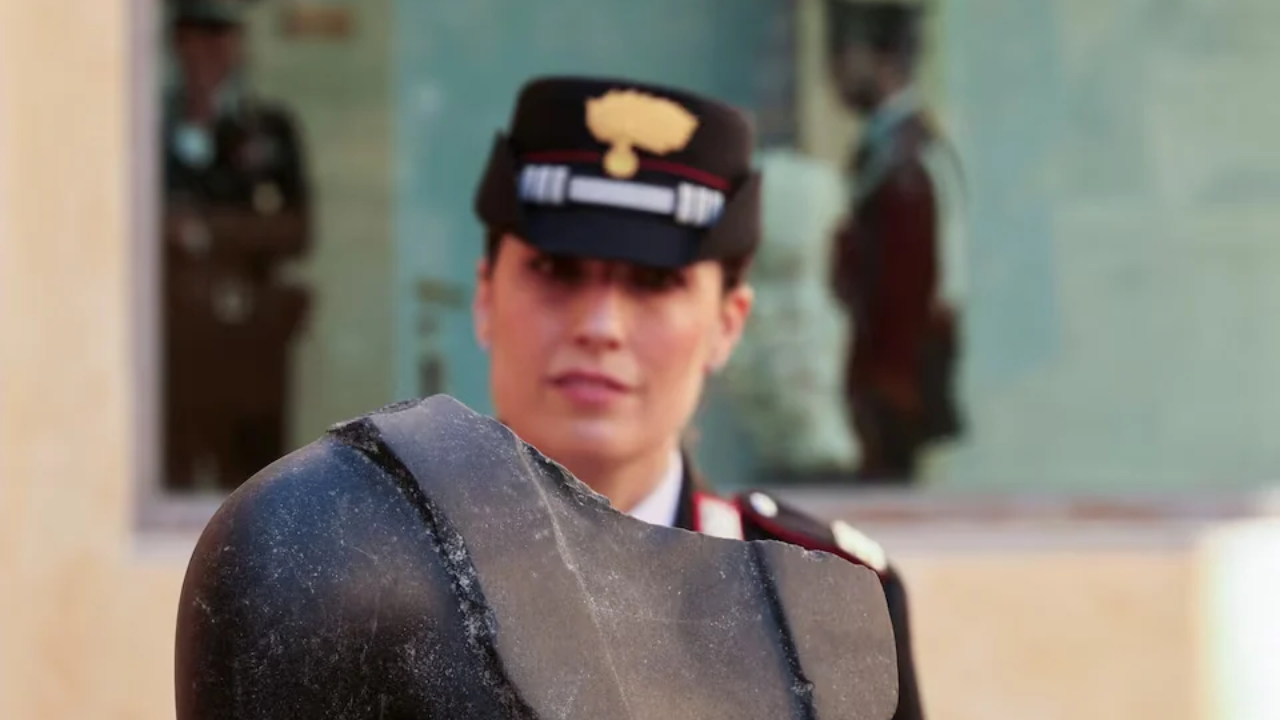
The United States has returned 337 looted antiquities to Italy, one of the largest recent returns of stolen cultural objects. The items were presented on 29 April 2026 at the headquarters of the Carabinieri, Italy's police force that protects heritage. The collection includes a marble head of Alexander the Great. It was stolen from a museum in Rome in 1960.

An hourly weather analysis in 90 seconds—without reanalysis
Weather forecasts start from a picture of the current air, called an analysis. Today that picture is made by slow, costly systems that update about every six hours. WeatherDreamer learns to update the picture every hour from raw observations, with no old reanalysis data needed. It makes one global analysis in about 1.5 minutes on one graphics processor, and its short forecasts beat NOAA's GEFS model for temperature, dew point and wind out to 12 hours.

A decade of Arctic ocean paths, calculated in hours
Scientists built KELP, a free tool that follows virtual particles drifting through ocean-model currents. It was designed to be run by AI coding agents, which set up most of the work in hours. In a 63-year test in the Arctic's Beaufort Gyre, 7.92 million particles were tracked, taking years to decades to reach Fram Strait. The full run took 3 hours 36 minutes on one computer node.

More papers, fewer paths: the hidden risk in AI-accelerated science
A new academic paper argues that science is publishing more than ever, but not exploring more directions. The authors say funding, careers, publishing and attention can filter research in similar ways, so many ideas get dropped. They warn that artificial intelligence could amplify this problem. The paper urges scientists to keep diverse routes for testing and correcting ideas.

When epidemic models meet real life, the simpler one can lose
Researchers compared two ways of predicting how diseases spread. One used physics-informed neural networks, a type of AI that uses known science rules. The other was a simpler, traditional model. The AI model did better on London's real first COVID-19 wave, but worse on made-up test data.
A safe zone that can anticipate the attacker’s next move
Researchers studied how to protect control systems, such as power grids, from hidden false data attacks. The defender picks a safe zone first, and the attacker then picks its attack shape. The new method solves this two-step game using a set of linear programs. A load frequency control example shows how it works.
Photons forecast turbulent flows—even after half are lost
Researchers used a machine that runs on particles of light, called photons, to predict how fluids move. The fluid models tested were convection in a heated layer and global air circulation. The light-based system stayed accurate even when up to 50 per cent of photons were lost. It also predicted further ahead than a standard classical computer model with the same query budget.

A possible new approach for treating autism and conditions caused by a single faulty gene copy
Researchers at UCLA Health grew human brain cells in the lab. They found that turning up the activity of a healthy gene copy can offset the effects of a mutation linked to autism. The work was published in Nature Neuroscience. It is still at an early stage, but it points to a new way to treat autism and related brain conditions.

HIV prevention education brought into Baltimore beauty shops through community-designed program
A new HIV prevention program is bringing education into beauty shops in Baltimore, Maryland. The program was designed with the community, so it fits the people it serves. Stylists and shop visitors can talk about prevention in a place they already trust. The goal is to reach people who may not visit a doctor's office.