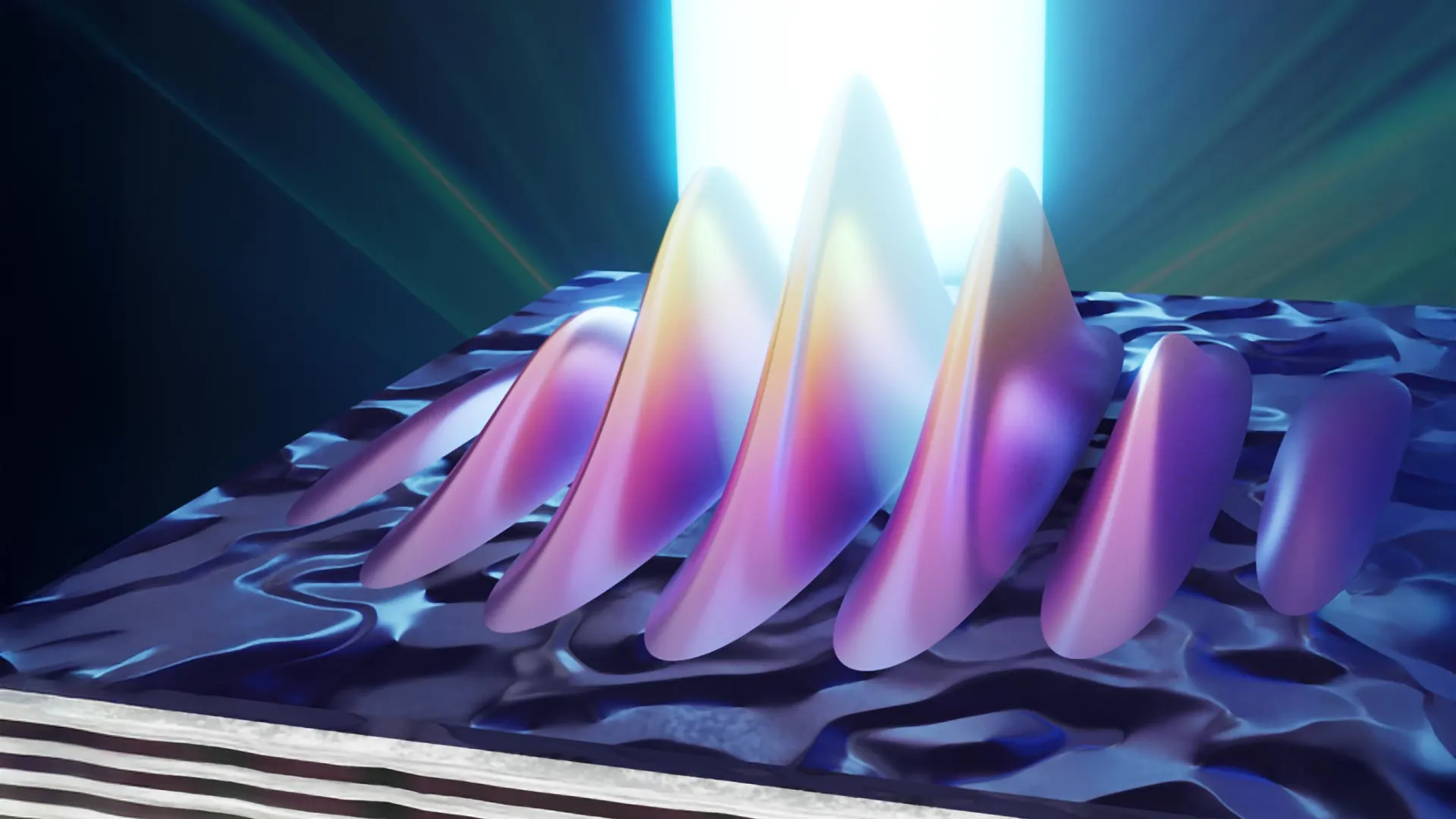
At the University of Warsaw, a tiny optical chamber helped light and matter form a state that behaves like a crystal and a frictionless liquid at once. The experiment offers a new way to study a rare quantum effect without cooling atoms to temperatures near absolute zero.
The state is called a supersolid. A crystal has a regular pattern in the way its particles are arranged. A superfluid, by contrast, can flow without the usual internal resistance, or viscosity. A supersolid combines both traits: it has an orderly structure and the unusual flow of a superfluid. Physicists proposed the idea in the 1960s, but it took until 2017 for experiments with ultracold atoms to confirm supersolidity. Those studies required complex equipment and extreme cooling.
An international team took a different route. Researchers from the University of Warsaw's Faculty of Physics, Poland's Military University of Technology, IBM Research Zurich and the French National Centre for Scientific Research, known as CNRS, worked with exciton polaritons. These are hybrid particles formed when light interacts strongly with matter. They behave partly like light and partly like matter.
The team built an optical microcavity, a very small chamber for light, containing a specially designed liquid crystal and covered it with an organic semiconductor. This setup made light and matter interact strongly enough for the hybrid particles to form a coordinated quantum state. The particles usually last only a few picoseconds—trillionths of a second—but can still act collectively as a condensate, a group sharing one quantum state.
The researchers looked at light emitted by the sample for signs of the change. As the system entered the supersolid phase, the light showed regularly spaced bright fringes. The pattern pointed to repeating changes in the density of the particle condensate, much like the repeating arrangement inside a crystal.
The liquid-crystal microcavities can work at temperatures approaching 60 degrees Celsius, or about 140 degrees Fahrenheit. Professor Wiktor Piecek of the Military University of Technology, whose group developed the liquid-crystal structures, said the chambers could operate at that temperature. That is a striking contrast with experiments that depend on atoms cooled close to absolute zero.
The work, published in Science Advances, was carried out through the international TopoLight consortium. Its approach could make some kinds of quantum behavior easier to investigate, because it does not depend on the demanding cold-atom setup used in earlier demonstrations. The researchers' result may also inform future technologies, including optical computing, which uses light to process information, and highly sensitive sensors.
A light-based supersolid is not itself a ready-made computer or sensor. But showing that a crystal-like pattern and superfluid behavior can emerge in a system operating near room temperature gives scientists another tool for exploring quantum physics. The next step is to learn more about how these patterns form and what practical devices, if any, can be built from them.