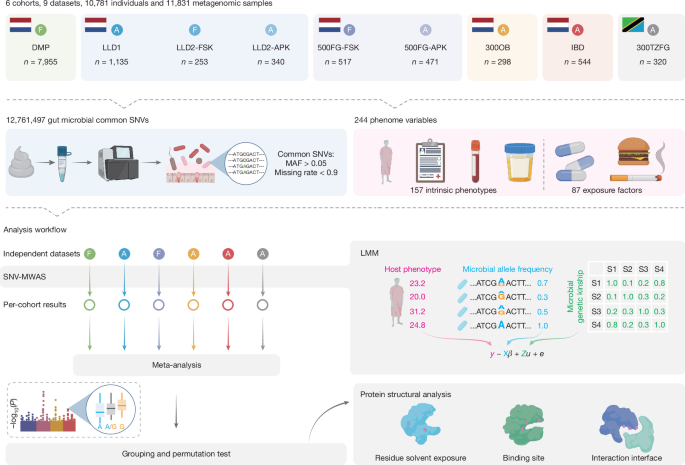
A study of 11,831 stool samples has traced 940 links between tiny genetic differences in gut microbes and people’s health traits or exposures. The samples came from 10,781 people in the Netherlands and Tanzania, giving researchers a broad view of how microbial genes vary alongside human lives.
The gut microbiome is the community of microbes living in the digestive system. Scientists have often studied which species are present, but members of the same species can also carry different genetic variants. Those differences may affect how microbes use food, interact with the body or behave in the gut. Finding such links could help researchers understand why microbiomes differ from person to person, though an association alone does not show that a microbial variant causes a health condition.
The team brought together six research cohorts: five in the Netherlands and one in Tanzania. The Dutch groups included the Dutch Microbiome Project, Lifelines-DEEP, the 500-Functional Genomics Project, the 1000 Inflammatory Bowel Disease Project and 300-Obesity. The Tanzanian group was the 300-Tanzania Functional Genomics Project. The researchers analyzed genetic data from stool samples and assembled information on 244 health traits and exposures, such as measurements or factors linked to participants’ lives. The number of people available for each trait varied from 593 to 11,706.
They identified 12.8 million single-nucleotide variants, or SNVs: places where the DNA code differs by one building block. To test these variants, the researchers developed an analysis method that accounted for how closely related different strains of the same microbial species are. That step matters because related strains can share many DNA differences, which might otherwise make a variant appear linked to a human trait when the broader family relationship is the real explanation.
The analysis found 940 independent association signals, supported across multiple cohorts. Together, these signals connected 39,663 SNVs in 101 microbial species with 69 human traits or exposures. The study examined 244 factors in all, but not every factor had enough data across cohorts to contribute to a supported finding. The team also used protein-structure analysis to explore what some of the genetic links might mean biologically.
Earlier research had tied specific microbial variants to particular functions or conditions, including examples involving intestinal barrier function and type 2 diabetes. This study takes a wider approach, testing many microbial DNA differences against a large set of human measurements and exposures. Its results do not establish that the microbial variants cause those traits, but they offer researchers a map of associations to investigate further.
The findings and full results have been gathered in an online catalogue. By making the links available for follow-up, the researchers offer other teams a starting point for checking which microbial variants matter, how they work and whether the patterns hold in more populations. The work also shows how combining large cohorts with careful genetic analysis can turn the gut microbiome into a more detailed subject of human health research.