In a dish of developing human brain cells, turning down one autism-linked gene often changed the activity of hundreds of others. That pattern offers a possible explanation for how very different genetic changes can lead to some of the same effects—and points to a gene that may help illuminate why autism is diagnosed more often in males than females.
Autism spectrum disorder has been linked to hundreds of genes. Many of the risks arise when a rare mutation disrupts one copy of a gene, suggesting that the amount of gene activity matters. Autism is also more common in males, while research has found that females generally need a greater load of inherited or new genetic risk to develop the condition. Scientists call this difference the female protective effect, but its biological basis is not yet clear.
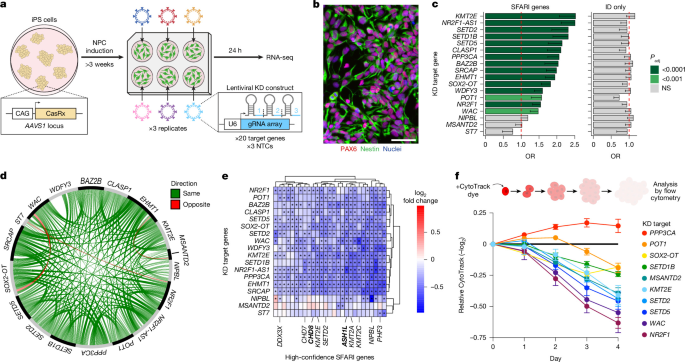
To investigate, researchers reduced the activity of 20 autism-linked genes in human neural progenitor cells, early-stage cells that can develop into brain cells. The targets included 18 genes listed by the Simons Foundation Autism Research Initiative and two long non-coding RNAs, NR2F1-AS1 and SOX2-OT. The team used CasRx, an RNA-targeting tool, and measured gene activity 24 hours later.
Nearly every gene reduction produced many changes in the cells’ gene activity. Across the experiments, the median number of significantly changed genes was 920. Eighteen of the 20 tests produced enough changes for the researchers’ deeper analysis; each of those 18 affected at least 287 genes. In 15 of the 18 cases, the changed genes were enriched for other known autism-linked genes. In other words, disrupting one risk gene often rippled through a wider network that included other genes already connected to autism.
The team used these overlapping patterns to map gene regulatory networks: systems in which some genes help control the activity of others. The analysis identified CHD8 and REST among the key drivers of autism-gene activity. It also highlighted ZFX, a transcription factor, meaning a protein that helps switch genes on or off. ZFX is more active in females and is expressed from both X chromosomes in female cells, including the X chromosome that is usually largely switched off.
That makes ZFX a possible link between gene control and the female protective effect. The result does not show that ZFX explains the sex difference in autism, or that changing ZFX would prevent the condition. Instead, it offers a specific mechanism for researchers to test: ZFX may help regulate autism-linked genes in a way that changes how much genetic risk is needed for autism to emerge.
The experiments were carried out in cells grown from one control male stem-cell line, so the findings will need follow-up in other cell models and in studies of female cells and living brains. Still, the broad overlap between the gene disruptions suggests that many different genetic routes may converge on shared changes in developing brain cells. Understanding those shared networks could help explain how autism risk works—and where future research might look for common pathways.