Near Bergen, Norway, a culture of the bloom-forming alga Gephyrocapsa huxleyi offered researchers a clue to a puzzle: how can an entire bloom collapse when fewer than 30 percent of its algal cells appear to be infected by a virus?
The question matters far beyond one culture dish. Marine algae capture about 50 gigatons of carbon each year, helping feed ocean life and shape the movement of carbon and nutrients. G. huxleyi is found across the world's oceans and can form blooms that cover thousands of square kilometers. When these blooms end, viruses are known to infect and kill algae. But the low share of infected cells measured during some collapses suggested that viruses might not be acting alone.
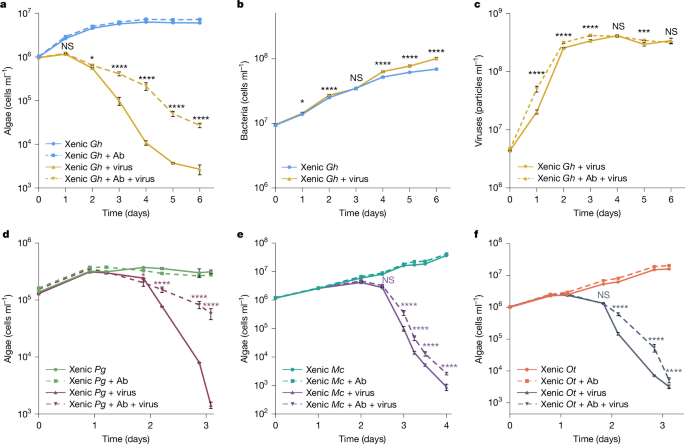
To test that idea, researchers studied a G. huxleyi strain collected from a bloom created during a mesocosm experiment near Bergen. They compared cultures with their naturally associated bacteria to cultures treated with antibiotics to reduce those bacteria. Without a virus, the antibiotic-treated algae grew up to 1.2 times as much as untreated algae. That result points to competition between the algae and their bacterial community under ordinary growth conditions.
After the researchers added the Emiliania huxleyi virus, or EhV, the algal population began to decline from the first day. But the cultures treated with antibiotics lost algae much more slowly. Their mortality was as much as 19 times lower than in cultures where the bacteria remained. The finding suggests that bacteria can work alongside the virus to speed the algae's death, rather than acting only as competitors.
The bacteria also became more abundant in infected cultures, reaching 1.5 times the abundance seen in uninfected cultures from day four onward. The researchers found differences in virus production between treated and untreated cultures during periods when viruses were being released, but the total virus levels later became similar. That points to a role for the bacteria in the pace and effects of infection, even though the study did not find a lasting difference in total virus abundance.
The results help explain how a bloom can decline even when most of its algal cells do not show active viral infection. They also add bacteria to the picture of how blooms end and how their carbon is recycled or carried deeper into the ocean. Algal death can release nutrients for other microbes, while cell remains may gather and sink; these processes affect how carbon moves through marine ecosystems.
The work was carried out in cultures, so it does not by itself show how large this effect is in a natural bloom. The researchers' findings nonetheless point to a three-way relationship among algae, viruses and bacteria that may help shape bloom fate. Understanding those interactions in the ocean could clarify why blooms collapse and what happens to the carbon they have captured.