Nearly 600,000 gene pairs in tuberculosis bacteria were included in a new effort to map how essential genes work together, opening a wider view of the machinery that keeps the pathogen alive. The maps reveal thousands of previously unknown genetic interactions and could help researchers plan future drug combinations.
Mycobacterium tuberculosis, or Mtb, is the world’s leading infectious cause of death. Although its genome has been studied extensively, scientists still do not understand the roles and connections of many of its genes. That gap makes it harder to explain how the bacterium functions and to find effective treatments. In particular, many possible antibiotic targets are essential genes: genes the bacteria need to survive, which older genetic mapping methods often could not examine.
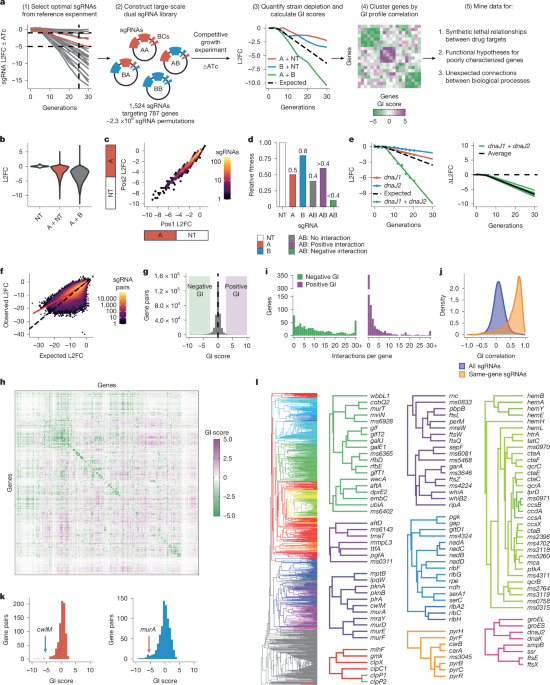
To address that problem, researchers built a CRISPR interference (CRISPRi) system that can reduce the activity of two genes at once. They adapted a method called CombiGEM, giving each guide RNA—a short instruction that directs the gene-targeting system—a barcode. By reading the barcodes, the team could track the abundance of bacterial cells carrying each gene pair and look for changes in their growth.
The researchers also developed an experimental and statistical process to identify interactions with high confidence. When reducing the activity of two genes produces a stronger effect than expected from the two changes separately, that can point to a harmful or even lethal interaction. A milder-than-expected effect can signal that the genes work in related ways or compensate for one another. These patterns help researchers form ideas about what genes do, including genes whose jobs are not yet known.
Using the platform, the team mapped interactions among nearly all essential genes in both Mtb and the related bacterium Mycobacterium smegmatis. The maps recovered biological connections already known to researchers, a check that the approach was working, while also uncovering thousands of new links. To explore which links might involve proteins physically joining together, the team used AlphaFold3, a tool for predicting protein structures, to model gene pairs represented in the maps. They examined about 600,000 pairs in total.
The study also tested selected predictions. These included interactions between drugs and evidence linking several genes of unknown function to the electron transport chain, a set of processes cells use to move energy. Such checks offer a step beyond a large catalogue: they begin to connect patterns in the maps to possible biological explanations. The researchers say the resource could support work on Mtb biology and the design of combination therapies, where two medicines are chosen to work better together or to avoid working against each other.
The maps do not by themselves produce a new treatment, and the source does not report a specific drug combination ready for use. But by bringing essential genes into large-scale interaction studies, the platform gives researchers a way to investigate targets that were previously difficult to study. Further work can test the new links and determine which ones matter most for treating tuberculosis.