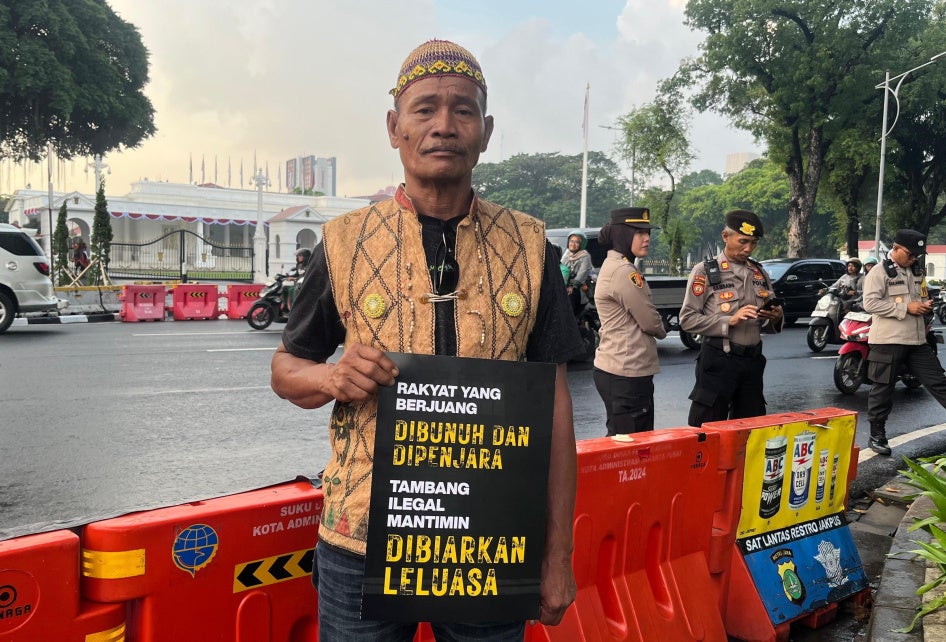
When Misran Toni walked out of an Indonesian courtroom in April 2026, he was a free man. Twenty months after police arrested him for a stabbing he said he did not commit, and after spending nine months behind bars, a judge had cleared his name. Last month, on August 5, Indonesia's Supreme Court made it official, upholding his acquittal and bringing his long ordeal to a close.
Toni, an Indigenous Dayak farmer known as Imis, had found himself at the center of a deadly conflict in East Kalimantan, the Indonesian province on the island of Borneo. For years, coal mining operations had been rolling through his village of Muara Kate — as many as 100 trucks rumbling past every single day. The villagers say the traffic was destroying their roads and threatening their safety. When a truck rolled backward and overturned in October 2024, killing a young pastor, the community had had enough. Toni and his neighbors set up a protest camp to block the coal trucks from passing through.
Then, in November 2024, tragedy struck again. Two villagers sleeping at the camp were stabbed before dawn. One died. The other was badly hurt. Police later said they found blood matching one of the victims on Toni's shirt, and prosecutors charged him with murder.
But the case fell apart under scrutiny. Witnesses, including Toni's own son, told the court that Toni was actually asleep at home when the stabbing happened. The blood on his shirt, they explained, came from helping carry the victims to an ambulance. His lawyers from the Samarinda Legal Aid Institute alleged that police had bullied witnesses and charged him without doing a thorough investigation. In April 2026, the district court agreed, acquitting Toni and setting him free.
Toni has since filed complaints with four different Indonesian oversight bodies — the National Police's internal branch, the Ministry of Human Rights, the National Commission on Human Rights, and the National Police Commission — hoping to hold those responsible accountable. He said he was grateful but still raw from what happened.
"I've spent nine months in police detention," he said. "I'm very disappointed."
The case shines a light on the dangers facing communities near Indonesia's coal mines and the people who speak up against them. Dayak communities have been fighting mining projects in Kalimantan for decades, worried about deforestation, pollution, and their way of life. What happened to Toni shows how those who resist can sometimes end up blamed for the violence around them. But it also shows that when evidence is examined closely, the truth can win out in court.