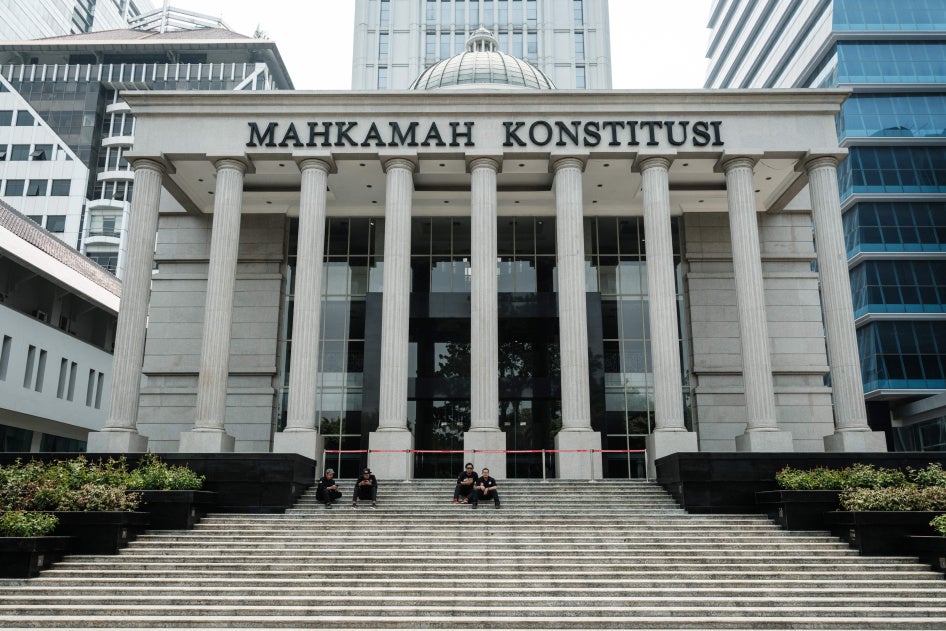
On October 15, 2026, all nine justices of Indonesia’s Constitutional Court agreed that the country’s military justice law cannot remain as it is: unless lawmakers change it by October 2028, it will be unconstitutional. The ruling sets a firm deadline for a reform that has been delayed for decades and aims to ensure that soldiers accused of ordinary crimes can be tried in civilian courts.
The case centers on a 1997 law that has kept civilian police from investigating most crimes by military personnel. Even when a soldier is accused of an offense under the same criminal code used for civilians, the case has generally stayed inside the military justice system. Human Rights Watch says that system lacks transparency, independence and impartiality, and has failed to properly investigate and prosecute alleged serious abuses.
The court ruled that the law is conditionally unconstitutional under two parts of Indonesia’s 1945 Constitution, which protect an independent judiciary and equality before the law. The justices said lawmakers must clearly separate military offenses from ordinary crimes. Justice Enny Nurbaningsih warned that when a crime has no military character but is handled through a command-based system, military institutional interests may conflict with independent and impartial proceedings.
The court also pointed to a wider problem: military judges are active-duty soldiers, and investigations, prosecutions and trials all happen within the military chain of command. The military judiciary, it said, is not fully integrated into the system overseen by the Supreme Court. It urged lawmakers to create a single judicial system.
The ruling responds to a gap left by earlier reforms. In 2004, after the end of President Soeharto’s authoritarian rule, a new Armed Forces Law said soldiers should face civilian courts for ordinary crimes. But that provision was not to take effect until a new military justice law was passed. Revisions have remained pending through successive governments. The court has now given lawmakers two years to act, though Muhammad Afif Abdul Qoyim of the Indonesian Legal Aid Foundation said there is no reason to wait that long.
The stakes are visible in cases involving alleged violence. In March 2026, soldiers attacked Andrie Yunus, a 27-year-old deputy coordinator at KontraS, with acid. He suffered burns over 24 percent of his body and may lose sight in his right eye. A military court convicted four soldiers in June, sentencing them to between 18 months and three years and dismissing them from the military. In August, an appeals court cut the two longest sentences by six months and reversed the dismissals. Indonesia’s Judicial Commission alleged ethical violations by the first trial panel.
Another petitioner was the mother of a 15-year-old boy tortured to death by a soldier in Medan, North Sumatra, in 2024. The soldier received a 10-month sentence, although the maximum penalty was 15 years. These cases help explain why families and rights groups have called for civilian investigations and trials.
The decision does not itself rewrite the law, but it gives the government and parliament a clear deadline and a constitutional requirement to meet. Human Rights Watch urged President Prabowo Subianto and lawmakers to consult victims and rights groups as they draft changes. KontraS called the ruling a step toward closing a legal loophole that has shielded soldiers from accountable law enforcement. What happens next will depend on whether lawmakers turn that ruling into rules that put ordinary crimes before independent civilian courts.