Latest News
Positive stories from around the world · Good news by country
Showing 35617–35640 of 37354 articles
World's best keeper? Raya helps Arsenal get back on track
Arsenal beat Sporting 1-0 at Estádio José Alvalade in Lisbon. David Raya was outstanding in goal, making key saves throughout the match. His teammates declared him the best goalkeeper in the world after the clean sheet. The win helped Arsenal get back to winning ways in the competition.

Expert explains how AI could redefine the scope of engineering work
National Academy of Engineering President Tsu-Jae Liu says AI is better understood as a tool that boosts engineer capabilities rather than replacing them. The technology can handle repetitive, routine tasks that currently take up much of an engineer's day. This frees engineers to focus on higher-level creative work and innovative solutions. Liu's view is that AI will make the profession more impactful, not obsolete.

What is muscle memory, and can I improve mine?
Muscle memory refers to your body's ability to learn complex tasks and perform them automatically over time. Whether it's riding a bike or knitting, repeated practice helps your brain and muscles work together more efficiently. The article explains the science behind how these automatic pathways form. This knowledge can help you understand how to practice effectively.
Arsenal 'had a point to prove' after 'difficult period' - Arteta
Arsenal beat Sporting 2-1 in the first leg of their Champions League quarter-final at the Emirates Stadium in London. Manager Mikel Arteta said the team had a point to prove after back-to-back defeats. Kai Havertz scored the winner in stoppage time. The Gunners now take a lead into the second leg in Portugal.
AI is reengineering drug discovery by speeding up testing and scanning petabytes of data
AI tools are now helping scientists discover new drugs faster than ever before. These computer programs can scan through petabytes of scientific data to find promising clues for new treatments. Researchers Jeffrey Skolnick and Benjamin Brown recently explained how AI is changing the slow, expensive process of drug development. The technology could help bring life-saving medicines to patients more quickly.

How childhood dementia begins in brain cells
Australian researchers have uncovered a crucial mechanism behind Sanfilippo syndrome, a common form of childhood dementia. The study reveals how hyperactive and dysregulated synaptic circuits develop in affected children's brain tissue. Published in Nature Communications, the discovery helps explain why brain cells misfire in these children. This breakthrough could guide future drug development for the devastating condition.

This protein helps cancer cells survive treatment—and points to new treatments
Scientists at Umeå University in Sweden have discovered how cancer cells protect themselves from cell death during treatment. The research reveals how certain proteins work together to keep cancer cells alive. This new understanding could support the long-term development of more effective cancer therapies. The findings add to our knowledge of cancer biology at the molecular level.
Woodland relying on security to cope with PTSD
Gary Woodland, the 2019 US Open champion, has opened up about living with PTSD from his military service. The professional golfer explains that he experiences sudden episodes and never knows when one might happen. At the Masters tournament in Augusta, having security close by provides him with a sense of calm and stability. Woodland credits this supportive environment with helping him continue competing at golf's highest level.

Molecular map could unlock new treatments for heart and lung diseases
Scientists at Trinity College Dublin have created a detailed "molecular map" of a receptor in the body that helps control blood clotting and inflammation. The research team used a powerful technique called cryo-electron microscopy — basically a super-powered camera that can see molecules in tiny detail — to capture high-resolution images. This new understanding could help scientists design better medications for serious conditions like pulmonary hypertension, heart disease, and some cancers.
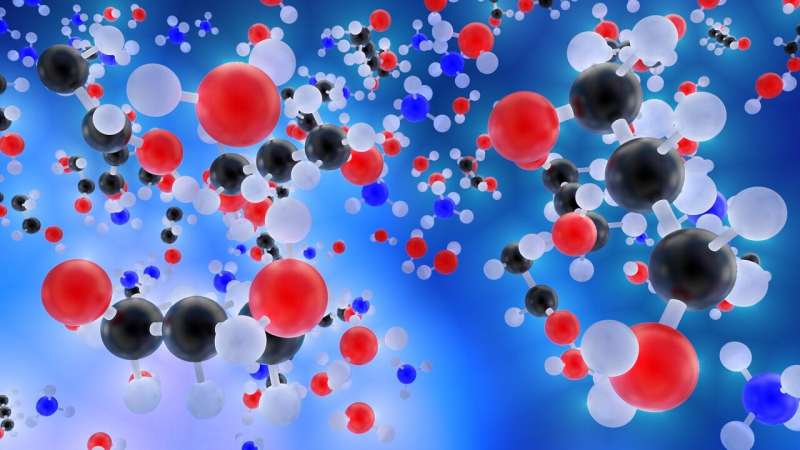
Molecular editing tool relocates alcohol groups to neighboring sites while preserving 3D structure
MIT chemists have developed a precision tool that relocates alcohol groups on molecules to neighboring sites while preserving their 3D structure. The technique, called alcohol group migration by proximity-enhanced H atom abstraction, was led by Professor Alison Wendlandt. This method could help scientists build complex molecules more efficiently, potentially accelerating drug discovery. The research was published in the prestigious journal Nature.

Molecular 'leash' measures force-sensing protein activation at about 15 piconewtons
Researchers at the National University of Singapore created a molecular "leash" to directly pull on a force-sensing protein called Piezo1. They discovered the protein switches on at roughly 15 piconewtons - an incredibly tiny amount of force. The study, published in Nature Sensors, shows proteins can be activated by physical tethers, not only by membrane deformation as previously thought. This advances our basic understanding of how cells sense and respond to mechanical forces.

Scientists reveal a new way cancer cells survive DNA damage
Scientists at Scripps Research discovered how cancer cells survive DNA damage by using an enzyme called Pol theta (Polθ). This enzyme repairs broken DNA at replication forks — one of the most common types of DNA damage in fast-growing cancer cells. The findings help explain why tumors keep growing despite constant DNA stress. The research was published in Molecular Cell and could help improve cancer drugs already being tested in clinical trials.

Key protein required for the function and survival of pheromone‑sensing neurons identified
Scientists at TIFR Hyderabad have identified a protein called Cnpy1 that pheromone-sensing neurons need to survive and work properly. These neurons help animals detect chemical signals from other members of their species. The protein acts as a specialized factor that helps maintain functional receptor complexes in the neurons. The research was published in the journal Proceedings of the National Academy of Sciences.

Researchers clarify how cells remove damaged endoplasmic reticulum
Scientists have uncovered how cells perform a vital housekeeping task: cleaning up damaged parts of their protein-making machinery. The endoplasmic reticulum (ER) is a key cell structure that makes and folds proteins. When the ER gets damaged, cells use a process called ER-phagy to surround and remove the broken pieces using small vesicles called autophagosomes. The research team clarified the signaling steps and membrane origins that trigger this self-cleaning, answering long-standing questions in cell biology.

AI-powered blood test paves the way for early diagnosis of leprosy
Scientists at the University of São Paulo in Brazil have created a new way to detect leprosy. The method combines a blood test, a simple questionnaire, and artificial intelligence to identify the disease in its early stages. They tested it using blood samples from a COVID-19 survey. Traditional lab tests often miss early leprosy because symptoms are subtle at first. This new approach could help catch cases sooner and improve treatment outcomes.
Fu moves one step closer to a Crucible return
Former world number 4 Marco Fu secured a convincing 10-1 victory in the first round of World Championship qualifying in Sheffield. The Hong Kong-born player, once ranked fourth in the world, is fighting to earn his place back at the Crucible Theatre. Fu reached the semi-finals at the prestigious venue in 2016 and has been working to rebuild his career after a difficult period.

Smart MRI molecules developed to detect and treat cancer
Researchers at NYU Abu Dhabi have created smart molecules that can detect and treat cancer simultaneously. Unlike regular MRI agents that only help doctors see tumors, these new molecules also release medicine to damage cancer cells. Made from manganese, they stay inactive in healthy tissue but activate in tumors, which are slightly more acidic. The molecules even crossed the blood-brain barrier to target glioblastoma, one of the hardest brain cancers to reach.

Fly ball: Drosophila can learn while playing with tiny spheres
Harvard neuroscientists found that fruit flies are much smarter than previously thought. Using a rotating pinwheel of blue and black stripes, they guided flies toward small plastic balls. The flies eventually learned to grab, manipulate, and even "throw" the balls with surprising dexterity. Researchers observed nearly 30,000 ball interactions by 48 male flies, revealing five distinct behavior patterns like "ball walking."

ILO report calls for stronger protections and reforms in Pacific labour migration schemes
The International Labour Organization published a report examining Pacific labour migration programs, particularly the PALM and RSE schemes. The report acknowledges these programs bring benefits but finds significant gaps in how they protect workers. Key recommendations include reducing the high costs workers pay to migrate and letting employees switch employers more easily. The analysis comes from the ILO's Suva office and focuses on improving conditions for Pacific workers.

Would you spread pain to be fair? fMRI study tests moral choices in ice water
Scientists studied how people make moral decisions using a simple test. Fifty-two university students in South Korea chose between hurting one person or spreading the same pain among more people. Even though spreading pain meant more total harm, most chose fairness. On average, participants added 68 extra seconds of discomfort to the group to avoid one person being unfairly targeted. Brain scans showed that thinking about others' feelings was key to this decision. The study was published in PNAS Nexus.
Is 'free' McIlroy ready to create more Masters history?
This BBC Sports article discusses Rory McIlroy's return to the Masters Tournament, where he will attempt to win a rare back-to-back title. Twelve months after his previous victory, the piece previews his golfing prospects. However, this sports entertainment coverage does not align with Meridia's focus on positive environmental, social, and progressive change.

When trees get 'sunburn': Study shows how young trees can handle the heat
Swiss researchers found young trees can handle heat better than expected. A study by WSL and EPFL shows warming itself is not the biggest issue for trees. This offers hope for forest adaptation as temperatures may rise 5°C. Forest managers can use this knowledge to prepare forests for hotter, drier climates.
Premier League secures fifth Champions League spot
England's Premier League will have five teams in the Champions League next season. This comes after the league secured a European Performance Spot for the second consecutive year. The spot rewards leagues whose clubs perform well in European competitions. England becomes the only league to hold this spot for two straight years.

Experiment indicates new type of mesic nuclei that could reveal how matter acquires mass
Researchers have found a new type of mesic nucleus that could help explain where mass comes from. A mesic nucleus forms when a meson—a particle made of a quark and its antimatter partner—attaches to an atomic nucleus. Scientists say this combination lets them probe the structure of the physical vacuum, the invisible background of space that gives everything its mass. The experiment offers a rare glimpse into the mechanism that makes matter "weigh" something at all.